Todays Reading Acts 27
Water. This integral element has been an essential part of creation from the beginning of existence.
Genesis 1:2
The earth was without form and void, and darkness was over the face of the deep. And the Spirit of God was hovering over the face of the waters. Through water we are borne, purified, and sanctified. Water can be manifested in many ways: seas, lakes, rivers, dew, rain, and storms. In these many different forms water can embody both: order and chaos. Order manifested as rivers, lakes, and seas: water is used for food, transportation, and cleansing. Chaos manifested as rain, tempest and storms it can bring refreshment, cleaning, and clarity.
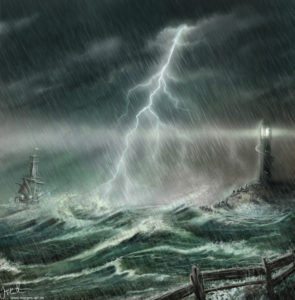
Throughout the bible, God uses storms to get our attention and bring a new revelation to our current situation. God has many types of storms to get us to refocus and look to Him. The first storm that is mentioned is the storm with Noah. God uses this storm as a communication tool. He used the storm and the flood to communicate His sadness of the people who wanted to turn away from Him and submit to their own desires and God offers this salvation to the world through cleansing. Another time that God uses the storm as a communication tool is with Jonah. During the time that Jonah is trying to escape his duties and obligations, God send a tempest to the sea where Jonah is traveling. This allows God to communicate to Jonah, but it also is used as miracle moment where the sailors start to praise God for the awesome powers that they witnessed.
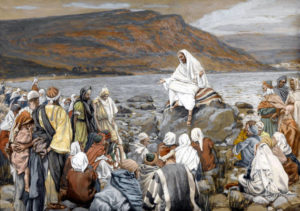
In the new testament, God through Jesus, shows the true power of Christ amid several storms. These storms are demonstration devices. In Matthew 8 and 14:
Matthew: 23- 27
23 And when he got into the boat, his disciples followed him. 24 And behold, there arose a great storm on the sea, so that the boat was being swamped by the waves; but he was asleep. 25 And they went and woke him, saying, “Save us, Lord; we are perishing.” 26 And he said to them, “Why are you afraid, O you of little faith?” Then he rose and rebuked the winds and the sea, and there was a great calm. 27 And the men marveled, saying, “What sort of man is this, that even winds and sea obey him?”
Matthew 14:23- 27
When evening came, he was there alone, 24 but the boat by this time was a long way[b] from the land,[c]beaten by the waves, for the wind was against them. 25 And in the fourth watch of the night[d] he came to them, walking on the sea. 26 But when the disciples saw him walking on the sea, they were terrified, and said, “It is a ghost!” and they cried out in fear. 27 But immediately Jesus spoke to them, saying, “Take heart; it is I. Do not be afraid.”
These instances were demonstrations of the complete and ultimate power that Christ possess in the bible and in our lives.
In Acts 27, as Paul is coming to the closure of his mission, he is sent to Rome to be persecuted by Caesar. In the previous chapters, Paul makes his case to Agrippa and then is sent to Rome by ship. This trip takes several months to complete. During this time, Paul can communicate and share the gospel with many of the crew members and the guards from Rome. They all know this man as a decent man, but he is still considered a prisoner and not truly worthy of any grace. But God uses this opportunity to produce some amazing miracle moments.
- Be strong in your convictions and knowledge of whose you are:
-
- Acts 27: 21- 25: “Men, you should have listened to me and not have set sail from Crete and incurred this injury and loss.22 Yet now I urge you to take heart, for there will be no loss of life among you, but only of the ship. 23 For this very night there stood before me an angel of the God to whom I belong and whom I worship, 24 and he said, ‘Do not be afraid, Paul; you must stand before Caesar. And behold, God has granted you all those who sail with you.’ 25 So take heart, men, for I have faith in God that it will be exactly as I have been told
- We to listen to direction from God and his messengers to be delivered and saved
- Acts 27: 30- 32: And as the sailors were seeking to escape from the ship, and had lowered the ship’s boat into the sea under pretense of laying out anchors from the bow,31 Paul said to the centurion and the soldiers, “Unless these men stay in the ship, you cannot be saved.” 32 Then the soldiers cut away the ropes of the ship’s boat and let it go.
- When the time for deliverance is ready, we must be ready
- Acts 27: 33-34: “Today is the fourteenth day that you have continued in suspense and without food, having taken nothing.34 Therefore I urge you to take some food. For it will give you strength,[f] for not a hair is to perish from the head of any of you.”
In all the storms that we have seen in the bible and in our lives, we should inquire: What is the revelation that God is presenting to me: Is it a communication tool, a demonstration device, or a miracle moment? When we allow God to reveal this to us, then we must then be strong in our relationship with God and know that this is something that will create a deeper relationship and expand our work through Him.




You must be logged in to post a comment.