Fortress

Fortress

Today’s Reading: Psalms 18:2, 91:2

Ps. 18: 2

The Lord is my rock and my fortress and my deliverer,
my God, my rock, in whom I take refuge,
my shield, and the horn of my salvation, my stronghold.

Ps. 91:2

            I will say[a] to the Lord, “My refuge and my fortress,
my God, in whom I trust.”

During the last days of his life, David wrote the first Psalm in the reading.  The words of this psalm are also written in 2 Samuel Chapter 22.  This psalm or hymn is one of praise and adoration to God for the salvation and the preservation that he had given David over his entire life. The life of David was not a glamorous or splendid.  David lived a life full of joys and sorrows, victories and defeats,  life giving and life taking.

In the beginning of his life David had the most dangerous and detested job during his time, that of a shepherd.  He lived with the flock on a daily basis, away from the family in isolation in the wilderness.  In his later years, he was given another role, royal musician.   In this role King Saul subjected David to cruelty and abuse. Later in life he became the hero of Jerusalem and the king’s son-in-law.  He was then chased from the castle and pursued by the king with teams of armies. After the death of the king, David ascended the throne and had some peace until his own children banished him from Jerusalem.  After sometime had passed, David returns to Jerusalem and finishes his days as king of the land.  For over seventy years, David continued to see God as the rock and fortress of his life. It is only this belief and faith that allowed David to be in his rightful place in our history and journey.

In our lives we will face many obstacles and distractions.  This is programed in our nature as humans.  We will constantly look for the better deal or the better item. We naturally cannot find contentment in what we have.  David teaches us that when we have a solid foundation in God, He will be our fortress and shelter us through whatever we may encounter and this will give us peace that will lead to contentment.

When we look at the word fortress, we see protection, strength, and peace.

Protection:  A fortress provides a barrier for us from the outside forces.  These forces can be physical, mental, emotional, and spiritual.  The barrier is only as strong as we make it.  If we do not reinforce and maintain the walls, then the enemy will find ways to penetrate and invade our defensives.  We have to daily enforce our fortress in God by reflecting, worshiping, or communicating with Him.

Strength:  The fortress provides a strength and stability in the midst of a hard world.  One of the most fortified city’s that is mentioned in the bible is Jericho.  This city was situated in a particular area that allows it to maintain strength and stability from any adversary that came to its walls.  This was a major attribute for Jericho and should be one that we take example from. The wall was one that took the combined and intentional effort from the children of Israel to demolish.  This was a strong fortress that was not going down easily.  We have to emulate this strength in our faith and relationship with God.

Peace:  Shalom, is the completeness that God gives us, which translates to peace.  Any fortress has to be completely sound and intact to give stability.  If the fortress has any bricks or stones that are not in place or missing the complete stability of the entire structure is compromised.  Any additional structural defects will result in complete destruction.  In our lives there are many holes that have weakened our fortress: heartbreaks, divorce, deaths, setbacks, layoffs, betrayals, etc. These things that we hold on to will continue to weaken our spiritual infrastructure.  This will not allow our fortress to sustain the battles of life. But if we allow God to give us his peace, he will replace all of the stones that life have taken away.  This will give us strength to continue to endure and move toward his glory.

Dear Heavenly Father,

Thank you for being our refugee and fortress.  Thank you for the protection, strength, and peace that you give without limit.  Amen

First Born of Many Brothers

For whom He foreknew, He also predestined to be conformed to the image of His Son, that He might be the firstborn among many brethren.

Romans 8:29

God’s number one purpose for each of us is to bring us into a loving relationship with Jesus Christ.  To accept the free gift of salvation through Jesus.  It is God’s intent for Christ to be the first born among many brethren.

In Jewish culture the term first-born always referred to a son.  The first-born male child in a Jewish family had a privileged status.  Being first-born represented preeminence (superiority or distinguished).

The term brethren is a synonym for believers.  God’s primary purpose in His plan of redemption was to make His beloved Son “the first born among many brethren” in the sense of Christ’s being uniquely preeminent (superior) among the children of God.  Those who trust in Jesus become adopted children, and Jesus, the true Son of God, graciously deems us worthy to be called His brothers and sisters.

For whoever does the will of my Father in heaven is my brother and sister and mother.

Matthew 12:50

What an honor it is to be able to say that we are brothers and sisters of Christ!  It will certainly be an honor on that day we enter Heaven and are welcomed into the grand family with Jesus.  

We are blessed because the “first born among many brothers” is not ashamed to call us His brother or sister.

The First

“In the beginning, God created the heavens and the earth.” The very beginning of the Bible points us to one of the fundamentals truths of God’s nature, and one of the toughest for us to get our heads around: God was the First; He has always been here, and He will always be. In Revelation 22:13, Christ says “I am the Alpha and the Omega, the First and the Last, the Beginning and the End.” Isaiah 44:6 says “This is what the Lord says – Israel’s King and Redeemer, the Lord Almighty: I am the first and I am the last; apart from me there is no God.” Before anything, before time or space or matter, there was God.

Mankind has been trying on its own to wrap its collective head around what ‘forever’ could mean, how everything could have come into being, and where this origin point could have itself originated from. But we Christians know the answer through His word – God has always been, beyond our comprehension of these topics can reach. Isaiah 55:9 summarizes the Lord’s position very well on this: “As the heavens are higher than the earth, so are my ways higher than your ways and my thoughts than your thoughts.” Beyond the how, though – in this topic, so conceptually beyond our grasp we have trouble keeping up, it can be easy to gloss over how amazing this truly is and what exactly to take away from it.

I think about all of the emotions of beginning a new, monumental task; for example, buying a house or piloting a new project at work. All of the nervousness, excitement, hesitation, and trepidation that goes into those decisions that can have a huge effect for a long time to come. It can be difficult and incredibly stressful to start something new – now imagine starting literally everything. But these human feelings can’t begin to compare to how God handled such a momentous beginning. No, He had perfectly planned out every single event in time to culminate with the birth, life, and death of Christ here on earth without trouble.

God’s impeccable work as the progenitor of existence itself points to a simple takeaway: not only was God the first to be, but He ensured He would forever be the First. God is wiser, God is mightier, God is beyond us in all ways. And what’s more, he calls us to place Him first as well. As Deuteronomy 6:5 says, “You shall love the Lord your God with all your heart and with all your soul and with all your might.” Think about that today – are you placing the Lord, the first and the last, first in your heart and first in your soul? Pray for humility today, that we could see just how far above us God truly is, and for direction to show our appreciation and praise for how monumental and everlasting God is.

Consuming Fire

Today’s reading is Deuteronomy 4:24.

“For the Lord your God is a consuming fire, a jealous God.”

If you were to do a time log over the next month of what you do each moment of the day, what would it reveal? What would your bank or credit card statement reveal? How about your thoughts? What would this auditing say about you? It’s a little scary to think about, isn’t it? Even scarier to think about, what if all of this was made public? The good news is..it won’t be made public. However, one person knows the answers to what takes up our time, money, and thoughts…that person is God.

Chapter 4 of Deuteronomy is Moses reminding the Israelites that they should have no other gods. We can read some of the Old Testament and hear about the Israelites and other nations making man-made gods and think that is just silly. However, when we peel back the onion, we have our own other gods, too. Many of them are things God has blessed us with which are great until they overtake our time, thoughts, and lives, and as a result, God gets put on the back burner. Examples can be our career, hobbies, phone, money, and sadly even some things as great as our spouse or children can become gods we worship them more than Him.

We live in a society today which tells us to do whatever we feel like and whatever makes us happy. Some find it hard to believe a loving God is also a jealous, powerful God like a consuming fire and that He would allow us to go to Hell if we don’t believe His son Jesus died and rose again for the forgiveness of our sins. The Bible tells us this is the truth though. And when you think about it, He created us an has given us everything we have, including His greatest gift in His son Jesus, so He has every right to expect us to worship Him and be upset when we don’t.

Although He is a jealous and powerful God expecting our praise, worship, and attention like a consuming fire, Moses also describes Him further in Deuteronomy 4:31…

“For the Lord your God is a merciful God. He will not leave you or destroy you or forget the covenant with your fathers He swore to them.”

Thankfully, He further showed us this in the form of His Son Jesus. He established a new covenant making us all part of His family, not just Jews. Yes, He is a consuming fire who wants our time, hearts, and minds, but thankfully He does not punish us for our missteps and mistakes.

“There is therefore now no condemnation for those who are in Jesus.”

Romans 8:1

What greater way can we worship Him and say thanks than by giving Him the first fruits of our time, treasures, and talents!

Fear of Isaac


Gen 31:42

I’m going to be honest. As I read through this passage, I’m stumped. Nothing jumps right out as the obvious teaching I am supposed to grasp from the name of God in this verse. So I look farther back to get more context, I read the entire chapter. I now understand the story better but I am still not clear on the meaning of the “fear of Isaac”. I can’t find where this term is used again in the Bible accept for later in this chapter in vs 53 where it is used the same way as in vs 42.  I don’t find vs 53 to be  any more clarifying than vs 42. I think on the phrase literally for a few days and the life of Isaac, earlier in Genesis. I can string together some ideas about what Isaac experienced with God in his lifetime, but I am still unclear if I am on the right track or not. I decided to look into some writings of people much more studied than me to see what they discovered and interpreted about this name of God.

Jacob uses the phrase “fear of Isaac” as he is talking to his Uncle Laban. If you remember, Jacob went to Laban to seek a wife, and Laban cheated him at just about every turn. Laban had him work for seven years to earn Rachel and then tricked him at the wedding and actually gave Jacob Rachel’s sister Leah instead. Jacob worked for another seven years to earn Rachel, finally get her in marriage. Then Laban kept changing the rules on the “wages” of livestock that Jacob was managing for him. Laban changed the rules when he saw that Jacob was growing wealthy instead of himself. Every time Laban changed the rules, God changed the outcome to benefit Jacob. After Jacob’s time with Laban had been served and Laban’s wealth had grown under Jacob’s care, God told Jacob it was time to leave Laban and his land and go back to his home country with his wives, children and livestock. Jacob knew that Laban wouldn’t want him to leave because Jacob was making Laban wealthier every day, so he packed up his family secretly and headed for home when Laban was out of town. When Laban returned home and discovered Jacob had left, he gathered up a posse and pursued Jacob. The night before Laban reached Jacob, God came to Laban in a dream and told him, “I’m warning you, leave Jacob alone!” Laban tells Jacob that he shouldn’t have left without warning and that Jacob missed out on all of his goodbye parties and send offs, Jacob knows Laban is lying and they get into a fight. The argument culminates in vs 41 with Jacob saying, “For twenty years I slaved in your house! I worked for 14 years earning your two daughters and then six more years for your flock, and you changed my wages ten times! In fact, if the God of my father had not been on my side-the God of Abraham and the fearsome God of Isaac-you would have sent me away empty handed. But God has seen your abuse and my hard work. That is why He appeared to you last night and rebuked you.”

Laban had taken advantage of Jacob, but God overruled. Jacob using the phrase “fear of Isaac” was a reminder to Laban that Jacob was being divinely protected. Fear is also a feature of respect. Those who fear God have more regard for Him than for anyone else. To fear Him is to hold Him in such high regard that all other relationships pale in comparison. This fear is actually an expression of devotion to Him, the awe and reverence kind of fear. “The fear of Isaac is our Fear as well. Because Jesus died for our sins and was raised from the dead, He has eliminated the terror of punishment for sin so that we can love God above all. This is fear of the Lord.” Dr John Koessler

Father of the Fatherless

Psalm 68: 5:

“Father of the fatherless and protector of widows is God in his holy habitation”.


When you think of a father, what is the first thing that comes to mind? Many of us would look at our Earthly fathers to try and describe what we think a father is. We take our own personal connections to try and define what a father may be.

A father is supposed to guide, encourage, challenge, and love their children deeply. They lead their family with integrity and attempt to serve their family every step of the way. However, fathers don’t exist in every single family. Not only that, but there are so many parents in general that aren’t able to care for their children and have to give them up.

When I meditate on the beginning of this verse, I can only think of how different my life would’ve been without my Dad. He worked a lot of hours when I was younger to try and provide for the family. I am fortunate to have a Dad that served our family and who truly does love us. However, there are children that grow up without parents.

As seen in this verse, the Psalmist is expanding on the description of God being a Father to the fatherless and a protector to widows. This verse is only beginning to give us a glimpse of God being an eternal Father to all of us.

Orphans and widows both seem like terms that are used for those that are left behind and forgotten. God promises that He will never leave them and will be a Father and protector. John 14: 18 states, “I will not leave you as orphans; I will come to you”. Countless times in the Old Testament and New, the Word guides all to protect, provide, and comfort the widows.

The lost, fatherless, widows, and hopeless are only saved because of the love of their Father. God will never leave the fatherless and widows without protection. That is exactly why He sent His Son Jesus to die on the cross, for our brokenness. He redeemed us when all of us weren’t worthy. God the FATHER, has made it so that we will eternally be with Him.  No other Father or protector has ever been able to truly be there for all of us like God has and always will.

Overthinking and Doubt

God created us as sovereign beings.  We have a choice.  We can believe that Jesus Christ is our Lord and Savior and that he died on the cross to forgive our sins.  Or, we can doubt, question, and not believe.  It is our choice.

I have been challenged to understand how we have the opportunity to make our own choices and wonder how God’s “intervention” leads to His will being fulfilled.  When can we know God’s intentions for our lives and how do we make sure we follow His guidance?

Our world can be a sad and depressing place.  If there is a God, then why are bad things allowed to happen (natural disasters, diseases, pain and tragedies, death, etc.)?

At the beginning of chapter 11 verse 16, Jesus said “What shall I liken this generation?  It is like children sitting in the marketplaces and calling to their companions, and saying, ‘We played the flute for you, And you did not dance; We mourned to you, And you did not lament.’”

Jesus affirms in Matthew the rejection of Him during His time on earth.  He rebuked several cities and their people for their lack of trust and belief that He was the Messiah. He showed His presence in the form of healing the sick and deaf, raising people from the dead, and preaching the gospel to the poor. Even after all of these acts and documented eye witness accounts of His miracles and works, people of His time still doubted that he was the Messiah.

If we do not see something with our own eyes, do we believe what we are told?  Do we question and wonder why? Are we influenced positively or negatively by the people and voices around us and what we believe?

This verse speaks to me and says, stop overthinking and allowing doubt and uncertainty in our minds and trust in Christ. The world we live in is filled with unhappiness, focused on material possessions, is full of failed marriages and relationships, and is filled with sin and death.  Yes, it is easy to question God’s presence in our sinful world.  The doubting person in us can question the presence of Christ and pull us away from His word.  We are not able to comprehend and understand God’s will, all the time, based on our understanding of what we see on Earth. God’s purpose is so much greater than we are capable of understanding. Our minds are not built to comprehend how what we see and know can be of benefit to us, and trust that in all times.

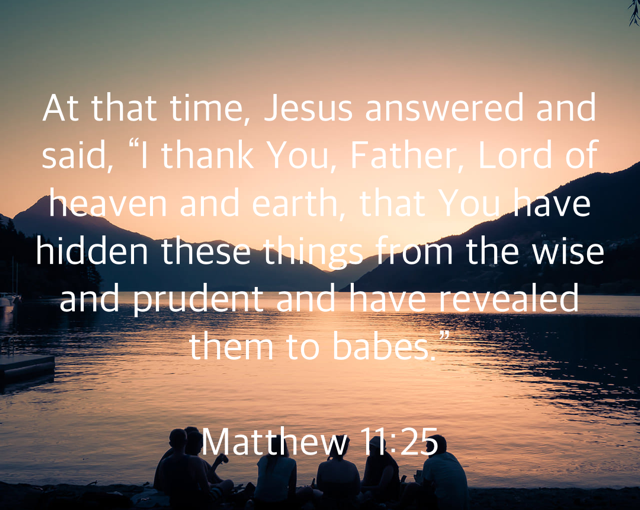
Matthew 11:25 speaks to me in this way. Stop doubting and overthinking God’s existence and presence with our Earthly minds. God is present always, in charge always, and fulfilling His purpose for our lives to bring about His perfect goals. Even when we don’t like what is happening to us or around us, we must trust in Him. 

Scripture tells us over and over that God is in control and He “works in all things according to the counsel of His will.” (Ephesians 1:11) We also learn that His “dominion is over all things (Proverbs 21:1, Daniel 4:25), and the times and places where we live (Acts 17:26).

Our minds push us to focus on self-preservation and survival.  We think thoughts that prevent us from pain or hurt.  We prevent ourselves from believing so we won’t be disappointed.  We overthink it. We self-sabotage relationships or situations so when it doesn’t work out, we won’t experience sadness. Our thoughts create our feelings, and our feelings create the results in our lifeMy prayer is that we guard our thoughts.  Guard our thoughts against overthinking what God’s will is for us, study scripture and patiently evaluate what He intends for our lives.

Jesus, Please help us to focus on your goodness, your presence in our lives, and be thankful for the blessings you have provided us.  I thank you for loving us, even when we don’t deserve it.  Thank you for your goodness and your forgiveness of our sins.  Amen.

Suffering

Today we explore suffering. Jesus was called the Man of Sorrow and also known as one Familiar with Suffering. It was even foretold in Isaiah 53 that he would be despised, rejected, not esteemed. He would suffer. GREATLY. God perfectly designed Jesus to be fully human and experience all the highs and lows of the physical life. Some of those lows are recounted in John 11:35 when Jesus wept over his friend Lazarus’ death, and in Luke 19:41 when he wept over the city of Jerusalem. A vivid moment of sorrow is in the Garden of Gethsemane when Jesus is disappointed that the disciples couldn’t stay awake, all the while he is praying and asking his Father to “take the cup from me” if it be His will. He knew the suffering that was going to begin, and he reveals his human emotions, completely aware of what the cross would entail.

Jesus, being fully God, also knew that Lazarus would come back to life, yet he still wept. He also knew the victory he would have over death, defeating the grave, yet he was still sorrowful and troubled. I love how God revealed his heart to us, showing us the full range of emotion. We are created in his image and the sorrow we experience is real.

Jesus’ death on the cross was the ultimate physical suffering, and then he experienced the greatest spiritual suffering when he took on the sins of the entire world and was separated from his Father. He did this for us – so we could be with him forever. Our sin separated him from the Father, and Jesus experienced the loss (Mark 15:34).

Nothing in my life comes close to that level of suffering. It’s hard to even call my experiences “suffering” when thinking of the true suffering that Jesus endured.

When I reflect on the more difficult seasons in my life, even now in hindsight, I have to admit that I wouldn’t choose them. While I have complete faith that God’s perfect will prevails and He will use any suffering I have experienced, I can’t say I’m to the point where I count it all joy, or even pray for tribulations and suffering. I’m so inspired by those that do, and face it so bravely. As God continues to sanctify me, I have confidence that one day I will genuinely rejoice in the scary medical diagnoses, challenging family dynamics, major marital strains, and unexpected deaths.

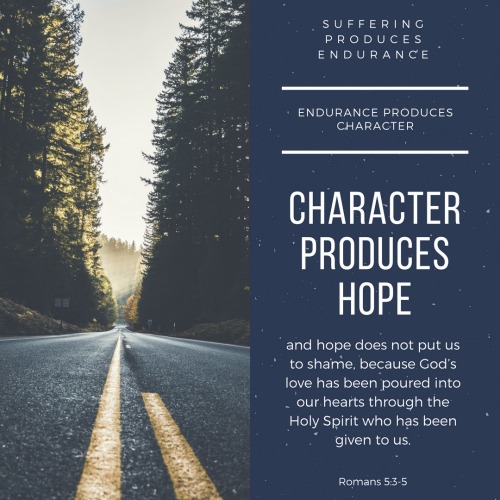
We rejoice in our sufferings, knowing that suffering produces endurance, and endurance produces character, and character produces hope. Romans 5:3-4

In searching my own heart, I find that I don’t like the lack of control and the unknown that comes with suffering (in addition to the actual suffering part). Sounds pretty obvious, right?

You may have picked up in past posts that I dabble in running. The past 25 years, there have been seasons of running for fun, running for health reasons, running socially, or running to reach goals. Each season is different and I’ve enjoyed all of them (and the dry spells). Running to reach goals includes an amount of physical suffering. Runners sometimes call this the pain cave, this place where you are intentionally positioning your body to suffer. And you don’t choose to run hard workouts so the pain lessons or it gets easier, runners choose this so they can endure the suffering longer. This chosen “suffering” is controlled and calculated. There’s an end to it, and you know there will be gains. Runners embrace this suffering in order to achieve goals. This hit me right between the eyes when trying to overlay this chosen suffering to unwanted suffering. Are there certain hard things in your life you’re able to choose, and other hard things you wish you could end?

I love how we are challenged to truly rejoice in suffering! How amazing to be so filled with the Holy Spirit that we choose hard things on this earth! And let’s be honest, any of my suffering is so much different than the true suffering of Christ. God hasn’t given me a calling that lands me in jail, I haven’t been beaten or persecuted for my faith. My experiences can hardly be called suffering or compared to Jesus’s suffering.

So what about you? Where does this topic land on you? Are you praying for trials and rejoicing in suffering? If not, what do you think is holding you back? I’d love to hear your thoughts!

Faithful and True

Think about the top news stories going on today domestically and abroad. What emotions do these stories bring to you? Confident? Uplifted? Full of hope? Joyful? Peaceful? Loved? If you do, please call me right away, I want to hear about it!

On the contrary, I imagine time spent following news stories gives us a glimpse into what Hell might feel like. Hopelessness, pain, despair, separation, destruction, and mourning. I believe we often feel these emotions because we are putting our faith and trust in the wrong things, and because the father of lies is behind a tremendous amount of manipulation.

The only person to put our faith and trust in is the only one who is faithful and true, and that is none other than Jesus Christ:

“And to the angel of the church in Laodicea write: ‘The words of the Amen, the faithful and true witness, the beginning of God’s creation. (Rev 3:14)

Then I saw heaven opened, and behold, a white horse! The one sitting on it is called Faithful and True, and in righteousness he judges and makes war. (Rev 19:11)

Jesus is the ultimate in faithful because of what he did: He remained faithful to his calling in living sinless, and then surrendered his body to be crucified. He is the ultimate in “true” because he defeated death through the resurrection. He did these things for us, this is the Good News!

What if for just one day the world skipped the headlines and got the Good News and truth from the Bible? Stories of love, redemption, joy, miracles, forgiveness and promises of hope for a wonderful future all all right at our fingertips. The choice is ours, do not be deceived: Faith in a broken world full of lies, or faith and hope in the one who is faithful and true.

What then shall we say to these things? If God is for us, who can be against us?(Romans 8:31)

Exalted

In the year that King Uzziah died, I saw the Lord sitting upon a throne high and lifted up; and the train of his robe filled the temple (Isaiah 6:1).

Exalted – elevated in rank, power, or character; held in high estimation, glorified or praised; raised high (Merriam-Webster).

When you think of the world exalted, who comes to mind?  Are there people you hold in high esteem?  I can think of a handful of people who “rank” in my book – a few family members, a friend, a couple of mentors.  When I reflect on why I hold these people in high esteem, it is generally because of something they’ve done.  Even if they are on my list because of their character, I know or have confidence in the strength of their character because of their actions (or inaction).  Most often, this is something that benefits me or supports something I believe in.

Exalted as an attribute of God the father, son and holy spirit couldn’t be more different.  In chapter 2 of his letter to the church at Philippi, Paul encourages believers to be united in Christ.  He further instructs them to follow Christ’s example by avoiding selfish ambition and valuing others as more important than themselves.

[Jesus] Who, being in very nature God, did not consider equality with God something to be used to his own advantage; rather, he made himself nothing by taking the very nature of a servant, being made in human likeness (Philippians 2:6-7).

Jesus was (and is) exalted because of who he is.  Not because of what he has done, and not because of something that benefits him, and not because of a position he supports. Just because of who he is.

Therefore God exalted him to the highest place and gave him the name that is above every name, that at the name of Jesus every knee should bow, in heaven and on earth and under the earth, and every tongue acknowledge that Jesus Christ is Lord, to the glory of God the Father (Philippians 2:9-11).

Jesus, we exalt you.  Be the Lord of our lives today.  Amen.