
A daily Bible reading with a public journal entry. Toss your email in the subscribe box to join in as we wrestle with applying God’s word to our lives together.
God Keeps His Promises
Joshua 1
The book of Joshua starts with some sad news on the banks of the Jordan river outside of the promised land. The leader of the people, Moses, was now dead and it was time for God to raise up the next leader. Moses struck the rock in Kadesh and because he did not hallow God in the eyes of the children of Israel, he would not enter the promised land (Num. 20:12). Moses is a type of the Law. The Law is a good teacher for us to see our sin, but it will net get us into heaven. Joshua is a type of Christ who leads us to the promised land.
God speaks directly with Joshua as He did with Moses. In verse 3 He states, “Every place that the sole of your foot will tread upon I have given you, as I said to Moses.” In verse 5 God states, “No man shall be able to stand before you all the days of your life; as I was with Moses, so I will be with you.” God will keep His promises. Using Paul’s words (Rom. 3:4), “Let God be true and every man a liar.” God doesn’t just make promises with His people, but he also makes commands for them. Let’s look at a couple.
In verse 2 the first command is to arise and to cross the Jordan. The second command is a major theme in the book of Joshua: be strong and courageous. The third command God gives to Joshua is to keep the law and to not turn to the right or left. This command is extended. God says that the book of the law should not leave their lips and they should be meditating on it day and night. God concludes this section of commands by telling Joshua to not be afraid nor dismayed. Let’s look at some promises that aid Joshua in keeping these commands.
God tells Joshua that He will never leave him nor forsake him. This is the key promise. Joshua could go and conquer in Canaan because God would not leave them nor forsake them. Joshua could be strong and courageous because God would not leave them nor forsake them. Joshua could keep the law while having a relationship with God because he knew God would not leave them nor forsake them. God tells Joshua that his obedience to the law would lead him to success. God’s law has a good and wise design, so it should not surprise us to hear that if you keep his commands things will go well for you. This is not to say that there were not times when Joshua faced suffering and pain, but there is a blessing when you keep God’s commands. And no, don’t think this is prosperity gospel. You must do some gymnastics to interpret this as a promise for financial blessing.
As you read through the Bible yourself, look for specific promises that you should take hold of and commands you need to keep! Be strong and courageous!
Joy, Hope, Endurance
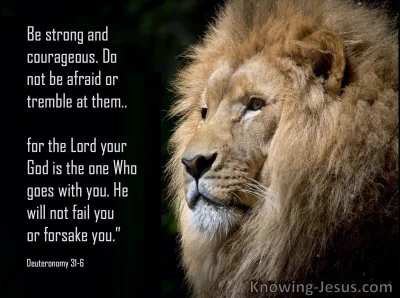
Then Moses summoned Joshua and said to him in the presence of all Israel, “Be strong and courageous, for you must go with this people into the land that the Lord swore to their ancestors to give them, and you must divide it among them as their inheritance. 8 The Lord himself goes before you and will be with you; he will never leave you nor forsake you. Do not be afraid; do not be discouraged.”
Deuteronomy 31 is one of these chapters that can provide hope in those dark days and hard nights. When you feel unequipped to take the next step. It provides the joy you need to take on the day and have only the fear of the Lord. The endurance to believe that no matter what the world pretends to offer, there is only One you will ever need. That one day will be the most important question you will need to answer.
Remember
-
- The Command: “Be strong and courageous”. This is an encouragement to trust God and stand firm when facing intimidating challenges or enemies.
- The Reason:
“The Lord your God goes with you”. Believers are called to be brave, not in their own strength, but because of God’s active presence
-
- The Promise: “He will never leave you nor forsake you”. This offers ultimate reassurance that God’s support is unwavering
Have a blessed day!
Who’s holding you up?

Today’s passage: Exodus 17
“Then Amalek came and fought with Israel at Rephidim. So Moses said to Joshua, “Choose for us men, and go out and fight with Amalek. Tomorrow I will stand on the top of the hill with the staff of God in my hand.” So Joshua did as Moses told him, and fought with Amalek, while Moses, Aaron, and Hur went up to the top of the hill. Whenever Moses held up his hand, Israel prevailed, and whenever he lowered his hand, Amalek prevailed. But Moses’ hands grew weary, so they took a stone and put it under him, and he sat on it, while Aaron and Hur held up his hands, one on one side, and the other on the other side. So his hands were steady until the going down of the sun.”
Exodus 17:8-12 ESV
I’m tired.
I can’t go on.
When will this be over?
These are some of the words and phrases that we say constantly when we are going through something or experiencing something that is not manageable.
We are human.
We are vulnerable.
We are fallible.
We get tired and frustrated and distraught. But in this passage, we see that God gives us the ability to persevere, but he also has resources that are there to help hold us up, Aaron and Hur.
No matter what we’re going through God has sent support to us in the midst of our battles and our troubles.
The thing that we have to do is to allow others to support us when we are in need.
Be Blessed
What Do You Call Him?
In Revelation 19, Jesus is called:
- “Faithful and True” (v.11)
- “The Word of God” (v.13)
- “King of Kings and Lord of Lords” (v.16)
His names reveal who He is and how we experience Him. Yet even with all the names we know, there is still a mystery about Him. Revelation says He has a name written that no one knows but Himself (v.12). And even if we knew it, could we fully understand it?
Many of His names describe what He does for us:
- Avenger — He fights the battle against the enemy.
- Rescuer — He pulls us from the grip of evil.
- Conqueror — He defeats the beast and overcomes all opposition.
- Just Judge — He deals righteously with sin and unrighteousness.
His names aren’t merely titles; they are revelations of His character and His work.
The question for us is: What do you call Him?
Every..
Today’s reading is Revelation 5.
In this chapter we read that no one was worthy to open the sealed scroll held by God the Father on the throne, except for the Lamb, Jesus, who was slain for all of us (Revelation 5:5). Right now, there are wars between nations with much talk and debate about those wars, as well as borders. Regardless of where you stand on these current events and issues, it’s important to remember these verses teach us Jesus died for every tribe, language, people, and nation. Jesus came for everyone who will believe and give their heart and life to Him.
“And they sang a new song, saying, “Worthy are you to take the scroll and to open its seals, for you were slain, and by your blood you ransomed people for God from every tribe and language and people and nation,”
Revelation 5:9
As we watch and read the news, let us pray for Christians everywhere, and let us pray for the Holy Spirit to reach those who are not yet Christ followers. Let us remember that God is sovereign and the Holy Spirit has no boundaries and will not stop until every tribe, language, people, and nation know Jesus and confess that He is their Lord and Savior.
The Throne is Never Empty
Revelation 4
In Revelation 4, John describes his vision like something from a Black Mirror episode, almost like a different dimension. A voice says, “Come up here”, and suddenly instead of being on Earth, he is in the throne room of God.
I have heard this room/experience depicted as the most overwhelming, awe-inspiring place. Kind of like coming up on the Grand Canyon or a pack super bowl stadium with your favorite team playing – then multiply that by infinity!
God is sitting on his throne and John can’t truly paint the picture to us what he sees. The closest he gets is gemstones and light. Jasper(clear/crystal) and carnelian(deep red) surrounded by an emerald green rainbow. More like radiance – a pure, overwhelming, beautiful presence.
Around God’s throne are 24 elders. They are ready to throw their crowns down for every moment that God is praised as a reminder – “whatever authority we have came from Him, and it belongs back to Him”. In front of the throne, a sea of glass, clear as crystal. Some believe it is a barrier representing an uncrossable distance. Others see it as a mirror, reflecting perfect clarity and peace.
Then some super unnatural imagery! Four creatures, covered in eyes from front to back. Never stopping, never blinking and representing the highest and best of all creation:
- Lion – wild/majestic(apex of wild animals)
- Ox – strength/service(apex of domestic animals)
- Man – intelligence/dignity(apex of humanity)
- Eagle – speed/freedom(apex of birds)
Bowing before God and constantly saying, “Holy, holy, holy is the Lord God Almighty – who was, and is, and is to come.”
The throne room of God is the most powerful place in existence — filled with radiance, lightning, and non-stop worship from every corner of creation. Before God reveals anything about the future, He makes one thing unmistakably clear: He is holy, He is sovereign, and He has always been in control. No matter what’s coming, the throne is never empty.
Surrender Control
Hebrews 1 lifts our eyes above changing circumstances to the unchanging rule of Christ. God is not distant, silent, or unsure. He has spoken fully through His Son, who is “the radiance of God’s glory” and the exact imprint of His nature. Jesus is not merely watching history unfold; He is upholding all things by His powerful word.
This chapter shows that God rules over circumstances through the authority of His Son. The same Christ who created all things also sustains all things. The same Savior who purified our sins now sits at the right hand of Majesty. That means our lives are not held together by our planning, strength, timing, or control. They are held together by Him.
Hebrews 1 also reminds us that Jesus is greater than every spiritual power, every earthly authority, and every fear that feels bigger than us. His throne is forever. His kingdom is righteous. His reign is not threatened by uncertainty.
So where do I need to surrender control? I need to surrender the places where I act as if everything depends on me: outcomes I cannot force, people I cannot change, futures I cannot predict, and burdens I was never meant to carry.
Lord, help me trust that Jesus is not only Savior, but King. Teach me to release my grip, rest under His rule, and believe that what He upholds is safer than what I try to control.
Be Confident as a Son or Daughter of the King
Romans 8
This chapter in Romans is one that I always come back to when I need a refresh of who I am in Christ. I even have a 3×5 index card on my desk to always remind myself that I am a son. It is easy, at least for me, to lose sight of this truth. For me, the time when I need a refresher on my identity in Christ, is when I wind up feeling like just a servant or a tool that God is using. It is important to have that word “just” in the previous sentence. Why? Because I am a servant of the King and I am a tool that He uses, but I’m not “just” those things. Satan will use mostly true statements to tell blatant lies against my identity.
The first 11 verses of Romans chapter 8 talk about being free from the power of sin and no longer walking in the flesh but in the Spirit. Paul mentions that if the Spirit is not in you, you are not Christ’s. That is the bad news. The good news is that if the Spirit is within you, and you know He is by seeing the effects of Him (righteousness and the death of your flesh), then you are His. Notice that the effects are not what save you, but what show you are saved.
Let’s keep going. If I know I am saved by the presence of the Holy Spirit, what does the Holy Spirit show? Let’s look at verse 14. Paul states, “For as many as are led by the Spirit of God, these are sons of God.” So, let’s keep tracking. I can have confidence of my salvation because I’m filled with the Holy Spirit. I can have confidence I am filled with the Holy Spirit by seeing the effects of Him in my life. I can have confidence I am a son because I am led by the Holy Spirit.
Let’s go a step further. Verses 16 and 17 show us some more Truth that we ought to cling to. Paul claims, “The Spirit Himself bears witness with our spirit that we are children of God, and if children, then heirs—heirs of God and joint heirs with Christ, if indeed we suffer with Him, that we may also be glorified together.” Lastly, I can have confidence of my inheritance in heaven because I am His son. I hope you see the importance of your identity in Christ. We used some simple reasoning to track some very important Truths about our position in Christ.

To An Uknown God
Today’s Reading: Acts 17
For as I walked around and looked carefully at your objects of worship, I even found an altar with the inscription: TO AN UNKNOWN GOD. – so you are ignorant of the very thing you worship–, and this is what I am going to proclaim to you.
Do you have an Unknown god? Maybe it’s this game 7 hockey game I’m watching? Is it my kids that I can chase from here, there, and everywhere? Maybe it can be work that can take hold of my thoughts and time. Or could my Unknown god be any of the selfish desires or distractions that can take me away from Him?
Paul reminds us, as I think of any circumstance I’m facing…
The God who made the world and everything in it is the Lord of Heaven and earth and does not live in temples built by human hands. And he is not served by human hands, as if he needed anything. Rather, he himself gives everyone life and breath and everything else.
It’s time to put away the Unknown gods… the desires and distractions that can keep making me feel like any of my circumstances is under my control.
Be Bold

Today’s Reading: Acts 4
“Now when they saw the boldness of Peter and John, and perceived that they were uneducated, common men, they were astonished. And they recognized that they had been with Jesus. But seeing the man who was healed standing beside them, they had nothing to say in opposition. Acts 4:13-14 ESV
Peter and John were two of the closest apostles that lived and were in close relationship with Jesus throughout his ministry, his death, burial and resurrection.
So she ran and went to Simon Peter and the other disciple, the one whom Jesus loved, and said to them, “They have taken the Lord out of the tomb, and we do not know where they have laid him.” 3 So Peter went out with the other disciple, and they were going toward the tomb. 4 Both of them were running together, but the other disciple outran Peter and reached the tomb first. – John 20:2-4
These two individuals were with Jesus or in close proximity to him at the crucifixion. They were the apostles that went to the tomb on the day of resurrection. They also were able to interact with Christ for the 40 days after he returned to earth. Peter and John are some of the most prominent apostles that we have.
At the beginning of their careers they were somewhat timid and did not know how to use the gifts that were given to them. But here in the Acts, we see that they have gained this boldness that transcends understanding. The boldness that they received is from the Holy Spirit. It is after Christ ascended in the Holy Spirit came to them that they had this boldness.
One of the best things that we have currently is the Holy Spirit is available to each at one of us. The Holy Spirit is God the spirit. The Holy Spirit is the same spirit that was at the beginning of time; the same spirit that was at the resurrection of Christ; the same spirit that was working through the apostles. The same spirit is what we have available to us if we open our hearts and our selves to the Holy Spirit.
When we allow the Holy Spirit to work in us, and we accept the Holy Spirit and understand that Jesus’ purpose was to bring the reconciliation of the Holy Spirit to us through his blood. We are able to use the same spirit to become bold in the things that we do. The things that we do for the spirit and for raising the connection in relationship with God to others.
There’s three ways that we can be bold to show God’s love to others.
Bold in the preparation
Bold in the asking
Bold in the doing
Be bold in the prep
Whenever we’re doing something, we have to have the confidence that what we’re going to do will be accomplished. We have to be bold in the preparation. We have to make a statement and know that when we make a statement it will be completed. When we have doubt and questioning, then that allows us to get into the scenario and not allowing the spirit to be the main purpose in the scenario.
Be bold in the asking
Many times when we are asking for things, we take a timid stand. We take a stand of shyness. When asking we have to be bold and asking and assure ourselves of what we’re asking. When we are asking God for clarity, or for understanding, or for health, or for financial peace, or for anything, we have to ask within the knowledge that He is going to provide it for us. We cannot be shy when we’re asking God for things. It’s not being arrogant or overconfident. We’re just asking with the understanding that our Father is going to provide for us the things that we need and he’s already given to us.
Be bold in the doing
One of the most important aspects of everyday life is the follow-through. Many times we can prepare and we can ask, but we do not have the follow-through. When we have the follow-through, we are doing the things that God has in store for us. When Peter and John were approached by this beggar in this passage, they were bold and what they could do and what they were able to do. They did not shy away from telling the beggar that they did not have money, but they did tell him they didn’t have money and what they were able to do.
And Peter directed his gaze at him, as did John, and said, “Look at us.” 5 And he fixed his attention on them, expecting to receive something from them. 6 But Peter said, “I have no silver and gold, but what I do have I give to you. In the name of Jesus Christ of Nazareth, rise up and walk!” 7 And he took him by the right hand and raised him up, and immediately his feet and ankles were made strong. – Acts 3:4-7
Many times we shy away from things that we can’t do and then we also shy away from the things that we can do. What we have to do is be bold in both. Be bold in our limitations and be bold in our strengths. When we walk in the spirit, we can be bold without being overconfident or arrogant. We also can be bold at the same time being humble because we understand that God is using us to fulfill the needs and the wants and they ask of others.
As we go through this week, let us see how we can be bold in the things that we have. Let us see how we can be bold in the preparation and be bold in the asking and bold in the doing.
You must be logged in to post a comment.