Time Is Up

Job 31-33, Psalm 102, Rev 19

I feel beaten down.  For the last several weeks, we have been listening to Job and Revelation.  It can be depressing.  Job’s life is destroyed, and the seven judgments are being poured out upon the people on earth.  Suddenly, a loud voice from a great multitude cried out, “Hallelujah!”

What is this sudden turn?  Why have I found myself reeling from the pain and anguish that the people of earth are enduring while all of heaven is proclaiming, “Hallelujah?”  They do it because they know the truth, and they know what is to come.  Hope has arrived.

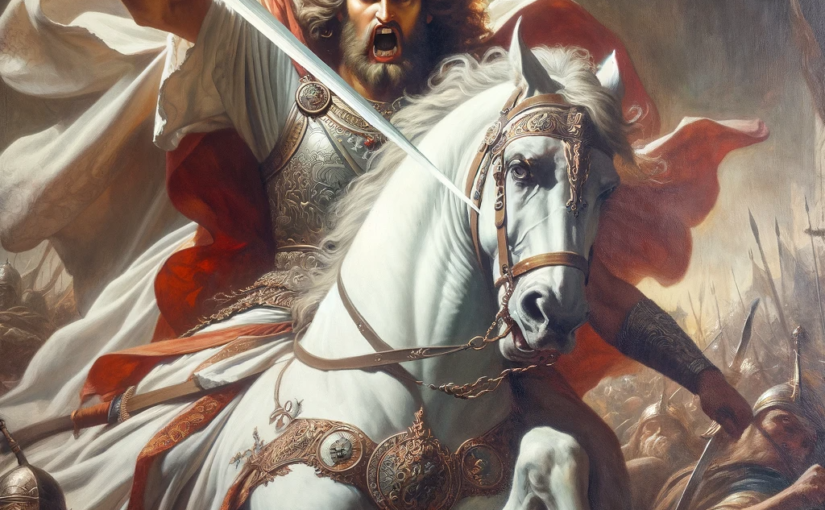
Then I saw heaven opened, and behold a white horse! The one sitting on it is called Faithful and True, and in righteousness, he judges and makes war.  His eyes are like a flame of fire, and on his head are many diadems, and he has a name written that no one knows but himself.  He is clothed in a robe dipped in blood, and the name by which he is called is The Word of God.  And the armies of heaven, arrayed in fine linen, white and pure, were following him on white horses.  From his mouth comes a sharp sword with which to strike down the nations, and he will rule them with a rod of iron. He will tread the winepress of the fury of the wrath of God the Almighty.  On his robe and on his thigh, he has a name written: King of kings and Lord of lords. Revelation 19:11-16 (ESV)

Why sing Hallelujah?  Because Jesus is here!  But, not the Jesus that you knew before.  This time, he is not a baby lying peacefully in a manger or the gentle pastor with children gathered all around, nor is his body beaten and broken.  He is full of fire, crowned with jewels, and armed for battle.   Victory is assured.

When I see the warrior, something happens.  Hope isnt something far off, hope is right now.  I find joy in vengeance over the enemy, but that is not the biggest thing.  The sight of the warrior, my savior is overwhelming.  I am not afraid.  He is for me and  I am prepared.  He is fighting for me as I fall to my knees and proclaim, “Hallelujah!”

Redeemer

Job 18-20, Psalm 141, Rev 15

When will it end?  For the last several days, we have been with Job.  We’ve witnessed him losing his family, his farm, all his possessions, even his health. The world has betrayed him.  God, according to Job, has betrayed him.  The pain and torture is unrelenting.  As if his physical and  mental anguish were not enough, Job’s friends also criticize him.  He can’t take any more.  “Have mercy on me, have mercy on me, O you my friends,” he cries out.  “Why do you, like God, pursue me?  Why are you not satisfied with my flesh?”  Incredibly, through all of this, Job’s faith is not shaken.  He knows that something more is coming, confidently claiming the promise he is given.  “I know that my redeemer lives,” he says.  Redemption where his fantastic hope comes from.  So does ours.

We have all found ourselves in a mess we cannot get ourselves out of.  Most of the time, our messes are a result of our poor choices.  The resulting shame and circumstances reinforce our fear that at any moment we will be fully abandoned, by our friends and by God.  Job can help us overcome that fear by reminding us that our efforts are futile.  If we are to be full, we must be redeemed.  We cannot just erase the past, we must be bought out of our mess.  Someone must pay the price.

Today’s world pretends to have the answer, but it falls short.  Positive thinking, exercise and education only go so far.  We didn’t see Job trying to double his effort or modify his beliefs.  He clung desperately and relentlessly to one truth, “my redeemer lives.”  This is our truth too.  Ephesians 1:7-10 tells us that “In him we have redemption through his blood, the forgiveness of our trespasses, according to the riches of his grace, which he lavished upon us, in all wisdom and insight making known to us the mystery of his will, according to his purpose, which he set forth in Christ as a plan for the fullness of time, to unite all things in him, things in heaven and things on earth.”  So, I, like Job, do not lose heart because my Redeemer lives!


Questioning God

Malachi, Psalm 2, Revelation 9

Humility, according to John Townsend, is accepting the reality of who God is and who you are.  That seems easy but, time and time again, we fail.  In fact, we fail more than we realize.  We see a blatant representation of this failure today in Malachi and it has me counting how many times I talk back to God.

Starting at the beginning, God reminds the priests, “I have loved you.”  Their reply is striking, “how have you loved us?” They question.  It’s as if they do not feel God’s love.  They certainly are not experiencing it.  While he patiently provides an answer of his deep love, the next statement is prepared.  “You have not honored me, and you do not fear me.”  The priest’s response, laced with indignation, comes “how have we despised your name?”  They pretty much ask God to prove it.  I think they were so buried in their own worlds and their own success that they really didn’t know.  They actually thought they are doing good.  So, Malachi explains the priests disregard for God.  Then, he adds yet another offense, maybe the worst yet.  “You cover the Lord’s altar with tears, with weeping and groaning because he no longer regards the offering or accepts it with favor from you hand. But you say “Why does he not?”  The priests have no idea why God won’t answer them.  That’s when Malachi hits them with the truth.

The questions that we ask of God reflect the condition of our heart.  Throughout the book of Malachi, the priests have it backwards.  They have denied the reality of who God is and who they are. So do we. Today, we get another chance.  The promises of God are only one decision away.  It starts with accepting the reality of who God is and who you are.

Townsend, John. The Entitlement Cure: Finding Success in Doing Hard Things the Right Way (p. 54). Zondervan. Kindle Edition.

Why Do You Weep?

Nehemiah 1-3, Revelation 5

John is in the throne room.  He’s watching God hold out a scroll with seven seals while an angel shouts to everyone “who is worthy to open the scroll and break its seals?” (v2).  When nobody was found, John began to weep.  It’s this reaction that I want to take a closer look at.  Why does he weep?  To understand John’s emotions we need to first understand what is in the scroll, then we need a closer look at John’s heart.

The scroll describes Gods future plans.  Remember that Jesus died and ascended to heaven but he also made another promise; to come again. Luke 21:27 (ESV) And then they will see the Son of Man coming in a cloud with power and great glory  (Mark 13:26-27).   This second coming will be the end to all trials and tribulation.  When it happens, Jesus will send out the angels and gather his elect (Mark 13:27).  This is what John was hoping for.  The scroll would finally reveal it. The full understanding of God and eternal presence with him is finally at hand.  But, there is a problem.  Who will open it?

John probably knew immediately that he, himself was not worthy.  He came to the throne room not with ambition and looking for opportunity, but seeking God, with humility.  Instead, I picture him eagerly searching for a face, for someone to step forward and take the scroll.  But they didn’t show up.  I feel like he matched 5 numbers on a lottery ticket and, waiting anxiously for that sixth number, only to find it doesn’t match.  John had lost.  But this wasn’t about a few dollars, this was everything he hoped for.  He “wept loudly.”

John was distressed until he was reminded to be patient.  There is one worthy, says one of the elders.  It is the “Lion of Judah.”  He has won the victory.  He is worthy to open the scrolls.  With this, John’s hope was restored but not in the way he expected.  He was looking for a lion, bold and strong.  But, what he saw was a lamb, and that Lamb that looked as if it had been slaughtered (Revelation 5:6).  In that moment, John sees Jesus for who he really is. He understands the price that was paid.  With that, John and the entire room fell down before the lamb and sang a new song (Revelation 5:8).

Defiant

Zechariah 12-14, Psalm 94, 2 John

2 John 2:6 says, Love means doing what God has commanded us, and he has commanded us to love one another, just as you have heard from the beginning. I’ll be honest, I struggle with being commanded to love. It’s like telling me I have to go to the gym.  No, thank you.  I don’t want to be out of breath. I don’t want to sweat, and I sure don’t want to be sore tomorrow.  But guess what?  I can’t be healthy without it.  Sometimes, the only way to get me to do something is to command it.

Why do I have this reaction to the commandment of love?  Because love is costly.  Bob Goff describes the cost of love in two ways: sacrifice and presence.  Sacrifice means giving up something I want so that someone else can have what they want.  Presence is about attention.  It’s a state of being.  When we are present with another person, nothing else matters.  Just them.

Perhaps Jesus presented it as a commandment because he knew I would be reluctant to pay the price.  Perhaps he knew that my obstinance would stand in stark contrast to his humility.  He was not reluctant to pay.  He gave his love freely.  Even when it cost him everything.

Greed and Fear

People will never change, according to Morgan Housel.  In his book, Same As Ever, he illustrates over and over that people are primarily driven by greed and fear.  They never change.  But, I am a Christian.  “I can change,” I think.  “I have been changed,” I demand.  These answer come without much thought.  Is it true, that we are changed?

Today, we are reading about Haggai. He enters the story some 60 years after the Israelites were released from Babylon.  Remember Babylon?  The city was known for its debauchery.  Under the rule of King Nebuchadnezzar, the Babylonians fought and “besieged Jerusalem.” “Nebuchadnezzar carried away all the treasures from the Lord’s Temple and the royal palace. He stripped away all the gold objects that King Solomon of Israel had placed in the Temple. King Nebuchadnezzar took all of Jerusalem captive, including all the commanders and the best of the soldiers, craftsmen, and artisans—10,000 in all. Only the poorest people were left in the land.”  (2 Kings 24:10-14). But, they would not be there forever.  The book of Ezra begins the next chapter, where King Cyress allows the Israelites to return to Jerusalem.  Specifically, he released them to Jerusalem to rebuild the Temple of the Lord.  Behind the scenes, God was stirring the hearts of the priests and Levites and the leaders of the tribes of Judah and Benjamin to go to Jerusalem to rebuild the Temple of the Lord. Ezra 1:5.  So they went.  But, they did not rebuild the temple.  Haggai has something to say about it.

Here’s what happened.  The Jews returned to Jerusalem so that they could rebuild the Temple, but the city was in ruins.  If they were going to do this work, they needed places to live.  God graciously gave them the gift of time.  And they took it.  They built lavish houses, planted bountiful fields, feasted together, and dressed themselves exquisitely (Haggai 1:4-6).  Now, 60ish years later, God reminds them that he would like his temple rebuilt.  “Not yet,” the people respond.  The time has not yet come (Haggai 1:2).  The people were greedy.  Some things never change.  Housel is right that people will always be greedy.  What about fear?

Rebuilding God’s temple was monumental work.  How could they ever build this temple the way Solomon did?  It would take forever! Plus, he was the wealthiest man that ever lived, and these were tough times for the Jews.  Remember, that they had been enslaved and their land destroyed? These reminders created fear for the Israelites. Fear told them they were unworthy. Fear said they are not capable.  But it was not true.  God stepped in.  He asked them to be strong.  Work, for I am with you, declares the Lord of hosts. My Spirit remains in your midst. Fear not (Haggai 2:4-6).  Looks like Housel is right.  Well, partly right.

The Israelites made a choice.  They were able to defer their greed and overcome their fears through the power of the Lord.  Without God, we remain with our current thinking, we are not transformed by His power, and we are forever subject to our humanity of greed and fear.

Triggered

Daniel 1-3, Psalm 88, John 17

Triggered: an emotional/psychological reaction caused by something that somehow relates to an upsetting time or happening in someone’s life, often when someone gets offended, gets their feelings hurt or people with strong victimization.

There are lots of things that trigger us.  Just say the words “I love Donald Trump” in a crowded restaurant and you will see what I mean.  Heck, maybe you get triggered because other people get triggered.

We are most likely to be triggered when we are afraid.  Think of triggered as the “flight or fight” response.  It starts with adrenaline and cortisol.  Our breathing becomes rapid and our hearts beat faster.  This is when we begin to sweat and our eyes dilate to broaden our field of vision.  The effects of fear on the mind are a little harder to discern, but they are very real.  Our mind becomes singularly focused.  We can only see the threat.  All of our brain power is directed toward one thing, relief.  How do we get out of this, fast!  Unfortunately, that often leads to poor decisions.

It’s easy to see in hindsight.  My reactions and responses when I am triggered are less than Godly.  Fear eliminates my big picture view.  Thankfully, there is a better way.  Consider Daniel.  King Nebechadnezer’s men came in, ready to kill him.  Yet, Daniel did not respond in fear.  In the moment, he was given power.  Not super human strength or mystical pwers like we expect, no, Daniel was given the power of peace.  How do we know?  Daniel 2:14 says that “Daniel handled the situation with wisdom and discretion.”  Do you know what that means?  It means that he was not overcome with fear.  He did not respond with adrenaline, rapid breathing, sweating and a narrow focus.  Instead, he was broadly focused.  He immediately saw the bigger picture.

What is it that separates Daniel from the rest of us?  Why do we get triggered and he gets peace?  The answer is simple.  Daniel first set his heart upon God, then  he allowed his mind to be governed by the Holy Spirit, and finally, he submitted his will.


Is It Me?

Ezekiel 37-39, Psalm 87, John 13

Gathered around the table, Jesus is talking to his disciples.  “One of you will betray me.”  He says.   The disciples looked at each other, wondering who he was talking about.  But it wasn’t that simple.  The disciples were struck with fear.  Matthew 26:22 presents them as “greatly distressed.”  In their worry, each man asked Jesus, “Is it I?”

instinctively, the disciples knew their hearts were fickle.  They could, at any moment, fail Jesus.  But that only explains part of it.  In a moment the disciples reaffirmed their hearts, clarifying their motives and commitment.  Having satisfied their inner turmoilI, they ask Jesus ‘Is it I,” with confidence.  Its as much a statement of ‘It is not I.’

It is easy for me to forget that this conversation occurs during the Last Supper, right in the middle of communion.  Can you imagine passing the elements at church and the Pastor says, “one of you…?”  The direct question brings to the fore my own betrayal.  The things I have done, the words I have said and the longings of my heart lay out before me.  My guilt overwhelms and is quickly followed by shame.  Thankfully, this not an ending, it is a beginning.   Like the disciples,  when I affirm my faith in Him I find hope.  One step farther takes me to his sacrifice.  Through it, I am justified.

 “Take, eat; this is my body.” And he took a cup, and when he had given thanks he gave it to them, saying, “Drink of it, all of you, for this is my blood of the covenant, which is poured out for many for the forgiveness of sins. Matthew 26:26-28 (ESV)


Where Would You Rather Be?

Ezekiel 19-21, Psalm 84, John 7

In almost every circumstance, I am thinking of where I would rather be.  If I’m at work, I’d rather be at home.  I’d rather be at my desk when I’m in a meeting, and when I’m at home, I’d rather be at the lake.  Thinking about it now,  I see it’s foolishness.  The places I’d rather be are not very thoughtful.  If they were, maybe my rathers would look more like the Psalmist in Psalms 84.

His thoughtful approach starts by considering the dwelling place of the Lord.  ‘Lovely,’ he calls it.  We see quickly that he would rather be in the dwelling place of God.  My soul longs, yes, faints for the courts of the Lord, he says. (v2)

Quickly determining the value of one day in the Lord’s courts, the Psalmist understands that he would rather spend one day there, than thousands elsewhere (v10).

Finally, the Psalmist compares the many options he has before him and determines that he would rather be a doorkeeper in the house of God (v10), than

I would rather be a doorkeeper in the house of my God, than live the good life in fine homes amongst the wicked (v10).

There is no doubt that today we will find ourselves longing for a place that we would rather be.   Setting our minds on the dwelling place of the Lord will be a good start.

Who Do You Love?

Ezekiel 7-9, John 3

Among the most terrifying stories in the Bible show up in today’s reading, Ezekiel 7-9.  It starts with God declaring that “the end is upon you!” ‘Now,’ He continues, “you will get my anger; I will judge you, I will punish you, and I will not spare you or have pity.”  If you have the audacity to keep reading, you will see doom, wrath, anger, judgment, violence, wickedness, pestilence, shame, and terror.

Reading through the horrifying list of proclamations against mankind has me looking for an out.  Should I fall on my knees?  Just ask forgiveness?  ‘Just give me a minute, God, to explain myself.  There is a perfectly good reason for all of this…’  But it is too late.  There is no more time for excuses.  The executioners have gathered near (EZ 9:1)

There are a few, however, that will survive the wrath.  Who are they?  How do you separate those who truly love God from those who just want a get-out-of-jail-free card?  God has a way.

“Put a mark on the foreheads of the men that sigh and groan.”  God cuts straight to the heart with this directive.  Instead of saying, mark the men who ask for help, or mark the men who beg for mercy, he wants the ones that sigh and groan.  The others are too easily masked by desperation.  We will do anything when we are desperate.  Mostly, we don’t feel guilty until we are caught.  In these cases, we have one thing in mind.  Ourselves.   We will do whatever it takes to save our butts.  I will say anything, do anything, and promise anything.  God knows this.

To root out the committed, He implemented a simple test that examines the character of men’s’ hearts.  Do they sigh and groan?  Do you know what that feels like?  Psalm 119:53 describes it as  “Hot indignation [that] seizes me, because of the wicked.” And, “My eyes shed streams of tears” because they ignore you (Psalm 119:136).  Those are both outward manifestations of pain, deep inside.  It’s not physical pain; it’s heartbreak.  It’s the kind of pain that drives us to our knees. Helpless, distressed, and desperate.  Matthew Henry says it this way: those who will receive the mark  “sigh in themselves as men in pain and distress, cry to God in prayer, as men in earnest, enormities that were abominations to God.”  Those last words get to it, “abominations to God.”  What are the marked so sick over?  The destruction of beauty, the eradication of love, and the elimination of hope.  These are the hallmarks of God himself.

Only one question remains.  Will you be receiving the mark?