We have no idea what to do.

Do you have a problem with no apparent resolution? If so, what emotions are you experiencing? Have you considered what God might be trying to teach you or how he is trying to shape you?

There’s a situation where my wife and I have no idea what we are going to do. We are both combinatorial thinkers and planners, however, no matter what we come up with, we don’t like any of the options. We have been discussing the topic for over two months and nothing has changed. As a result, we are experiencing some feelings of sadness and helplessness.

Without sharing the situation, it goes something like this. We can’t go back, we can’t stay where we are, we must go forward. Something has to change.

It is in these seasons where God always does his best work. We are being prepared for something but we are not sure what that “something” is. We have to remember that this isn’t a “me” or “us” story, this is a God story. Our only option, our only hope is to put all of our faith and trust in Jesus Christ.

“If you’re a hard worker and do a good job, you deserve your pay; we don’t call your wages a gift. But if you see that the job is too big for you, that it’s something only God can do, and you trust him to do ityou could never do it for yourself no matter how hard and long you worked—well, that trusting-him-to-do-it is what gets you set right with God, by God. Sheer gift.” (Romans 4-5, The Message)

The Message version of those verses really struck me because what we are facing is just too big, only God can do it. It is a reminder that we (like most people) need to stop trying so hard and give everything over to God. His story, his glory.

Doubt and Fear

2 Samuel 21-23, Psalm 18, Romans 3

I read recently that doubt and fear are Satan’s best tools.  If he can get you to doubt God’s goodness, God’s power, and God’s protection, he wins.  Once doubt is in place, fear takes over.  It’s a big victory.

Once our soul is given over to doubt and fear, life is perilous and hope is thin. Without God’s power, we have no refuge, no rock, no fortress and no shield.  Without God’s goodness, we cannot be drawn from the many waters, or rescued from our strong enemy.

Do you want to know where fear and doubt show up for me?  David, in the face of danger,  is able to claim righteousness (v20).  “According to the cleanliness of my hands,” he says, “God rewarded me. For, I have kept the ways of the Lord.”

But, what about me?  I haven’t done a very good job keeping the ways of the Lord.  I can’t claim righteousness like David did, nor am I one of God’s chosen like David was.  How will I ever survive?  Doubt and fear prevail.  Satan is winning.

It only feels like Satan is winning.  He is easily overpowered by the Truth.  You see, its not the cleanliness of my hands that God measures nor is it my ability to keep the ways of the Lord.  There is only one way to gain and maintain God’s goodness, power and protection; Jesus Christ.  By proclaiming Him, we are made right with God.  That means we are made righteous (Romans 3:22).  What’s more, that promise is not reserved for “God’s chosen people.”  Because of Christ, we are all chosen.

Once freed from the lies of the evil one, there is only one response.  David got it right in Psalm 18, as he exclaimed

The Lord lives, and blessed be my rock, and exalted be the God of my salvation!

Desire for His Presence

Today’s Readings 2 Samuel 15-17, Psalm 3, 63, Romans 1

In today’s readings, you will read about the rebellion of David’s son Absalom.  God had forgiven David for his sins but did not cancel the consequences of his sin.  Why did Absalom go against his father? Why did Absalom constantly take bad advice from others?

2 Samuel 15:4 Moreover, Absalom would say, ‘Oh that one would appoint me judge in the land, then every man who has any suit or cause could come to me and I would give him justice.’

While parenting a teenage son, I can reflect on the many sins that I have been forgiven for. I pray for my son to see and learn from my example that we can all experience forgiveness when we turn our lives over to God. It’s not saying sins will never happen again, but we can experience His love that will never go away.  As humans, we can be prone to the sins of our adults in our lives. We need to be aware and seek Him always.

Psalm 3 happens to be the Psalm written when David was fleeing from his son. David confidently trusted God for protection and peace. Many of my reflection moments and scripture reading time can happen in the morning. Prayers can come in the middle of the night when I wake and have questions that I can reach out to God for His answers.

3 But you are a shield around me, O LORD; you bestow glory on me and lift [2] up my head. 4 To the LORD I cry aloud, and he answers me from his holy hill. Selah 5 I lie down and sleep; I wake again, because the LORD sustains me.

These sleepless nights are covered by the Lord. This is also read in Psalm 63. Instead of tossing and turning in bed, David turned to the Lord in confidence.

6 When I remember You on my bed, I meditate on You in the night watches.

Lord we know that in our moments of uncertainity we can trust in Your future for our lives and our childrens’. We can learn from David about His peace and trust we can always have in You!

Beneath the surface

Today’s Reading : II Samuel 13-14, Acts 28 

We have all done it. We have made an assumption about someone or something on the first appearance. This is how human nature works. We are given evidence and ideas from our previous encounters with others and we make a generalized guess of something new. From this introduction we can make a better informed decision from our interactions with that person to create a more informed decision of that person. Many people could say this is the “judging a book upon its cover” with first impressions.

In our passages today, we have two individuals who on the surface can be seen in through the lenses of the author completely differently, Absalom and Paul . After reading these passages several times, I see we have to dig deeper beneath the surface to see some of the aspects of each of these individuals.

In the final chapter of Acts, we are seeing the last interactions that are recorded for Paul aside from his letters to the church.  In this chapter and the previous chapters of Acts,  we see a full conversion and transformation of Paul.  We see him from the chief prosecutor and executioner of the earlier Christian to become the leading figure for the spread of Christianity throughout the world.  In this particular chapter, we witness an additional revelation as we dive deeper than the surface with the shipwreck and the other adventures.


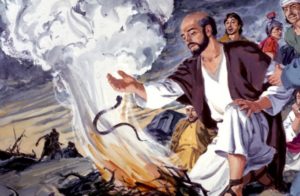
“When Paul had gathered a bundle of sticks and put them on the fire, a viper came out because of the heat and fastened on his hand. When the native people saw the creature hanging from his hand, they said to one another, “No doubt this man is a murderer. Though he has escaped from the sea, Justice has not allowed him to live.” He, however, shook off the creature into the fire and suffered no harm. They were waiting for him to swell up or suddenly fall down dead. But when they had waited a long time and saw no misfortune come to him, they changed their minds and said that he was a god.”

‭‭Acts‬ ‭28‬:‭3‬-‭6‬ ‭ESV‬‬

The people of the island did not know Paul.  They assumed that he was an evil man, but then they believed he was a “god”.  After a little while, the people actually were able to see who he was and Whose he was.  He manifests the Spirit and God allows him to witness unreachable people with unforeseen circumstances.  This interaction can be the reason people in this particular isolated island received the gospel.  Can you imagine the countless stories and miracles that happened because of the shipwreck? Sometimes the hardest things that we experience can be a window into how God is going to use you in the situation.  

How many times have we been in terrible situations and circumstances that we can’t imagine we are going to get out of, then God shows up and delivers us to something better? Now ask yourself, how did God use that situation to bring others to him? How has your relationship with Him created a safe space for others to see the goodness in the midst of adversity and allow you to invite them into His presence? 

A couple days ago, I was listening to one of TD Jakes’s sermons, the Threshing Floor. In portion of this sermon. He is speaking about the alabaster box. He speaks about how the alabaster can shield the essence of anything that’s in it. He compares us to the alabaster box. Some of the things that God has in store for us even people that are close to us cannot understand it until God is ready for us to open it. Just as the natives did not know about Paul’s true essence, how many people that we know do not know our true essence? How many of us do not know our true essence? What do we have to do or go through for God to show us our true essence? When we make this decision to see what beneath the surface, we have to rely on God to be in charge of everything, the highs and the lows.  

Be blessed 

Uncovered and Redeemed

2 Sam 11-12, 1 Chr 20, Ps 51 & 32, Acts 27

In April 2010, an oil platform called the BP Deepwater Horizon spilled an estimated 4 million gallons of oil into the Gulf of Mexico.  According to Time.com,

U.S. District Judge Carl Barbier said BP was mostly to blame for the 2010 Gulf of Mexico disaster, which killed 11 people and spewed oil into the water for 87 days. Barbier attributed 67% of the fault to BP, 30% to Transocean, which owned the Deepwater Horizon drilling rig, and 3% to Halliburton, the cement contractor.

 But, instead of fully acknowledging their role, BP deflected blame, pointed fingers and downplayed the severity of the incident.  In the end, the company agreed to pay $7.8 million to settle the claims against them.  The settlement was made without BP admitting to any wrongdoing.

BP, of course, is not the only company to settle claims without admitting fault.  It happens all the time.  Enormous amounts of money are offered up to make the problem go away.  On some level, it works.

King David found himself in a bad spot.  It was discovered that he had an affair with Bathsheba and that he attempted to cover it up by killing her husband, Uriah.  Now, David had gotten on with his life.  With Uriah dead, he married Bathsheba and she had a baby.  But the Lord was ‘displeased’ (2 Samuel 11:26).  Consequently, the Lord took the life of the child.  But that’s not all.  God also promised to punish him by ‘raising up evil from his own house and giving his wives to his neighbor (2 Samuel 12:10-11).  Clearly, God was angry and justice had to prevail.

If you were David, what would you do?

“I’m sorry. I’m sorry! I’m so, so sorry,” I would exclaim, my voice trembling. “I’ll do anything. Anything! Here, take this money.”

“I’ll give it to the church. I swear, I’ll help the homeless. I’ll give it to the poor. Just please, believe me.”

“God, you have to see—you’re going to be so happy with all the good I am about to do!”

“Surely we can make some kind of deal.”

What this confession misses, David gets right.  His first response when confronted was  confession. “I have sinned against the Lord,” he says.  In Psalm 51, David takes his confession deeper.  He pours his heart out to the Lord privately.  But this also happens publicly.  David made no attempt to cover up anything that he did.

Did you notice what is conspicuously missing from David’s confession?  Money.  In fact, he outright rejects the temptation to present money as reparation to God.  He says, “For you will not delight in sacrifice, or I would give it; you will not be pleased with a burnt offering.  The sacrifices of God are a broken spirit; a broken and contrite heart, O God, you will not despise” (Psalms 51:16-17).

Because of David’s confession and repentance, God is able to continue his aszzwork through him, starting with the blessing of another child, Solomon.  The sins and mistakes of the past have not been erased or eliminated as if they never happened.  They still exist and are well documented.  But, now, through David’s faithfulness, and God’s loving mercy, they are redeemed.

Leadership Lessons From Joab

Today’s readings are 2 Samuel 9-10, 1 Chronicles 18-19, Psalm 89, and Acts 26.

Both 2 Samuel 10 and 1 Chronicles 19 tell the story of David’s army defeating the Ammonites and the Syrians who joined forces. In both places we are told Joab, the leader of David’s army, came up with a strategy to split up, allowing his brother Abishai to lead a group with him leading the other still so that one group could help the other if they were in trouble. After gathering everyone and delivering the strategy, he told everyone the following in both passages which I will quote directly from 2 Samuel 10:12…

“Be strong, and let us use our strength for our people and for the cities of our God, and may the Lord do what seems good to Him.”

We can learn some great leadership lessons from Joab in both 2 Samuel 10 and 1 Chronicles 19 through this story.

  • You may be a good leader and great at what you do, maybe the best…but we must develop and trust in others, as well as delegate, to maximize our impact and what God will do through us to accomplish His will. We saw this through Joab allowing the army to split up and letting his brother Abishai lead the other group.
  • To lead others, we must have a strong “why” or purpose and communicate it to others with the potential to inspire them to potentially use it as theirs, too. Joab communicated the battle they were fighting was for their people and for the cities of God.
  • Have confidence. One of my past business coaches, Jason Selk, always said, “Confidence is the number one variable in success.” I can almost hear the confidence and conviction in Joab’s voice as he tells them to “Be strong..” Do you lack confidence? I do sometimes. A recent Tim Tebow book I read discussed having “God confidence.” As a believer in Jesus, your confidence is not in yourself, but what God can do through you. Check out Ephesians 3:20-21. It’s not what I can do, but what God can do through me. And that is more than I can ask or even imagine. I guess you could say these have become my life verse(s) in some way.
  • Joab gives it to God and ask that His will be done. I’ve also heard it said, “All we can do is to do our best, and let God take care of the rest.” As a Christ follower, it’s ok to ask for what we want..the Bible tells us that (Matthew 7:7-12). However, at the end of the day what should be most important to us is that His purpose is accomplished and that He is glorified which sometimes may come through our defeats and not through what we want occuring. We trust in God and that He will work good for whatever happens (Romans 8:28).

I pray we can apply these lessons from Joab in our lives which will allow God to be glorified through us and through all that we do.


God’s Guidance

Today’s Readings: 2 Samuerl 6, 1 Chronicles 13, Psalm 60, Acts 23

The passages 2 Samuel 6, 1 Chronicles 13, Psalm 60, and Acts 23, while differing in context and content, share several thematic elements that are notable in biblical literature. Here are the key themes that can be observed across these scriptures:

1. Divine Presence and Worship:
– 2 Samuel 6 and 1 Chronicles 13 both describe the transportation of the Ark of the Covenant to Jerusalem, emphasizing the importance of the Ark as a symbol of God’s presence among His people and the proper way to worship and revere God.
– The emphasis on worship and proper reverence to God can be seen in David’s joy and celebration as well as the tragic incident with Uzzah, who touches the Ark and is struck down, underscoring the holiness and sacredness of God’s presence.

2. Human Leadership and Divine Guidance:
– 2 Samuel 6 and 1 Chronicles 13 highlight the leadership of King David in uniting Israel and his role in bringing the Ark to Jerusalem, indicating a leader’s responsibility to seek and follow divine guidance.
– Acts 23 features the Apostle Paul, who, even while facing persecution and trials, is depicted as a leader who receives divine guidance and protection, reflecting the theme of God guiding and protecting His chosen leaders.

3. Conflict and Resolution:
– Psalm 60 is a lament and a plea for God’s help in the midst of national defeat and conflict. It reflects the struggle and eventual hope for divine intervention and resolution.
– Acts 23 details Paul’s conflict with the Jewish council and the Roman authorities, highlighting his reliance on God’s providence for protection and resolution of the situation.

4. God’s Sovereignty and Human Responsibility:
– In 2 Samuel 6 and 1 Chronicles 13, the incident with Uzzah underscores the concept of God’s sovereignty and the serious responsibility humans have in responding to God’s commands appropriately.
– Psalm 60 reflects on God’s sovereign rule over nations and the psalmist’s appeal to God’s authority for deliverance.
– Acts 23 demonstrates Paul’s acknowledgment of God’s sovereignty in his mission and his strategic responses to his trials, showing a balance between divine sovereignty and human responsibility.

5. Covenant and Promise:
– The transportation of the Ark in 2 Samuel 6 and 1 Chronicles 13 is deeply connected to the theme of God’s covenant with Israel, symbolized by the Ark itself.
– Psalm 60 speaks to the hope and trust in God’s promises to deliver and restore His people.
– In Acts 23, Paul’s mission is rooted in the new covenant established through Jesus Christ, and his actions reflect a deep trust in the fulfillment of God’s promises.

Overall, these passages collectively highlight themes of divine presence, worship, leadership, conflict, divine sovereignty, human responsibility, and covenant promises. Each passage, through its unique context, contributes to a broader biblical understanding of how God interacts with His people and how they are to respond to His guidance and commands.

Written with the assistance of ChatGPT

This price is right.

Have you ever watched the television game show “The Price Is Right” (TPIR)? I used to watch it as a kid and I wasn’t even interested in most of the products on the show. It was the excitement to guess the price and to see what sort of prizes would be offered! While writing this post I checked out some YouTube videos of TPIR in the 1980s and the one I stumbled across had the contestants bidding on “picture heaters”. The contestants and even Bob Barker were confused as to what a picture heater was (and I still am).

My whole life I’ve been fascinated with prices and I am certain that if I were a contestant on TPIR I’d win a new car. My obsession with prices drives my wife crazy. She bought egg whites the other day, and then my curiosity kicked in… The container says 15 eggs so my guess would be $7 so to find out if I was correct, I asked her how much they were. She said, “I don’t know, I’ll have to check the receipt”. Knowing I can be annoying about this I held off for a couple of days and asked again. Unfortunately, there’s no receipt so I’m making plans to head to the store and find out myself. I just have to know. Was the price right?

While the price-guessing game is fun, it reminds me of the things in life that cost everything and the things that cost nothing. Price is always important.

Today’s reading: 2 Samuel 3-5; 1 Chronicles 12; Psalm 122; Acts 22

In Acts 22:24-25 Paul is about to be whipped so he asks the centurion if this treatment was lawful for a man who is a Roman citizen and uncondemned.

“I am, too,” the commander muttered, “and it cost me plenty!” Paul answered, “But I am a citizen by birth!” (Acts 22:28)

Paul’s citizenship ended up saving him from the beating. He paid nothing for it, yet it could have saved his life. This leads to thoughts of the cross where like the commander, the cross cost Jesus plenty (everything), yet salvation for us is a free gift if we choose to put our faith, hope, and trust in Christ alone.

Too often I find myself wanting more of the things I don’t need and not being thankful for the things I already have. Let’s pause together to give thanks, palms up, eyes closed with gratitude for the one who paid it all.

What’s Next?

2 Sam 1-2, 1 Chr 11, Ps 96 & 106, Acts 21

America is the land of opportunity.  Anything is possible here.  You have the freedom to choose who to be and how to do it.  And, we have all chosen.  Some of us choose success, while others will choose family and children.  Still others will commit to community service, political power, or maybe leisure and pleasure.  What have you chosen?

Its easy to look back upon our lives and evaluate choices that we have made.  From some, we brim with pride while others bring deep regret.  Looking backward is easy.  Looking forward requires a bit more courage.  But, we all have to ask “what’s next?”  What will mark the next 10, 20 or 30 years of your life?  Will you choose exploits in the land of opportunity, or something else?   Before you choose, consider Paul’s response in s in Acts 20.  He says:

But my life is worth nothing to me unless I use it for finishing the work assigned me by the Lord Jesus—the work of telling others the Good News about the wonderful grace of God. Acts 20:24 (NLT)

Transitions

2 and asked them, “Did you receive the Holy Spirit when you believed?”They answered, “No, we have not even heard that there is a Holy Spirit.”3 So Paul asked, “Then what baptism did you receive?” “John’s baptism,” they replied.

Have you ever been in a transition in life? A new house, job, marriage, or child? All of these experiences involve a learning curve. Some right choices and often many wrong decisions are involved as well. Today, as I read the questions Paul asked the twelve disciples, their answers were transitional. They still followed the old law and did not understand what Jesus had promised once they truly believed.  In my faith journey, there was a time when I thought I had to earn His love and that there would be things I would need to cut out of my life for our Lord to consider me.  Wow! How wrong.  Our Lord has a love for us that He has always had.  The disciples here thought they would receive the Holy Spirit once they had arrived at a certain spiritual point in their lives.

Paul told them He told the people to believe in the one coming after him, that is, in Jesus.”  verse 4

We all need that. That’s all that we, as believers, have to tell others about! Believe in Him! God gives us the Holy Spirit to be with us in His fullness permanently, personally, and indwelling from the moment of our salvation.

Here are a few additional verses that we can share about His promise.

  • Romans 8:9 9 You, however, are not in the realm of the flesh but are in the realm of the Spirit, if indeed the Spirit of God lives in you. And if anyone does not have the Spirit of Christ, they do not belong to Christ.
  • 1 Corinthians 6:19 19You, however, are not in the realm of the flesh but are in the realm of the Spirit, if indeed the Spirit of God lives in you. And if anyone does not have the Spirit of Christ, they do not belong to Christ.
  • Ezekial 36:26-27 I will give you a new heart and put a new spirit in you; I will remove from you your heart of stone and give you a heart of flesh. 27 And I will put my Spirit in you and move you to follow my decrees and be careful to keep my laws.
  • 2 Corinthians 6:16 For we are the temple of the living God. As God has said:“I will live with them and walk among them, and I will be their God,
    and they will be my people.

Did you receive the Holy Spirit when you believed? Yes!