Luke 19

Today’s reading:  Luke 19

Corporate America’s response to the social unrest, racial tensions and political divide that were spiraling out of control in 2020 has been an increased focus on diversity and inclusion in the workplace.


Diversity – All the ways are different from each other.

InclusionBringing together and harnessing these diverse forces and resources in a way that is beneficial; inclusion puts the concept and practice of diversity into action by creating an environment of involvement, respect and connection – where the richness of ideas, backgrounds and perspectives are harnessed to create business value (T. Hudson Jordan, 2011).


From 20 years of experience in various corporate leadership roles, I truly believe in the power of diversity and inclusion.  Diverse perspectives, when coupled with an engaged group of employees who are inspired to be their best, is a recipe for great results and innovative solutions that exceed expectations.  Looking back over the last 20 years, I will attest that some of my greatest successes have been in situations where I was leading leaders and teams who were vastly different than me and each other.  How inspiring it is to reflect on the hurdles we overcame as a team made up of many individuals who were so diverse.


Our scripture for today begins with the story of Zacchaeus.  I’ve read this story (and sang the VBS song) thousands of times in my life.  But it wasn’t until yesterday that ever thought of it in the context of diversity and inclusion.  As you know, Zacchaeus was a tax collector.  Though Jewish by birth, tax collectors were some of the most unpopular people in Israel because 1) they chose to work for the Roman government, and 2) they gouged their fellow Jews in order to make themselves rich.  As such, they were shunned by Jews, including God’s people.  It is no surprise that those who witnessed Jesus heading to Zacchaeus’ home in Luke 19 looked on with disapproval.

Despite his differences, Jesus sought to intentionally engage Zacchaeus.   He called him by name, insisted on coming to his house, and quickly won Zacchaeus over.   In response,  Zacchaeus confessed his sin, promised to make retribution for all the people he had wronged, and Jesus rejoiced.

Jesus said to him, “Today salvation has come to this house, because this man, too, is a son of Abraham.  For the Son of Man came to seek and to save the lost” (Luke 19:9-10)


Are there groups of people you avoid associating with because of their political views, immoral behavior or life style you don’t agree with?  Today’s scripture is a good reminder that Jesus calls us to include and to love those that are different from us.  See, the reality is we are a lot more alike than we often think we are – you and I are sinners just like they are sinners, you and I need salvation every bit as much as they do.  Rather than avoiding them, God calls us to love them and share with them the Good News of Jesus Christ.

Prayer

Luke 18 talks a lot about prayer. The persistent prayer of the widow, the humble prayer of the tax collector, and the plea of the blind man.

In Luke 18:1-8, Jesus tells a parable of a widow who repeatedly went to an evil judge pleading for justice against someone that had wronger her. She was persistent and didn’t give up. He was a godless man with great contempt for everyone, but her persistence got the best of him and he answered her plea. If this evil judge rendered a just plea, just imagine what a good and faithful God would do with the persistent prayers of his children. He hears them and will respond.

Luke 18:9-13 Jesus tells the parable of 2 men who prayed. The first was the proud pharisee and the other was a dishonest tax collector. The pharisee’s prayer lacked humility as he thanked God that he wasn’t a sinner like everyone else. The tax collector on the other hand, knew his sin and felt conviction. He said, “Oh God be merciful to me for I am a sinner”. It was the sinner, and not the Pharisee that became right with God. Luke 18:14 “For the proud will be humbled, but the humble will be honored”.

Luke 18:35-43 A blind man was sitting beside the road and heard that Jesus was coming. He began shouting, “Jesus, Son of David, have mercy on me!” His shouting was a prayer to Jesus for healing. He was desperate.  And Jesus answered him with healing because of his faith. This is the prayer that comes when we are at the end of ourselves. In our desperation we can also cry out and say “Jesus, Son of David have mercy on me”!

What are you praying fervently for right now? Is there something that is always on your heart as you desperately wait for an answer? Do you present it to God fervently and without ceasing? Do you humbly approach the God of the universe knowing that we have no capacity to understand his full and wonderful plan? Do you cry out to “Jesus the Son of David” for healing?

There is so much to pray for in our personal lives and in the world. It is overwhelming to us, but none of it surprises God. He knows what will happen tomorrow, next week, and next year.

Keep praying.


Pride vs Humility

Pride. I can sometimes have a problem with pride. My pride can get in the way in many/all areas of my life. For example, my kids are not doing what I exactly want them to do and how I want to do it. Another one could be a conversation with my beautiful bride doesn’t go how I imagined it and according to all my standards.  At work, when something doesn’t go the way I had planned it. Or a response by a group of people that wasn’t the same kind of response I wouldn’t have had can leave me close-minded. All these situations can make my blood rises, my temper gets shorter, and words or actions come after faster than I wish. 

My pride can get in the way, and this predominant force can lead to sin. 

Anger, rudeness, shortness, yelling sarcasm can all fall into this category. Do you have any pride issues? In today’s reading of Luke 17, three verses focus on humility. Jesus is talking to the Pharisees and His disciples. Pride can impact us all! 

“Jesus said to his disciples, “Things that make people fall into sin are bound to happen, but how terrible for the one who makes them happen!”

  1. Refrain from offending others. Verse 1

“So watch what you do! “If your brother sins, rebuke him, and if he repents, forgive him.”

2. Be ready to forgive


“The apostles said to the Lord, “Make our faith greater.”

3. Recognize your weaknesses. 

Jesus calls for total humiliation. Here are a couple of additional verses that can increase our faith. Help me with complete surrender—humble my prideful self. 

“Happy are those who are humble; they will receive what God has promised!” ‭‭Matthew‬ ‭5:5‬ ‭

“He has no use for conceited people but shows favor to those who are humble.”‭‭Proverbs‬ ‭3:34‬ ‭

“In the same way, you younger people must submit yourselves to your elders. And all of you must put on the apron of humility, to serve one another; for the scripture says, “God resists the proud, but shows favor to the humble.”‭‭1 Peter‬ ‭5:5‬ ‭

“But the grace that God gives is even stronger. As the scripture says, “God resists the proud, but gives grace to the humble.” ‭‭James‬ ‭4:6‬ ‭

“No, the Lord has told us what is good. What he requires of us is this: to do what is just, to show constant love, and to live in humble fellowship with our God.” ‭‭Micah‬ ‭6:8‬ ‭

Proverbs 6 is very clear. 

“There are six or seven kinds of people the Lord doesn’t like: Those who are too proud or tell lies or murder,” ‭‭Proverbs‬ ‭6:16-17‬ 

Father, thank you for Your truth. I have a problem, and my only answer is total surrender to you. Search my heart and help me to humble myself to my selfish desires. Amen

Thinking outside the box… Living intentional

Today’s Reading: Luke 16 

Last week, the kids started school again. It is always a pleasure to see them go to the next level and the next grade. So currently we have a fifth grader, a second grader, and a first grader.

Each year, each teacher will send a note welcoming and introducing themselves to each of the students. This year my youngest is starting first grade and she received a letter from her teacher. This was one of the first times she could read the letter by herself. As we were reading the letter she needed some help with some of the words and was able to sound out the others by herself. At the end of the letter the teacher states that the student will be a first grade reader, writer, scientist, mathematician. For the first three words she needed some help. But I was the last and most complex word she was able to see it without any hesitation and complete competency and fluency: Mathematician. This made me smile because some of the hardest words are complex and difficult to pronounce or say, but with support and confidence and they are able to shine in shock us.

In Luke chapter 16, we have two major scenarios in which each individual after being presented with dire consequences of their actions they try to think outside of the box and become more intentional about their life.

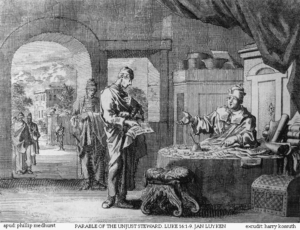
In the beginning there’s a manager who is not honest with his masters work. This manager has worked with the master for quite some time. The master knows the heart of this manager and he calls him to terms or his life is in jeopardy. This manager then becomes very intentional and thinks outside the box to fulfill his masters duties. In doing so the manager is able to correct his actions and set up his master for success. Jesus doesn’t want us to be dishonest as this manager, but wants us to see his example and be diligent and intentional about our own life in reference to what God has given us. The manager had to think outside the box because his life was in jeopardy. How many times do we have to be pushed to the edge to become intentional at our lives?

The second scenario is that of the Rich man and Lazarus. The rich man having all of the good things in life and Lazarus being poor and unable to care for himself. This parable is not a judgment on rich and poor, but the intentionally of each persons life. When the rich man is in Hades he starts to try to think outside the box to get his eternal life back on track. While he’s in Hades he tries to do several things he tries to get Lazarus to come and cool his thirst. The next thing The rich man does is try to get Lazarus to help his siblings to not make the same mistakes. So in these two scenarios the Richmond still thinks about himself and his brothers, but he’s thinking outside the box he’s thinking outside of his normal.

It is interesting in these two scenarios that the individuals knew what to do from the beginning. But they made a choice not to do the good or proper thing. Not to do these correct things or live intentionally for others. And because of those choices that they made they find themselves 1.) in fear of their earthly life; 2.) fear of their eternal life. How many times are we presented with opportunities to help or assist others? How many times are we scared or frightened because of the choices that we’ve made that have impacted us? How many times do we need to hear that our blood pressure is high before we make a change to our health? How many times do we need to be brink of diabetes before we are willing to change? How many times do we have to be presented with the loss of our family or friends before we make a change? This is the time that we need to become more intentional about our decisions and about our lives.

At the end of the chapter, one last statement from Christ about the state of affairs about intentionally. If we do not listen to the prophets and Moses, “ The Law”, how would we listen to a person who was raised from the dead? Are we hearing what Christ is telling us?

The Parable of the Lost Coin

“Or what woman, having ten silver coins, if she loses one coin, does not light a lamp and sweep the house and seek diligently until she finds it?  And when she has found it, she calls together her friends and neighbors, saying, ‘Rejoice with me, for I have found the coin that I had lost.’  Just so, I tell you, there is joy before the angels of God over one sinner who repents.”

Luke 15:8-10

Can you relate to the woman in this parable?  When have you lost something so important to you that you spent the next minutes or hours searching until it was found?? 

Oh, I can think of a few times when I was searching for something lost.  Most recently, it was my diamond wedding ring.  We were in the process of moving so I put my ring in a certain spot that I thought for sure would be safe.  Low and behold, after our move I checked all the spots where I thought I put my ring and it was NOWHERE!  You know that feeling…your heart is racing, your mind is racing, you get a little hot, and your attitude becomes strained??  I was there!  I had my husband helping me search.  Finally, I checked one last place and there it was, safe and sound.  The instant relief was amazing!!  

Just like in the parable above, after the woman finds her lost coin, she is elated.  This is not news she could keep to herself, she announces the discovery to all those around her and invites them to celebrate with her. 

In the day of this parable, women usually received ten coins as a wedding present.  Each coin held sentimental as well as monetary value, so the loss of even one was very upsetting.  The woman would have been willing to go to great lengths to find her coin.  

Jesus goes on to say that God sees every person as having great value.  The Lord feels great sadness when anyone is lost, following the ways of the world instead of Him, and longs for them to return.  

The end of the story shows the woman finding the silver after searching.  She shares her great joy with neighbors and friends.  Jesus directly compares her reaction to God and the angels rejoicing when a person repents of their sin, believes in the Son, and submits their lives to Him.  How much more valuable is a person turning towards Jesus than any monetary thing that we lose?  Jesus is shows us the rejoicing that happens when we find Him!

The Invitation

Today’s reading is Luke 14.

This passage today has me asking myself the convicting question: who are the good deeds of my faith for? Obviously when I am moved to be charitable & gracious & help those in need as Christ commands, I am moved by the Lord: but is my intention purely to glorify & magnify Him? Or deep within my heart, am I being a good Christian out of self-gratification? Or only in ways that could benefit me or reflect nicely on me? Or even done solely to please and gratify other people? In answer of these tough questions, I think of Psalm 75: “For not from the east or from the west and not from the wilderness comes lifting up, but it is God who executes judgment, putting down one and lifting up another.” Jesus’s words in these parables make me look deep inside, examine my own actions, and ask very difficult questions about what drives me, and grow more exuberant to help those in need and to grow as both man and believer.

These days, we’re stuck with a modern culture of both over- and under-investment. We all are bombarded with so many obligations and distractions it can be difficult to find the time to go out of our way to give the proper time to important matters; while on the flip-side, this makes it incredibly easy to not fully commit, instead using our plethora of options to conveniently be able to back out of things we don’t feel strongly enough about partaking in or inconvenienced by. From solely personal experience, this can happen in all sorts of people from all walks of life, but gets more common as you look at younger and younger people, who are most accustomed to this modern life of detachment. No high horse here though – it’s definitely something I’ve been guilty of, which is why this passage hits me hard. But like in many ways, what we perceive as solely modern issues have been struggled with in various ways for much longer than expected. Christ’s parable on the Great Banquet in v12-14 demonstrates this all too well – how this lack of commitment and search for ways out have been spiritual struggles since biblical times. We have been called to partake in a great celebration at God’s side, and of course we all want to partake. But have we all considered the cost of entry?

When we are loving and generous as Christians, it can’t always be convenient, or proper, or self-satisfying. It can be easy to internally rationalize away our need to act in love in difficult times, or in ways that could not possibly benefit ourself, or in ways that may just be irrational and incomprehensible from a merely earthly perspective. But Jesus very clearly explains what awaits those who won’t pay the cost to accept the reward of the Kingdom of Heaven: “For I tell you, ‘None of those men who were invited shall taste my banquet.’” Instead, in these parables, Christ encourages us to put loving those in need & growing the Kingdom of Heaven above our own selfish pursuits, or earthly gain, and even our loved ones. Not that enriching things such as self-growth, hard work, and family are at all evil or detestable – but that we must not put them before God, as if to hate them in comparison.

Especially important to me is the Parable of the Wedding Feast in v.7-11. Jesus calls us to humble ourselves so that we may be exalted when the time of the Feast arrives. Who better to command this than Jesus! Phillipians 2:5-8 tells us this: “Have this mind among yourselves, which is yours in Christ Jesus, who, though He was in the form of God, did not count equality with God a thing to be grasped, but emptied Himself, by taking the form of a servant, being born in the likeness of men. And being found in human form, He humbled himself by becoming obedient to the point of death, even death on a cross.” Our Lord and Savior acts as the ultimate example of humble love, giving everything He had to bring others to God and display His love. This selfless display embodies humility, love, and honor. This is the important essence of accepting lower and lesser positions of honor and celebration in various regards of life: not so we can grovel or gain pity at our own lot in life, but in how we could share in what we’ve been blessed with alongside those whom we’ve been humbled enough to serve as Christ might.

It warms my heart to see frequent examples of Christians embodying true Gospel love. Through giving above & beyond, spending their time feeding & caring after the poor, traveling far across the globe to lend a hand and the good news of Jesus to those with far less than us, even showing love & forgiveness to others expecting no reward or reciprocation. I thank the Lord for how he moves His followers to humble themselves to exalt Him, and pray He would continue to do so through the actions of each of us. I pray that I could lower myself to aid those who need it more so every day, in the hopes that His name would be raised & praised in the process. And I pray the same for all of us; that we may lower our own needs to put His call & His invitation above any other priority.

Confession and Repentance

Today’s reading is Luke 13.

How would you rank yourself on your spiritual discipline of confession? I think both individuals and churches often may be extreme in one way or another around the focus of confession and the fact we are all sinners (Romans 3:23). Often times we can have lots of confession and focus on all our wrong doings and forget that because of the cleansing blood of Christ we are no longer in darkness and can live life forgiven with peace and joy (1 John 1:7). I’ve said this before in prior posts, but Jesus was not just nailed to the cross just to forgive our sins..the story doesn’t end there. He was resurrected on Easter so that we might live life to the fullest knowing that we are no longer dead to our sin. Jesus says Himself in John 10:10 that He came to give us life! He’s not still nailed on the cross so let’s not live like it. However, just confessing our sins regularly and knowing we are forgiven does not give us permission to keep on sinning over and over either..more to come on this. Lastly, in my humble opinion, many individuals and churches talk about of the saving grace of Jesus, but have lost emphasis on the spiritual discipline of confession where we specifically name our known sins and ask for forgiveness of sins both known and unknown.

It is crazy how God works because this topic is something that has been on my mind for the past few months and wouldn’t you know it….my assigned verses and this week’s sermon in church were on this very topic. In Luke 13:1-5, Jesus emphasizes the importance of repentance because without it we will all die and are going to the same place because we are ALL sinners (Romans 6:23). He also makes it clear that when bad things happen to us, God does not make it happen as a punishment for our sins. This is another topic in and of itself..see John 9:2-3 and Romans 8:1. But back to repentance which is from the Greek word matonia. It doesn’t just mean confession. It means a change in one’s life…to go in the other opposite direction of sin and go towards God. Jesus is telling us it is not ok for us to just go on living life in a sinful way because we know we are forgiven. Changing how we live is critical part of being a Christ follower. 1 John 1:6 says that if have fellowship with Him while still walking in the darkness we are lying and don’t practice the truth. Does that mean we will not sin when we are a Christ-follower? No..we are human and will mess up again, but we should be able to proclaim that we are working on it. 1 John 3:6 tells us that no one who abides in Him keeps on sinning because they know they will be forgiven anyway.

So, can we call ourselves a Christ follower without the spiritual habit or discipline of confession? Can we go to Heaven without confessing our sins? 1 John 1:8 says, “If we say we have no sin, we deceive ourselves and the truth is not in us.” Again in 1 John 1:10, “If we say we have not sinned, we make Him a liar, and His word is not in us.” In between these verses, John talks about the importance of confession for forgiveness in 1 John 1:9, “If we confess our sins, He is faithful and just to forgive us our sins and to cleanse us from all unrighteousness.” I raise the prior questions not to get into a debate, but rather to emphasize that I believe God calls us in his Word to confess our sins. If we do not, we are likely being untruthful with ourselves about our sin problem and need for Jesus’ saving grace on the cross. It doesn’t seem to me that one can call himself or herself a Christ follower without confessing that one is a sinner themselves and the need for Him as their savior. My understanding of the Gospel is that coming to this realization, asking for forgiveness for all sins (even once), and believing in Him is the ticket to Heaven. At the same time, I believe the spiritual habit of confessing our sins and naming those we are aware of individually through calling them out in prayer is what will truly help us change the way we live and the direction of our lives as Jesus speaks of through the Greek word matonia. This is tough at times, but we know that God knows anyway, and I believe our sins continue to erode us and bother us when we don’t  name them. Naming our sins in prayer to Him will bring them to light, make us feel better, and also increase the likelihood of changing the way we live in the way He calls us.

Lastly, what about those who are not a Christ follower yet and have not prayed to Jesus asking for forgiveness and His grace? Well, it is interesting that immediately after Luke 13:1-5 where Jesus speaks on the importance of repentance, He then tells a parable in Luke 13:6-9 about a fig tree not yielding fruit. However, the vine dresser gave it multiple years and chances to yield fruit before finally cutting it down.  We all will eventually perish as Jesus speaks of in Luke 13:1-5, and He we won’t have forever, but He gives us time to turn to Him and His open loving and forgiving arms.

Let each us reflect on where we are on our walk with Him and whether confession, repentance, or both is something we need to work on. Let us know we are all a work in progress as we try to grow closer to Him. But above all, let us go with peace and joy today knowing that God did not send his One and Only Son to condemn the world, but so that the world may be saved through Him (John 3:17).

Money, Money, Money

Today’s reading is Luke 12

In Luke 12, Jesus spends most of His time teaching about the use and value of money. This is not surprising when we think about the fact that every day we make decisions that require the use of money. Look at your day…watch how many times you mindlessly swipe your credit card, write a check, transfer funds for a bill payment, order amazon, pick up lunch while you are out, fill your gas tank, stop at the grocery store. The list is long for ways we spend money daily and it doesn’t even include the big stuff of life that we plan for and stew over for weeks months or years before purchasing- houses, cars, kids college, retirement, vacation, a new roof, appliances…you get the picture. My guess is that some of us feel nervous and anxious just reading through the list. There is always something in life that we are stressing over because we don’t have the money that it takes to accomplish it, we haven’t saved what we had planned to save for a given event, or an emergency took funds that were allocated for another need. We need money on a daily basis and we spend a lot of our thought time trying to figure out how to make our money stretch to meet all of our needs and some of our wants. No wonder Jesus spends so many verses talking about money and trying to help us understand how we should be thinking about it.

Vs 6-“What is the price of five sparrows-two copper coins? Yet God doesn’t forget a single one of them. And the very hairs on your head are all numbered So don’t be afraid; you are more valuable to God than a whole flock of sparrows.”

Vs 15-“Beware! Guard against every kind of greed. Life is not measured by how much you own.”

Vs 21- “A person is a fool to store up earthly wealth but not have a rich relationship with God.”

Vs 22-“I tell you not to worry about everyday life-whether you have enough food to eat or enough clothes to wear.” (vs 25) “Can all your worries add a single moment to your life? (vs 26) If worry can’t accomplish a little thing like today’s food or clothing, what’s the use of worrying over bigger things?”

Vs 28-“If God cares so wonderfully for the flowers that are here today and thrown in the fire tomorrow, he will certainly care for you. Why do you have so little faith?”

Vs 29-“Don’t worry about what you will eat or drink, your Father already knows your needs. Seek the kingdom of God above all else, and he will give you everything you need.”

Vs 32-“So don’t be afraid, little flock. For it gives your Father great happiness to give you the kingdom.”

Vs 33-“Sell your possessions and give to those in need. This will store up treasure for you in heaven! And the purses of heaven never get old or develop holes. Your treasure will be safe; no thief can steal it and no moth can destroy it.”

Vs 34-“Whereever your treasure is, there the desires of your heart will also be.”

Vs 48-“When someone has been given much, much will be required in return; and when someone has been entrusted with much, even more will be required.”


Quite a few of these statements of Jesus are contrary to what our culture and times would advise. Some don’t even make sense on this earth. Jesus is trying again though His teachings on money to help us see that this earth is not our home. Our goal should not be to live our best and most fulfilling lives…our goal and focus needs to be on God and His framework for this “mist” of a life on earth so we can properly prepare for eternity in heaven with Him.


So let’s take a few more minutes to read back through Jesus’ words printed above and look at them with a heavenly lens instead of our default earthly lens.

The Lord’s Prayer

Luke 11

If you grew up around the church, you learned the Lord’s prayer.  Not only did we recite it in every service, but it was also a song.  Now, the good part about that is I know it by heart.  So do you.  The only time I get in trouble is when I go to a different church.  I never know if they have trespasses or debts.  It gets me every time!

Did you know that’s what happens when you memorize like that?  I get so worried about which “right” word to use that I forget all about what the words actually mean.  In Luke 11, I think Jesus is far less concerned about the actual words and far more worried about what they mean.  Let’s slow down for a moment, and consider how this perfect prayer is constructed.

Father, Hallowed be your name

This first line is about who God is.  First, he is our Father.  Thinking deeper into that, we know that he is our creator.  In fact, he is not just my creator, but the creator of the universe.  He is the Father of all things.

Now, Father is a common name for us but God, our Father, is anything but common.  That is why we use the specialest of all special words Hallowed.  To be hallowed is to be truly set apart.  Yes, it is about being revered and honored, but it is more.  It carries with it holiness and consecrated.  Perfection in one word.  I think it is fitting.  It is only God that gets this title.

Your kingdom come, Your will be done

This is a statement of hope and our deepest desire.  It asks him to bring the perfect righteousness of his kingdom, right here, right now.  To make such a request requires humility and surrender.  You see, when we ask for God’s kingdom to come, we are confessing that it is better than our own.  Additionally, we are asking that His will reigns supreme over us.  That means that my kingdom and my wants are not just secondary to his, they are irrelevant to his.

Give us each day, our daily bread

A simple request for provision.  I need to be reminded that it is a request, one day at a time.  It’s not about provision for the year, or for retirement, just today.  Then, of course, it’s bread.  Why not steak?  I mean, if you are going to ask, then go big, right?  This simple request leaves the provision up to God.  If he wants to give you more, he can.  We, however, will be content today, with the simplest of God’s provision.

And forgive us our sins

This line puts us squarely in the jaws of grace.  It is a reminder that we are less than perfect.  We have fallen well short of God’s expectations.  It is also our confession that we do no measure up and have no means of payment.

For we forgive everyone who is indebted to us

Fittingly, this falls after our request for forgiveness.  For me, it is a fitting reminder that if I am to receive God’s grace, I must also extend grace to those around me.

And lead us not into temptation, but deliver us from evil

This last line acknowledges our humanity.  We know that in the moment, we will make poor choices.  We also know that God is a great protector.  He can, and in fact, promises to deliver us when temptation and evil show up (1 Corinthians 10:13).

For thine is the kingdom and the power and the glory forever, and ever

Sorry, that line doesn’t exist in the Bible.  I don’t know when or who added it but it is a fitting and dramatic ending for the song, leaving my heart right where it needs to be with God at the center.

A Good Samaritan…Without Expectations

In around 2012, I was walking from my hotel to my company’s office building in downtown San Francisco.  I remember the day vividly. It was a crisp morning, and the sun was shining. It was a beautiful day. I was feeling great.  My confidence was high.  I was at a good place in my life professionally, but I will admit that my relationship with Christ was not at a place of strength.  I was a believer but not living it.

My post is a little longer today, but I would like to share my journey with you.  I hope you will stick with me and read until the end.

As I walked down the sidewalk, I encountered morning commuters. People were walking with purpose.  They had a place to be, and they were rushing to get there.  It was a typical San Francisco street that was a bustling with lots of people.  In addition, I saw many homeless people, most sitting along the sidewalk asking for food or money.  My memory is that no one was stopping to help them out, including me. None of the homeless approached me but I tend to look at people in the face to acknowledge them.  Perhaps it’s how I was raised or maybe my Midwest upbringing, but a “Good morning” or a head nod to acknowledge a person was my typical pattern.  I have done this throughout my life, in small towns, major cities, or just walking in my neighborhood.

As I continued to my destination, I could see a homeless man walking down the sidewalk towards me.  I was quickly studying him.  His head was down. He had no bags or possessions, only the clothes on his back.  He was dirty. He had way more clothes on than the weather that day required.  I remember doing a quick assessment and what flashed through my mind was, “he is completely broken.” As we walked past each other, we locked eyes.  I didn’t say anything.  I made a facial gesture, something like a half-smile, a head nod, to acknowledge him.

The next twenty seconds are forever ingrained in my memory.  He spun around as my back was to him and he began to shout at me.  “What are you looking at? Do you think you are better than me?  Don’t you look at me? Don’t you ever look at me!”

Keep in mind, there are hundreds of people around us, and a man I don’t know, is screaming at me on the sidewalk.  My confident swagger then turned to nervousness, embarrassment, discomfort, and ultimately, I fled from the situation.  I don’t recall what else he said from that point, as he continued to yell, but I hurried from the scene with a much brisker walk to my destination.

From that moment, I would say I became somewhat afraid or intimidated by homeless people.  We live in the Washington DC area and encounter the homeless frequently.  We see them on sidewalks or begging for money at stoplights.  “Don’t give them money.  They will just buy drugs or alcohol.”  “Have you seen the news coverage of people who say they are homeless and then they walk over to their nice car and drive away?”

All these negative thoughts went through my mind for years as I would be confronted with people in need. I made many excuses why I should not engage the homeless, and shamefully, I did not give money or acknowledge the homeless for years.

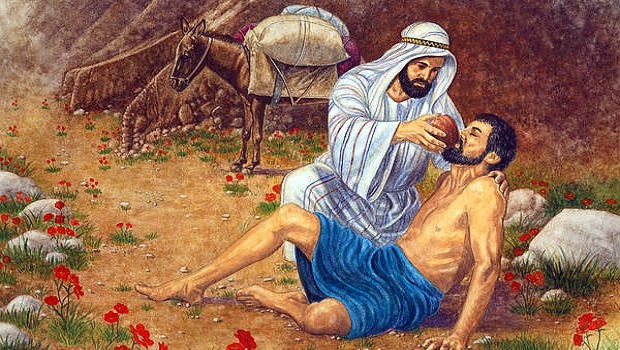
Today’s reading is Luke chapter 10.  Verses 25 to 37 are the famous Parable of the Good Samaritan.  In case you have not read it, here’s the summary.  Jesus said, a man was walking between two cities, he was robbed, beaten, “leaving him half dead.”  A priest saw him and “he passed by on the other side.” A Levite saw him and “he passed by on the other side.” Then, a good Samaritan came to where the man was, “when he saw him, he had compassion.” He “bandaged his wounds,” and “brought him to an inn and took care of him.” When the good Samaritan left the inn, he gave the innkeeper money and said to him, “Take care of him; and whatever more you spend, when I come again, I will repay you.”

God has been working on me the past few years.  I have had numerous Bible studies, sermons, podcasts, and conversations where helping homeless people has been on my heart.  I have not known what to do with these “voices.”  Is this God speaking to me?  Is this what it is like when the Holy Spirit is “talking to me” or influencing me?

A couple months ago, my family and I were driving near the city, waiting in line at a stop light.  There was a man sitting on the side of the road, begging for money.  He was smiling, looking people in the eye, and wishing them to “have a great day.”  He appeared to be homeless, he was very dirty, had tattered clothes and there was a bag of what looked like his possessions behind him.  In that moment, I felt compelled to help him.  I rolled down my window, he approached.  I cannot recall exactly what he said but he gave me a pleasant greeting.  I was nervous and wanted to hurry through the encounter.  Get it over with and move on. I handed him money and the first thing that came to mind was, “what is his name?” “Sir, I hope this helps.  I will pray for you and hope that your situation gets better.  Don’t give up.  Pray to God for strength and He will help you. What is your name?”  He looked me in the eyes and said, “Thank you.  I really appreciate that. My name is Peter.”

A couple weeks later, we are in the car at a different stop light.  I see another man begging for money.  I reached for a few dollars, not thinking about what the man will do with the money, but that he is asking for help.  “Sir, here is some money, I hope this helps you.  I will pray for you.  What is your name?” He responded, “Thank you for asking, sir, my name is Matt.”

To say I am ashamed is an understatement.   For years, I have turned my back on God’s children in need.  Who am I to judge what they will do with what I give them?  Yes, many homeless are addicts and some have a mental illness.  Bottom line is they are in need and asking for help.  Period.  Jesus tells us in Matthew 22:37-39, “You shall love the Lord your God with all your heart, with all your soul, and with all your mind. This is the first and great commandment. And the second is like it: You shall love your neighbor as yourself.”

Is it a coincidence that the names of the first two homeless people I helped had names of Jesus’ disciples?  Yes, Peter and Matthew were two of Jesus’ closest confidants throughout his three years of ministry on earth.

My prayer is that you hear my journey of fear and selfishness and, perhaps, it stirs emotion in you to help others.  I pray that we all look our fellow man in the eye, with compassion, reserving judgement and negative thoughts.  Every person has a story, good or bad, about the journey that life has taken them on.  Every soul is worth saving and every heart is worth healing as we are all God’s children.  The most powerful force that saves people’s lives and brings about everlasting change is having a relationship with Jesus, our Lord and Savior.  Bring words of hope, peace, and comfort to those in need.  They may not acknowledge you, respond with the perfect comment to you in the moment, or even seem thankful for your generosity.  Should we only give to others if they seem to appreciate it?

Jesus suffered and died on the cross for us, all the while knowing His fellow man, the very people He was dying for, would turn on Him and sentence Him to a terrible death.  Moving forward, I think I can muster the courage to give and not expect anything in return.  That is what Jesus did.  I will give freely to God’s children and not expect anything in return.

Photo Credit:  Orthodox Christian Network