Our Lifesaver

Today’s reading is Daniel 1.

King Nebuchadnezzar, leader of the Babylonians, took over Jerusalem and ruled the Jews. He asked his chief eunuch to bring in some of the sharpest Jewish youths to come and learn in order to teach them the language of the Chaldeans. They also must eat the king’s food which was different than the diet of the Jews and eating it would defile them. But, Daniel said he would not eat the food and defile himself leading Shadrach, Meshach, and Abednego to follow suit. Daniel even suggested that they test their diet by comparing them to others who ate the king’s diet and after 10 days, Daniel and his friends were healthier. Not only did the stewards of the king then let them eat their own diet, but when they were put in front of the king in Daniel 1:20, the king noticed they had much better wisdom and understanding than his own magicians and enchanters.

A while ago a brother in Christ shared with me a story about when he was in high school. He was a good athlete, popular, and known to be a Christ-follower and someone who although not perfect, stuck to his values and generally did the right thing. A group of peers, and one peer in particular, kept trying to get him to do something high school kids often do but that he did not. He stood his ground saying no many times, but then finally gave in agreeing to partake. Jesus says in Matthew 26:41, “The spirit indeed is willing, but the flesh is weak.” I could have used one of many examples of my own missteps and mistakes, but this story is especially insightful. The one peer who was always trying to persuade him to take part admitted that he was not only surprised, but actually was disappointed that this individual finally gave in. You see, even those that try to persuade us to do bad things often secretly want us to stand our ground. Even though they will typically never admit it, not only do they respect us for doing the right thing, but they secretly want us to continue to do the right thing because they want to believe that good still exists. This inspires them to want to do better and believe that they too can do the right thing when faced with temptation. They may not come around at the time, but just like King Nebuchadnezzar who later came around and gave glory to God after God protected Daniel’s friends in the fiery furnace, they may too in the future as a result of your actions today. St. Francis of Assisi is generally given credit to saying, “Preach the Gospel, and if necessary, use words.” Others must see the truth and good that exists through the Holy Spirit and Jesus living in and through us.

We will, however, mess up. Thankfully, that’s when we have our greatest opportunity to speak the Gospel. Romans 3:23 says, “for all have sinned and fall short of the glory of God.” He’s our lifesaver. We humble ourselves before God and others to let Him and them know we are not perfect and are in need of a savior. We can let them know we are saved and forgiven by His grace alone through his death on the cross. And we too will live, just as He lives through His resurrection on Easter. They can do the same…all they have to do is ask and believe. Just grab the ultimate lifesaver right there within arm’s reach. Is it that simple? Yes..it’s that simple.


Dry Bones


Ezekiel 37

In the last week or so we have been looking at several of the prophets that God used over 300-400 years to call out to Israel and Judah. He wanted relationship with them so badly and they continued generation after generation to turn their backs on Him by putting other god’s before Him and choosing to disobey Him. At the time of Ezekiel, Judah and thousands of others had been deported to Babylon when their king surrendered to the leadership of Babylon because they couldn’t fight them any longer. (God would have protected them and kept them safe as a country if they would have followed His plan, but they chose their selfish ways instead of His and landed themselves in exile in another country.) God used Ezekiel as a watchman to warn the people of Judah to turn to God as they were living in captivity. His message was that God expected personal obedience and worship from each of them no matter their circumstances.

As I have read through the prophets this time I have developed a deep sympathy for them in the work God assigned to them. They spent their lives preaching to people who were not interested in their message.  Their job was vitally important and necessary in God’s plan, but in the world I think they just appeared crazy. When I picture Ezekiel calling out to people on the streets, or meeting with groups to deliver God’s message, the picture that comes to my mind is the guy in a crowded city or on a college campus who is yelling out his message to a bunch of people who are maybe a bit afraid of him, or who are wondering if he is mentally stable, or at the very least feeling uncomfortable as they pass by.  How do you stay motivated to get up every day and stay at the work at hand when you are mocked, ignored, and pushed aside every time you speak? I hope that my perception of what it must have been like for Ezekiel is wrong, but after reading chapter 37 and seeing Ezekiel’s personal encounter with God, I’m pretty confident that Ezekiel’s job felt like a steep uphill climb, daily!

So three quarters of the book of Ezekiel is God’s message to Judah while in captivity. The entire book is filled with God’s words that Ezekiel speaks to the people of Judah over years of time, until chapter 37 hits. In this chapter Ezekiel reports the events of the vision God gives to him one day. The first verse, “The Lord took hold of me, and I was carried away by the spirit of the Lord to a valley filled with bones.” The bones were scattered out all over the ground and dried out completely. God asked Ezekiel if these bones can become living people again. Wisely, Ezekiel answers that God alone knows the answer to that question. So God has Ezekiel prophecy to the bones that He will put breath into them and make them live again. He will put flesh and muscle over them and cover them with skin and they will come to life. So Ezekiel obeys. As he speaks there is a rattling noise all across the valley and the bones gather themselves into complete skeletons and as he watched, muscle and flesh formed over the bodies but they still had no breath in them. So God again told Ezekiel to prophesy over the bodies. As he did, breath came into their bodies and they all came to life and stood to their feet. Then God told Ezekiel that the bones represent the people of Israel, old dry bones…all hope gone. God told Ezekiel to prophecy to the people anyway and tell them that He will open the graves of exile, cause them to rise again, and then He will bring them out of exile back to the land of Israel. When this happens they will know that He is the Lord and He has done what He said He would do.

God reached out to Ezekiel to encourage him and give him new urgency and motivation to share God’s message. Ezekiel had been sharing God’s word for years with no fruit, no change in the people, and no hope for change.  (Frankly, I would have given up!)  God knew that this message needed to land in some hearts so He could accomplish His plan for bringing Jesus to the earth in a family from the line of David. God needed Ezekiel to stay faithful in a steep uphill climb so that Israel and Judah could be reunited and He could live among His people again.

This morning, can you see encouragement from God anywhere in your life to stay at something that feels hard but needs to be done?

Bold prophecies

The Lord instructed Ezekiel to draw a picture of Jerusalem on a clay tablet and to stage a miniature siege of the city, complete with siege ramps, enemy camps, and battering rams. The prophet was also to place an iron pan between himself and the city. This action perhaps illustrated the unbreakable nature of the siege or represented the barrier between God and His sinful people.

God also instructed Ezekiel to symbolically bear the punishment of Israel. He was to lie on his left side for 390 days, corresponding to the years of the Northern Kingdom’s punishment. He was then to lie on his right side for 40 days, corresponding to the years of Judah’s punishment.

At the Lord’s command Ezekiel made bread from various grains and stored it in a jar. During the 390-day period he was to eat a daily portion of eight ounces of bread, supplemented by two-thirds of a quart of water. This restricted diet would symbolize the food rationing that would be necessary during the coming siege of Jerusalem. The Lord also told Ezekiel to cook his bread over a fire fueled by human excrement. Though the Old Testament law does not specifically prohibit this, it does suggest it would be regarded as unclean (Duet. 23;12-14). Ezekiel’s action would portray Judah’s spiritual uncleanness and the plight of the exiles, who would be forced to eat food in an unclean foreign land. When Ezekiel objected that he had always kept himself ceremonially pure, the Lord allowed him to use cow manure as fuel.

Applying this prophecy to my daily walk with the Lord, and putting something into words to share with you this morning was a challenge. What meaning do these prophecies have in our lives here and now? Probably more than my feeble mind can comprehend 🙂 Today though, my takeaway is this: How many of us would be willing to so dramatically portray the sins of our nation?

I need to pray for greater boldness in my witness for the Lord.


Dangerous Calling

Ezekiel 2-3

I don’t have much understanding of prophets.  They are far too mystical for me to understand.  Most of the time, I think of crystal balls, tarot cards and Ouija boards.  In our culture, these things are shrouded in secrecy and darkness.  There are at least two reasons I do not go near them or the people that interpret them. The first is skepticism.  What makes them so important that they can see the future?  If I could get over my skepticism, I would be confronted with fear.  You see, when our future is predicted, our sense of control disappears.  We must endure the future without choices.  I have to consider the pain and suffering that will come along with it.  It’s hopeless.  I want nothing to do with it!

My definition of prophets helps me.  Wait a minute. Maybe that’s not the right way to say it.  My perspective of prophets might be preventing me from fully realizing my calling as a Christ-follower.  How does that work?  Read through God’s calling in Ezekiel 2:3.  It reads, “And he said to me, ‘Son of man, I send you to the people of Israel, to nations of rebels, who have rebelled against me. They and their fathers have transgressed against me to this very day.”  God wants Ezekiel to rebuke them.  Now, imagine that God said that to you.  I’m guessing that your response is similar to mine.  “No, way!”  Why not?  Because my reputation, my friendships and my very life are at stake.  What will people think of me when they hear me talking like that?  Guess what?  It doesn’t matter.  God continues with Ezekiel saying, “whether they hear or refuse to hear” Ezekiel 3:11 (ESV).  These words are important to us because I believe that God may be calling us to be prophets.

No, God may not endow us with powers like Elijah or the ability to determine future events.  We need to think about prophets differently.  I would like to share something I learned from A.W. Tozer.  He helps me fix my picture of prophets and how we fit in.  In his book Tozer on Christian Leadership,  he describes today’s prophet as someone who interprets the present.  This calling requires discernment to understand current events and the ability to translate God’s position on them.  Unfortunately, I think most Christians cut ourselves short.  God may be wanting to bestow this gift of prophecy on us, but our refusal to surrender to Him inhibits the spirit from working.  What would it look like if we fully sought him and surrendered?   Maybe, you are like me, worried that He might call you to be something more.

It’s time to retire my old definition of prophet and replace it with God’s truth. Jesus Christ does not remove control from me.  He restores control to me.  Because of Jesus’ sacrifice, my future is secure. Abundance, peace and love are mine.  Forever and always.  If you believe that, it is worth considering what a prophet looks like.  I’m sure that we have been given the command, just as Ezekiel was given the command.

Go therefore and make disciples of all nations, baptizing them in the name of the Father and of the Son and of the Holy Spirit, 20 teaching them to observe all that I have commanded you. And behold, I am with you always, to the end of the age.”  Matthew 28:19-20 (ESV)


Show me Your Glory

A few years ago I was part of a women’s bible study called Seamless. This study guides you through the entire Bible, start to finish, showing the connections of God’s plan for us, from Creation to Jesus, to the Early Church, and everything in between. It showed the seamlessness of the Bible, and how it all fits together when you look at the bigger plan of salvation. I absolutely LOVED this study! For so many years I felt like the Old Testament was a bunch of separate Sunday School stories that were anything but seamless. I didn’t understand the timelines or eras, and while I knew some of the main characters and plots, I didn’t have it “mapped out” and how it all points to Jesus.

In the last month of Bible Journal entries we have moved from Kings to Prophets. Thanks for following along with us as we uncover these early leaders in the Old Testament. If you take a step back, you can see that God’s people have been led by Priests, Judges, Kings, and Prophets, each role spanning different time periods and for different reasons. God used the prophets to guide His people back to him. Stick with us – it really does all come together and point to Jesus!

Today I get to introduce you to Ezekiel. He (and other Israelites) have been living in exile for five years in Babylon, at the hand of King Jehoiachin. The next few days we will cover more scripture from Ezekiel – and heads up, it gets pretty interesting.

Chapter 1 he leads right off with a vision that God gave him, of the glory of God. Take a few minutes and read it. Do you need a pen and paper to draw out what he is describing, to keep it all straight? All the features, and body parts and animals? I’m not a bible scholar or dream interpreter…and it’s hard to know what to make of all of this! I read this several times and I thought and prayed… Okay Lord, what do you want me to learn from this?

I’d truly be guessing if I tried to share some big theological explanation of what his vision could symbolize and mean. When I was studying and digging deeper into this chapter, I found a lot of smart opinions and guesses out there. If you’re into that kind of stuff, your bible may have a lot of cool footnotes, or google and dig around the web. When I did an image search for ‘Ezekiel 1 Vision Picture of God’s Glory’ it was crazy to see all of the different ways artists interpreted Ezekiel’s description – the picture in my mind was completely different! I also found it fascinating how one source compared verse ten’s four faces (man, lion, ox, eagle) to Jesus. Jesus is fully man, he is king and victorious like a lion, he is a servant and sacrifice like an ox, and he transcends and is spiritually sovereign like the eagle. Chapters like this leave me curious and hungry to understand more – heaven, come quick!

There were also two things I learned about Ezekiel that really encouraged me:

First, Ezekiel is BOLD. And like I said – STAY TUNED – there’s more coming. He’s clearly being directed by the Lord, and has no qualms about telling the Israelites every detail of what he just saw. They’re living in exile, and God is using Ezekiel to share His message with His people. What message does God have for you to share? Maybe it’s not an indescribable being from a vision, maybe it’s your own life experiences. Maybe it’s not a message for a people group living in exile.. maybe it’s something God has for you to share with your family, a group of teens at your church, or some co-workers. I’m encouraged to be BOLD, even at the risk of sounding a little loony.

Second, Ezekiel is reverent. Verse 28 tells us that when he sees all of this he falls on his face. He didn’t run and hide in fear. He didn’t look the creature in the eye or give him a high five. He went to the ground, face down, to show his humility, awe, worship, and adoration. Have you had those fall to your knees or go face down moments in your faith journey? Those deeply spiritual moments you can always go back to, that can draw your heart to worship and praise? Whether the circumstances were tragic or triumphant – your only response was one of complete surrender?

I can go back to some of those moments in time in my life, like when I first made a commitment to follow Christ, or when my daughter came out of spinal cord surgery at five and a half months old. Remembering and reliving those moments of complete praise and surrender draw my heart closer to the Lord.  Third Day has a song called Show Me Your Glory, and I love this part of the chorus:

Show me your glory
Send down your presence
I wanna see your face
Show me your glory
Majesty shines about you
I can’t go on with you Lord

We don’t have to wait for heaven to experience the glory of God – what a gift! Let’s ask God to help us see His glory today!

Fallen Fortress

There are two very heavy vehicle-sized doors made of iron at the entrance of our driveway and a very tall fence around the perimeter of our multi-family dwelling. The only way in is through the doors or climbing the fence so it feels relatively secure.

Unfortunately this week our “fortress” was proven to be weaker than we had thought. While leaving for work one morning, I discovered someone had “keyed” the side of my car. Why… how… who…? I have no idea… After the initial shock and disgust there were many other feelings. I was a victim to a crime which led me to feel powerless, betrayed and violated, with no one to rescue me.

What if (hypothetically) in this scenario I had a brother who was aware of the crime taking place? And in this crime my brother not only sat idle and did nothing, but then proceeded to help the criminal destroy my vehicle and then insult me after doing so?

That’s pretty much what happened in Obadiah 1.

The people of Judah (their brothers) were being attacked and not only did the Edomites sit idle, they helped the attackers! Imagine first the feeling of “being attacked” then imagine your brother (or someone who should help you) helping the attackers complete the job, then laughing in your face, pillaging and plundering your belongings.

In the end, God was furious with the Edomites (the house of Esau) for their pride, greed, violence and betrayal. God made it clear that they would pay dearly.

 For the day of the Lord is near upon all the nations.
As you have done, it shall be done to you;
  your deeds shall return on your own head. (Obadiah 1:15)

As always I look for Jesus in the story. We betrayed him. We spit upon him, denied him and murdered him therefore we deserve the same fate as the Edomites. We betrayed God’s chosen one and we continue to betray him through our sin.

Unlike the Edomites, we can look to the one we betrayed for redemption. Even though we are guilty of putting him on the cross through our sin, he does something what no other “god” can do: Jesus forgives us even though we do not deserve it, then he offers us an eternal place with him in Heaven.

Mercy and grace and an eternal home in a place with no sadness in exchange for our hearts. Deal.

In him we have redemption through his blood, the forgiveness of our trespasses, according to the riches of his grace (Ephesians 1:7)

Tears

Today’s reading:  Lamentation 3

Do you cry often?  I find that very few things actually bring me to tears.  It isn’t that I have a heart of stone or am completely uncaring, it is just that crying is honestly not a usual behavior for me.  I think it’s how I’m wired.  There are a few things, however, that evoke an unusual emotion from me.  In response to these topics, my threshold for tears is often pretty short.


  • My family – reflecting on how God has been faithful to provide for my grandparents/parents/BJ and I over the years, sharing the struggles of my teenage children, or doing my best to turn the other cheek when someone has wronged the ones I love will bring me to tears almost every time.
  • Perpetual frustration – when someone or something frustrates me time, after time, after time, I will sometimes hit a point where I’ve just had enough.  One small, relatively benign, encounter might push me over the edge and leave me in tears.
  • The saving grace of Jesus Christ – listening to testimonies of people who’ve reached the end of their rope, have finally laid their burdens at the cross of Jesus Christ, and accepted him as Savior and Lord also stirs my heart.  It isn’t uncommon for me to get choked up on baptism Sunday.


Our text today has us in the book of Lamentations, often called the book of tears.  Jeremiah wrote this dirge to mourn the fallen city of Jerusalem.   God warned his people that he would bring destruction if they abandoned him.  It wasn’t until after the Babylonians had destroyed the temple, overthrown the king, and sent them into exile, did God’s people realize their situation and confess their sin.  Jeremiah was moved to tears because of his love for God and his people.


Fortunately, our assigned reading for today is Lamentations chapter 3.  Midway through the chapter, the song turns from suffering and sorrow to hope.  Although God temporarily turned away from his people because of their sin, he was still their hope for restoration.


But this I call to mind, and therefore I have hope: The steadfast love of the Lord never ceases; his mercies never come to an end; they are new every morning; great is your faithfulness. “The Lord is my portion,” says my soul, “therefore I will hope in him” (Lamentations 3:21-24).


So I ask you again, what makes you cry?  Like Jeremiah, is your hope truly in the Lord?  I don’t know about you, but it seems like I’m reminded of my inadequacies almost daily.   Thankfully, I have a new opportunity to put my trust and hope in the Lord EVERY SINGLE DAY.  God does not give up on me.  He is still my only hope for restoration.


Thank you Lord for being faithful, for loving me, and for giving me new mercies every day.

Debating God

Today’s reading is Habukkuk 1.

Habakkuk was a prophet of the Lord who was struggling with God’s plan. Instead of running from God he shared his concerns very vocally with the Almighty.  He was willing to ask hard questions and wait for a response.  In Habakkuk 1:5 God responded, “Look at the nations and be amazed! Watch and be astounded at what I will do! For I am doing something in your own day, something you wouldn’t believe even if someone told you about it.” God then goes on to tell Habakkuk about the Babylonians and how he will use them to bring about His plan. This is still a concern for Habukkuk and he continues to debate God’s actions. And God responds again to his questioning with plans that are far beyond what he could hope or imagine.

In the end, Habakkuk is brought to greater faith in the Almighty and he puts his trust in God’s plans. When you are upset with the way God is moving in your life do you let it pull you away or do you dig in to your faith?

Practice personalizing Habakkuk 1:5 in times of questioning God’s actions.

“I will look at the nations and be amazed! I will watch and be astounded at what you will do! For you are doing something in my day, something I wouldn’t believe even if someone told me about it.”

God’s ways are not our ways….but prayer (and sometimes prayerful debate) brings us closer to the heart of God and His plans. It increases our faith.

Habakkuk 3:17 “Even though the fig trees have no blossoms, and there are no grapes on the vine; even though the olive crop fails, and the fields lie empty and barren; even though the flocks die in the fields, and the cattle barns are empty, yet I will rejoice in the Lord! I will be joyful in the God of my salvation. The sovereign Lord is my strength! He will make me as surefooted as a deer and bring me safely over the mountains.”.

Shelly

Speaking Up

Just this last week at school (principal at K-5 building)  I had an opportunity to talk with some students and their families about the many decisions they have the opportunity to make daily.  When talking to these students and their families I referred to 1 or more of Paul’s characteristics of the fruit of the spirit in Galatians 5. That in acting out of love, joy, peace, patience, kindness, faithfulness, gentleness, and self-control there are many more chances to experience joy.  Just like these children’s decisions we equally get to make daily choices. Often our decisions are based on our own self-serving attitude, and at times they can come from pressures of the world or others.  Prayerfully,  our decisions can be given to God and model Godly obedience.

Today, in Jeremiah 38 there are a few decisions being made by multiple people.  Each of these decisions can fall into one of the above categories.  Let’s look at who they were and where their faith was.

Princes and King – Even though just a chapter earlier, (37:21) King Zedekiah was listening to Jeremiah, now the king had the attention of these princes. (38:4-5) In these verses the king had told them he didn’t have any control of Jeremiah, that they could do what they will.  The princes were listening to the voices of the people of Judah, believing that the words from Jeremiah were weakening their armies. The princes were eventually given the ok by the king to put Jeremiah into a cistern to die. People pleasers.

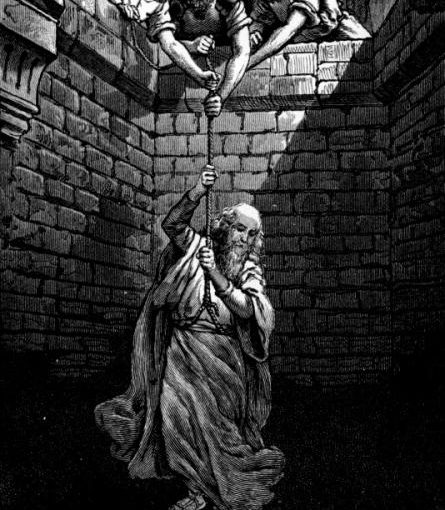
Ebed-melech the Ethiopian – God uses us in many ways.  Ebed-melech showed his faith in various forms here. First in going to speak with the king about saving Jeremiah.  Then convincing his friends to help him pull out Jeremiah. He even thought to get extra padding for the ropes to hurting Jeremiah.  He feared God more than the people.  (Later after Jerusalem fell captive to the Babylonians Ebed-Melech received a very encouraging word of hope through Jeremiah’s prophecy Jeremiah 39:15-18) .

“Then the king commanded Ebed-melech the Ethiopian, saying, ‘Take thirty men from here under your authority and bring up Jeremiah the prophet from the cistern before he dies.’ So Ebed-melech took the men under his authority and went into the king’s palace to a place beneath the storeroom and took from there worn-out clothes and worn-out rags and let them down by ropes into the cistern to Jeremiah. Then Ebed-melech the Ethiopian said to Jeremiah, ‘Now put these worn-out clothes and rags under your armpits under the ropes’; and Jeremiah did so.  So they pulled Jeremiah up with the ropes and lifted him out of the cistern, and Jeremiah stayed in the court of the guardhouse” (Jeremiah 38:10-13).


My message to the kids this last week and often is you can go along with the crowd or do what is right.  In this situation Ebed spoke up for God.   When have you stood up for what is right even when it was risky? What helps you to serve God when people around you are not doing so, and even when they criticize or threaten you? When another person is treated wrongly do we speak up and show love and kindness? Maybe even pull them out of the cistern they are currently in? Have you ever been in the trenches? Thank God for the times He sends an “Embed-melech” your way.

Dear God, We are so grateful for the prophet Jeremiah and his faithfulness. For  those like Ebed-melech and the rope holders who’ve helped pull us out of difficult situations. Those who have given us an uplifting message, interceded in prayer on our behalf, and provided their time and expertise to help us in our dilemma. Help us to be a rope holder and offer a word of encouragement, be a listening ear, and extend tender compassion and mercy to one in need. Help us to obey and be Your hand extended to those in need.  Amen.

Two promises

Today’s Reading Jeremiah 31

Jeremiah is one of the big prophets that is critical to the history and wisdom of God in the Old Testaments.  Jeremiah is the author of the Book of Jeremiah and Lamentations.  He has an eyewitness account the fall of Jerusalem and conquest of the Babylonians.  But in these verses in Chapter 31, he reveals two promises that have been addressed previously: God will bring his people to him AND God will dwell in them.

Jeremiah 31: 31-34

31 “Behold, the days are coming, declares the Lord, when I will make a new covenant with the house of Israel and the house of Judah, 32 not like the covenant that I made with their fathers on the day when I took them by the hand to bring them out of the land of Egypt, my covenant that they broke, though I was their husband, declares the Lord. 33 For this is the covenant that I will make with the house of Israel after those days, declares the Lord: I will put my law within them, and I will write it on their hearts. And I will be their God, and they shall be my people. 34 And no longer shall each one teach his neighbor and each his brother, saying, ‘Know the Lord,’ for they shall all know me, from the least of them to the greatest, declares the Lord. For I will forgive their iniquity, and I will remember their sin no more.”

In this section, God reveals for a second time (first in Isaiah with the coming of Christ) that He will create a new covenant with Judah and Israel.  This is important because the children of Israel new something big is going to happen, but they are not sure when or how.  This is the covenant with Christ. This promise meant that some suffering and sacrifice would have to be made.  God reveals here that he understands the ultimate price is something that we, as humans, were unable to complete.  He has seen our inability to complete our promises and He being a merciful father will aid us in this promise.  After many times and attempts, God steps in and creates peace in the disorder that we have made.

The first promise is Salvation with Christ.  The second promise is the creation of the temple of God dwelling in each of us with the Holy Spirit.

For this is the covenant that I will make with the house of Israel after those days, declares the Lord: I will put my law within them, and I will write it on their hearts. And I willbe their God, and they shall be my people. 34 And no longer shall each one teach his neighbor and each his brother, saying, ‘Know the Lord,’ for they shall all know me, from the least of them to the greatest, declares the Lord. For I will forgive their iniquity, and I will remember their sin no more.”

This is the combination of the Father, Son, and Holy Spirit working in tandem for His benefit for us. God is revealing the promise of not only will He save us from the hurt and destruction that we have subjected ourselves, but He will wipe away everything that is blocking our connection, then He will then reside within us.  He even states that there is no one that would be able to take credit for or against it because He will reveal Himself to everyone.  These are the promises that God has made.  Let us remember.  {Further reading Romans 8}