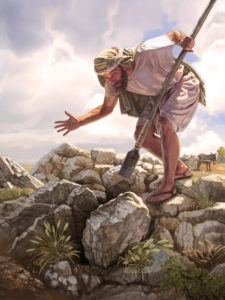
”The kingdom of heaven is like treasure hidden in a field. When a man found it, he hid it again, and then in his joy went and sold all he had and bought that field.” Matthew 13:44 NIV
Last night I discussed this parable with my family. We were all a little unsure of the meaning. We were thinking the guy stole something that wasn’t his and took credit for it! That doesn’t seem right! Yes…..on first reading that’s the initial feeling. But in remembering the purpose of the parables we knew there was deeper meaning. I found my BSF notes from a 2007 study on the book of Matthew to help gain some insight. They noted that the people of that time often buried their “treasures” in the ground to keep them safe. According to Jewish law, if someone found buried treasure it belonged to them. The man in this parable found hidden treasure that became his once he found it. He was so excited about his “find” that he promptly buried it again so he could sell everything else in order to buy up the land and get the treasure too. He was all in. He knew what he found was special. Nothing else mattered anymore except holding on to that treasure. He got rid of his old life because the treasure he found was better than anything he had before.
The treasure is Jesus Christ.
Am I so excited about Jesus that I‘m willing to sell all I have? Am I willing to completely redirect my life for the treasure of heaven instead of the treasures of this world? Do I really believe the kingdom of heaven is better than the things I’m trying get in this life?
Luke 14:33 “In the same way, anyone of you who does not give up everything he has cannot be my disciple”. NIV
Matthew 16:25-26 “For whoever wants to save his life will lose it, but whoever loses his life for me will find it. What good will it be for a man if he gains the whole world, yet forfeits his soul? Or what can a man give in exchange for his soul?” NIV
Psalm 108:4-5 “For great is your love, higher than the heavens; your faithfulness reaches to the skies. Be exalted, O God, above the heavens, and let your glory be over all the earth.” NIV
Today’s Reading: Matthew 13:33, Luke 13:20-21, and Psalm 107
Matthew 33 He told them still another parable: “The kingdom of heaven is like yeast that a woman took and mixed into about sixty pounds of flour until it worked all through the dough.”
Luke 20 Again he asked, “What shall I compare the kingdom of God to? 21 It is like yeast that a woman took and mixed into about sixty pounds of flour until it worked all through the dough.”
Influence. Have you ever really thought about the influence you have throughout the day? Your family, neighbors, co-workers, friends, community? These influences can come in the shape of a simple hug, smile, phone call, or word of encouragement. All small gestures can have great influences. You see we never know what may be going on that day with the other person you give this gesture to. A Christ-like gesture can make a difference like Jesus’s parable about yeast to dough, you can change a persons day.
As I look at this picture of making dough I’m reminded of how God is shaping us, kneading us, and watching as we rise to a closer and more intimate relationship with Him. I think about small kingdom words or expressions I could use in my everyday moments. Maybe the gesture of praying with someone, praising God in song, or maybe recognizing fruits of the spirit being acted out by others. These positive moments that model our Father can influence like the yeast that starts out small in dough, but spreads throughout.
Our Father is building His Kingdom always. We always have influence. I was reminded by a friend this morning that we are called to influence. That in Romans 8:12 we have an obligation not to the flesh, but to the spirit.
Yeast is used in both good and bad contexts in the bible. Yeast can spread corruption as we are reminded in Galatians 5:9 or 1 Corinthians 5:6 or it can also be for building His Kingdom. The kingdom is promised to those rich in faith and who love Him. James 2:5,
What will you do with the yeast you provide today?
Colossians 4-5 Be wise in the way you act toward outsiders; make the most of every opportunity. 6 Let your conversation be always full of grace, seasoned with salt, so that you may know how to answer everyone.
Dear Father,
Thank you for your parables that you speak into us through your living word. Just like we have had others speak into us, help us today to be an ambassador for you. Let our grace, kindness, encouragement, and love for others point back to you God. We are grateful for each day we get to praise you and pray for us all to continue to draw closer to you each day. Amen
Give thanks to the Lord for he is good, His love endures forever. Psalm 107:1
The Parable of the Mustard Seed is a tale of small faith with extraordinary outcomes.
Matthew 13:31
31 He put another parable before them, saying, “The kingdom of heaven is like a grain of mustard seed that a man took and sowed in his field.
Mark 4:30-32
30 And he said, “With what can we compare the kingdom of God, or what parable shall we use for it? 31 It is like a grain of mustard seed, which, when sown on the ground, is the smallest of all the seeds on earth, 32 yet when it is sown it grows up and becomes larger than all the garden plants and puts out large branches, so that the birds of the air can make nests in its shade.”
Luke 13: 18- 19
18 He said therefore, “What is the kingdom of God like? And to what shall I compare it? 19 It is like a grain of mustard seed that a man took and sowed in his garden, and it grew and became a tree, and the birds of the air made nests in its branches.”
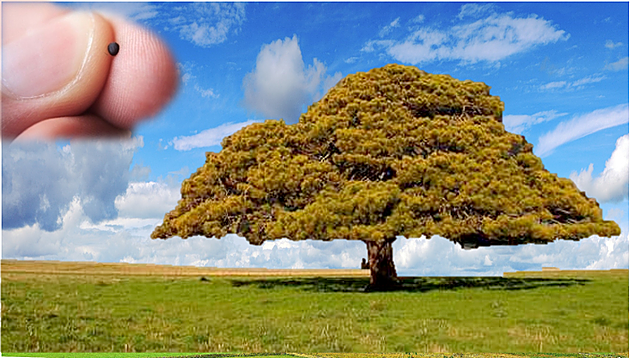
In the ancient Jewish culture, there were many things that were common and widely known. Everyone was aware of and some practiced the Levitical practices prescribed by the Torah, for example abstaining from work on the Sabbath. Another common topic was gardening and harvest. Many people during this time relied on producing their own food through means of planting and harvesting or shepherding or fishing. The parable of the Mustard Seed is one that utilizes the commonness of a “weed” to make an important point of faith and transformation. The mustard seed that is mentioned in these stories, was considered a weed and not suitable for cultivating. The size of the seed was among the smallest seeds known at that time. The plant was not as desirable to eat or cultivate. The normal size of the plant would be the size of a regular bush. Jesus uses this example to illustrate the immense power of transformation and glory of God and His the kingdom. He shows that the purpose of this small and somewhat insignificant seed can be transformed from the small bush to one of the trees that can be houses for birds. In this context it is aligned with the olive tree and fig trees, two of the largest trees during this time period. The parable demonstrates that no matter how small or insignificant we might think of something, God has the ability to change it into something monumental and awe inspiring.
I am continually awed by the grace and wonderfulness of God. Throughout our life, we have the fortune and opportunity to witness the newness of life and the tenderness of the delivery process. In the hospital setting, we witness countless births that take place on a daily basis. A week ago, some close friends of mine where expecting their second child to be delivered through a regular process. Within hours of the delivery process, there were some complications that arose and the life of the mother and child were compromised. Emergency procedures were done to revive the mother and deliver the child. The mother and child were place in critical care and the odds of full recovery seemed dim and uncertain. But God has used this situation to show demonstrate His awesome grace and healing. The mother was released from the critical care area and released home this weekend. The baby is stable and making progress. God has used this situation to show that in the midst of “common” processes, He has the control and the power to make it extraordinary. Lets ask God to reveal the extraordinary in the common and regular activities of our life.
I have definitely been shown in the past half century that I am NOT in control of my life! Most situations in my life have not had the outcome that I expected.
The most recent example of this is what has occurred in my family over the past 6 weeks. Next fall, we will only have 3 members of our family living here in our 5 bedroom home. My oldest 2 children will be off to college and that will leave just myself, my husband and youngest daughter for the next 3 years. Of course this could change in the drop of a hat, because as I stated in the first sentence…we are not in control of our lives. That being said, we have been considering “downsizing”. As this discussion became more prominent in our daily talks, we have had 2 different families, out of the blue, contact us about selling our house. I have spent countless hours cleaning and organizing to have the house “show ready”. Each time the people looked at our house we got very positive feedback. Then it was the waiting process. In the first 24-48 hours it seemed like both families looking were going to take the plunge and purchase our house. This began the excitement and thinking of all that we need to do to get ready to move and find a place to live. Lots of emotions take place in this time frame. Then, after we were at peace with moving, the people come back to say they are going to “Pass” on our house. And…just like that, the planning, dreaming, and excitement are over. We must go back to our normal day to day lives and be content with where we are planted (literally).
During this process we think we knew what the situation would be and even through praying we think we know how God is answering and what is going to happen in the future. Then, it all changes! Just proving to us that we are not in control!
Our parable for today demonstrates how I feel about what we have been enduring over the past month or so. I continue to ask, “where are you god?” “what are you doing in my life, Lord?”
Today we read The Parable of the Growing Seed in Mark 4:26-29
26 He also said, “This is what the kingdom of God is like. A man scatters seed on the ground. 27 Night and day, whether he sleeps or gets up, the seed sprouts and grows, though he does not know how. 28 All by itself the soil produces grain-first the stalk, then the head, then the full kernel in the head. 29 As soon as the grain is ripe, he puts the sickle to it, because the harvest has come.”
If we can’t control our own lives, how much more true is that about the kingdom of God??? This parable reminds me (which I need on a daily basis) that I am dependent on God’s grace and mercy. God will bring the kingdom in His good time, even though I don’t know how or when.
I have no idea if our house will sell (it is not even on the market), but God does. Even as I sleep, He is working and moving.
This parable gives us freedom. It reminds us that we are not ultimately responsible for bringing in the kingdom…God is. God is both faithful and trustworthy. This does not mean that we can go about our days without God, we have a role to play. Even though the farmer may not know how the seed grows, he is called to plant, to wait, and to harvest. So also, you and I are called to participate in the kingdom even though it is beyond our comprehension or control. It is not our job to bring it all about, God tells us here in this parable that He will make the harvest happen. But while we wait for the harvest, we are to continue to scatter seed and know that God is at work. It does not all depend on Us! Thank YOU, Lord that we can trust that You will bring the seed to sprout and grow, it is not up to us to make this happen.
As for me, I am reminded that my belief in God gives me freedom. Because I have put my faith and trust in Him, I can sleep at night not knowing how situations will turn out, but KNOWING that He already KNOWS and in His time, His ways will be revealed to me.
As I reflect on the parable of the weeds, I hear two things. A strong warning and extraordinary hope. First, we must remember that we are living among the weeds. Without diligence, we will be distracted, our growth disrupted, and our destiny destroyed. The faithful, however, thrive in the confusion. Their hope is not found in the things of this world. Instead, life is found in the creator, our living God. How do they do it? Can they help us remain faithful? The answer is surprisingly simple. Know God.
This is where it gets scary. For me, at least, because I’m not sure that I really want to know God. Dallas Willard explains my thoughts in his book, Knowing Christ Today. He says, “we can fail to know because we do not want to know—because what would be known would require us to believe and act in ways contrary to what we want.” Do you hear it? It is the subtle choking of weeds telling us divergent stories. These stories shift our focus ever so slightly from knowing God to knowing the world. As you already know, the consequences are catastrophic. Consider these words from Hosea 4:6,
My people are destroyed for lack of knowledge; because you have rejected knowledge, I reject you from being a priest to me. And since you have forgotten the law of your God, I also will forget your children.
If you want to know God, Psalm 104 is an amazing place to look. Today, the Psalmist reminded me that yes, God is our wonderful creator. And, he is much, much more. When you spend time getting to know him as he Psalmist did, there is only one response. Worship. It’s written right there in verses 33-35.
I will sing to the Lord as long as I live. I will praise my God to my last breath! May all my thoughts be pleasing to him, for I rejoice in the Lord. Let all sinners vanish from the face of the earth; let the wicked disappear forever. Let all that I am praise the Lord. Praise the Lord! Psalms 104:33-35 (NLT)
Today’s reading is the parable of the sower and the seed which is found in Matthew 13:3-8 and Matthew 13:18-23, Mark 4:3-8, and Luke 8:5-8 and Luke 8:11-15. The fact that this parable is found in 3 of the 4 gospels tells me this might be one the Lord once to empathize through His Word. This parable was actually my first ever Bible Journal writing topic in January of 2017. One of my mentors always said, “repetition is the mother of learning,” so most of what is contained below is from that post. However, there were a few new things I picked up in reading this again which I added.
Jesus first tells of seeds which fell along the path and were eaten by birds. He clarifies this is those who hear the message, but don’t understand and accept it. Their hearts are hardened, and they are not ready to accept their Lord and Savior Jesus. The Devil carries these seeds away. The Devil and the norms of this earthly world are leading their life. He then tells of seeds that fell on rocky soil. He clarifies here He is describing those that gladly hear the Good News, but lose faith when trouble and persecution come. The Word did not “sink in” so to speak like the seeds did not sink in the soil. He then tells of seeds that fell among the thorn bushes. These seeds grow up, but are choked out by the worries of this life, the love of riches and the world. Finally, Jesus tells of seeds sown in the good soil which sunk in and bore great grain. This is describing those that hear the message, understand it, and bear fruit by living it out in their everyday lives.
A few years ago, I told my wife how thankful I was for the blessings we have received, but that I was also fearful for how I would react when we faced what I perceived as some “real” challenges others have faced. We know that challenges will come because James 1:2 says “when” trials come and not “if.” I had attended church my whole life, but how do we make sure our faith is strong and the seeds are planted deep in the good soil? Is going to church regularly enough? Would that prepare us?
In order for the seeds to be buried deep and take root, we must have a strong relationship with Jesus. In fact, Jesus specifically directs us to do so in John 15:5.
“I am the vine, you are the branches. Whoever abides in me and I in him, he it is that bears much fruit, for apart from me you can do nothing.”
How do we foster that relationship with Him? Here are a few things we came up with…
Find a church that focuses on the Bible and sees it as the truth and never changing with time, despite what modern day culture tries to tell us.
Be in the Word daily (finding a daily devotional helps) to provide a constant and consistent message of instruction and direction.
Be in prayer throughout the day to be in communication with God and keep our heart in the right place. This draws us close to Him.
Join a Bible study/small group to create a community of believers and friends that can help facilitate and hold us accountable to growing our relationship with Him and our faith.
Since this conversation, we have faced some new challenges we had not faced before or ever anticipated, and I believe we were better prepared to face those by improving in the areas above. Are we where we need to be? No. We can always grow closer to Him by improving even more in these areas. We need to grow more to live more like Him as we are called to and also in order to be ready for the next round of challenges which may be even tougher. Putting on the armor of God (Ephesians 6:10-18) to create a relationship with Jesus allows us to move forward with confidence each day in knowing we are equipped to face trials and tribulations. Again, Matthew 13:18 and James 1:2 says “when” trials come…not “if.”
One additional takeaway from reviewing these passages again is Luke 8:15.
“As for that in the good soil, they are those who, hearing the words, hold it fast in an honest and true heart, and bear fruit with patience.”
If the love of, and relationship with, Jesus has truly taken root deep in our heart, we will hold fast and be able and willing to wait as we often get thrown curveball after curveball in this life without reprieve which we cannot understand. We will trust in Him and know that nothing happens to us, but happens for us..to learn and grow closer to Him. We will cling to Him and have faith in His perfect plan for our life which ultimately leads to joining Him someday in Heaven.
What one area above will you focus on to bring you closer to oneness with Him and to be better prepared to face current and future trials?
For additional reflection on the riches of his mercy and the glory which will be revealed in Heaven, read Psalm 103, which is titled “Bless the Lord, O My Soul,” and check out amazing song, 10,000 Reasons by Matt Redman.
Part 2 of the The Fig Tree. When I went to write today’s post, I remembered writing about a Fig Tree in the past and went to research my past post. It was actually quite different than today’s verses. The past post showed Jesus’ use of power and how he crumbled the Fig Tree. It was one of Jesus’ very few examples of power in a more negative fashion.
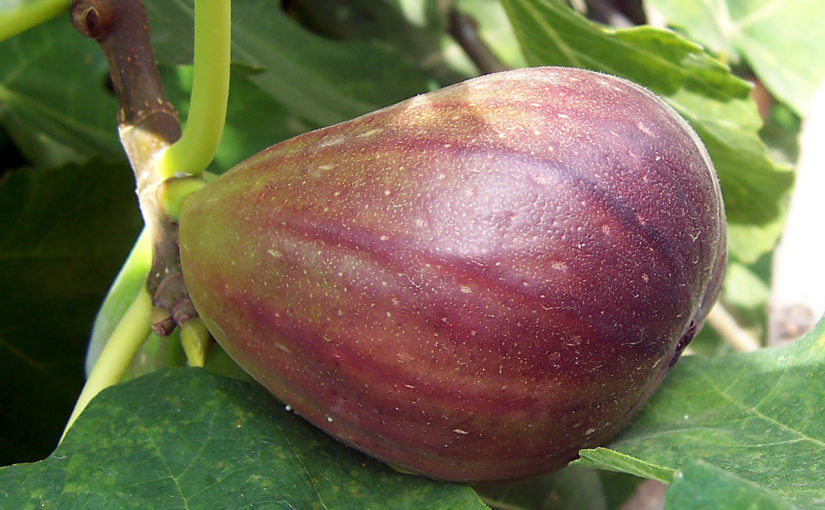
Today’s reading is a different twist on Fig Trees. In ancient times, Fig Trees were often used in stories as they are symbolic to Israel and are important to the Jewish community. “Today Israel is full of fig trees – huge, well developed, shady and mature. They produce two harvests of fruit a year, the early crop around Passover time in the spring, even before the leaves have unfurled, and the biggest, best, most juicy fruits come into their own in September, close to the Jewish holidays of Rosh HaShanah, Yom Kippur and Sukkot (Feast of Trumpets, Day of Atonement and Feast of Tabernacles respectively).” Read more here. Fig Trees are just one of a few trees used in the Bible. Others include the “tree of life” and the “tree of knowledge of good and evil”. My point here is to pay attention when the Bible refers to Fig Trees. Take note, important message coming!
Our verses for today are short but right to the point. The parable is about disappointment and also about patience. The fig tree owner was not pleased with the fig tree. He had been waiting for fruit for three years but still had none. He was disappointed and most likely frustrated with the lack of progress in bearing fruit. His impatience grew to the point of wanting to give up and cut the Fig Tree down. In his mind, the tree had been barren long enough. Yet, the caretaker showed great patience. He asked for another year. Can you visualize him pleading his case as he lays out his plan for continuing to improve the health of the tree?
This story relates to our lives. Jesus is the vineyard owner and we are the trees. Jesus’ patience may run out with us, not necessarily after three years, but it he may ‘move on’ to others. He may grant us mercy for yesterday, for today, but not forever if we don’t open our hearts for him. He keeps knocking but will we answer? Will we confess our sins? Will we believe? Do we take advantage of our borrowed time in the right manner? Will we bear fruit on earth? These verses are short but certainly powerful. Our lives on earth might be over. He might not give us another year. Kind of scary in a way IF we don’t believe. The good news is he is a patient God. He does have caretakers watching us, helping us, prodding us along in the word. He does grant extra time to bear fruit. A good lesson for us on repentance and on staying ready for his coming.
In case you wanted to read another parable about a Fig Tree, I have included my The Fig Tree post from February 10, 2017 Also included in this post are facts about the fig tree as a fruit again showing how important it was in ancient times and what a source of nutrition it is today, not only to the body, but in the case of the parables, to the mind.
Todays readings come from Matthew 24:45-51, Luke 12:42-48 and Psalm 101. Jesus’ parable about the wise and foolish servants talks about a “faithful and wise servant, whom his master has set over his household” who, having been left in charge of the household, does well with his responsibility and is blessed for it. Conversely, the foolish servant who “says to himself, ‘my master is delayed in coming,'” and does not follow the instructions of the master. The master shows up unannounced and finds the servant’s disobedience, which has pretty severe consequences.
This parable, like all other parables – and all of scripture, for that matter – has a lot going on in it. I’m being spoken to today, though, on the surface context of this passage. There are some basic messages here without having to dig too deeply.
Jesus says we must carry on with diligence while the Lord is gone. We must be that faithful and wise servant who takes care of his master’s business while the master is away.
Jesus also promised that we will be rewarded for our diligence. The servants serve the master, but the master knows how to take care of and reward the servants.
Jesus warns of having an attitude that relies on a master “delayed in coming.” Instead, we should live in constant anticipation of His return.
Thankfully, we’re not expected to be perfect all the time. But when I think about having to give an accounting for my actions to the Lord, it is always in some far-off future time and place, not in the here and now.
What if in the middle of my workday – or evening at home with family – or weekend visiting with friends – Jesus came and said that it was time to answer for everything. How would He find me? Would I have been in prayer, in communication with him that same day? Would I have been meditating on His words found in scripture?
Or would He instead find me binge-watching one of my shows on Netflix, in a messy house with my kids running amok?? Or gossiping with someone? The list could really go on here, but I think you get the idea.
David sets high standards for behavior in Psalm 101.
I will sing of (be enthused by!) steadfast love and justice
I will ponder the way that is blameless
I will walk with integrity of heart
I will not set before my eyes anything that is worthless
I will know nothing of evil
I will not tolerate gossip or haughty/arrogant behavior (v5)
I will look with favor on the faithful and dwell with them
I will be ministered to by those whose walk is blameless
I will not tolerate/dwell with those who practice deceit
Let’s meditate on this Psalm and the parable today. Which servant am I? Am I ready for my master to return at any moment?
Good Morning! I hope you have the day off for Memorial Day and you are able to devote some of your free time to prayer and study in God’s word. Often, when I write for Bible Journal I take a few hours during the week to study my assigned passages in depth before I start the process of writing to you. I like to read several Bible translations, various commentaries and research the author and historic context. Well friends, I didn’t do any of that today. The thing is, this week has been sort of a mess! A heavy blanket of worry and anxiety has settled over us that we can’t seem to shake. This afternoon, I sat down and just copied today’s parables from Mark and Luke onto a piece of notebook paper. I asked God to speak truth into my heart and to help me share that truth to you. The first words we hear in Mark 13:33 say:
“Be on guard! Be alert!” You do not know when the time will come.” Mark 13:33
Did you see that? Jesus said, “you do not know WHEN the time will come” he did not say, you do not know IF the time will come. That’s a promise that we can trust in Jesus to keep. How often do we spin our wheels trying to solve our problems or take control of a situation without asking Him first to work in our lives? In this passage, Jesus is urging his followers to look for a future event. Our culture invites us to indulge in immediate gratification and concentrate only on the present conditions. Instead, Jesus is calling us to stay alert and engaged in our faith. He’s encouraging us to be always at the ready for his return:
“Stay dressed for action andkeep your lamps burning,and be like men who arewaiting for their master to come home from the wedding feast, so that they may open the door to him at once when he comes andknocks. Blessed are those servantswhom the master findsawake when he comes” Luke 12:35-37
So what does it look like to be dressed for action as modern Christians? How can we remain awakened to the presence of Jesus Christ in our lives? I think it starts with a commitment to prayer and a willingness to be vulnerable with Him. I think it looks like serving Him and worshiping Him even in the midst of a storm. I think it looks like going to Him and believingthat He is the only true healer that can restore us. Worship is the glue that holds us together in the most difficult times. God is present in each situation and when we can awaken ourselves to His promise to restore us, we can let go of our own expectations. When we are stripped of all else, God offers us the power to endure through the Holy Spirit.
“Therefore stay awake—for you do not know when the master of the house will come, in the evening, or at midnight, or when the rooster crows, or in the morning—lest he come suddenly and find you asleep. 37 And what I say to you I say to all: Stay awake.” Mark 13:35-37
Lord, help us to stay awakened to your presence in our life. Help us to always be ready to invite you into our life and allow you to intercede. Lord, give us the patience and the wisdom to be faithful to you and await your return. -Amen
If you aren’t familiar with this parable, make sure to read these few verses. Luke 12:16-21 and Psalms 99.
A farmer has an abundant harvest, more than he could store in his barns. So he tore down the existing barns, built bigger barns to store it and save for himself so he could relax. Specifically, he was looking forward to taking it easy, eating, drinking, and being merry, for the rest of his days. Cue the voice of God: You Fool! Tonight you will lose your life, then who will have all of your stored up harvest?
Jesus wraps up the parable with the warning that the same will be for any of us, that store treasures and is not rich toward God.
I wonder where specifically this farmer went off track? He is described in the beginning as rich (but not yet called foolish)…so maybe leading into the abundance he is a rich + wise farmer. Having a good harvest or abundance isn’t bad. I don’t even know that storing the harvest was all that awful. He had to put it somewhere, right?! Although I’m not sure why he had to tear down the small barns and build the bigger barns…couldn’t he have built an extra barn for the excess? Why tear town the existing barns? I’d really like to ask this farmer a few questions. 🙂
It seems like it went downhill with his heart + desire. We don’t hear anything about a grateful heart for the abundance, a tithe or offering back to the Lord, and we don’t read that he sought direction from God on how to use the abundance. We don’t even hear any of his own plans to use the abundance to further the kingdom. He wants to relax and not have to worry about his future, keeping it in his own (perceived) control, relying on the abundance. Don’t get me wrong, I LOVE a good sabbath – we are even commanded to rest. But not forever!
The farmer’s plans sure sound A LOT like modern era retirement goals! Or lottery dreaming… “If I win the lottery, I am quitting my job tomorrow and living the good life”. While retirement planning is a good way to show stewardship over what God has provided, doing it without the Lord will lead us down a path like this Rich Fool. It seems like a fine line!
How much of my financial planning and saving is to be a good steward and how much is me wanting to have control? It feels hard to discern. Are my conversations with God about money sincere? Is my heart and mind completely open to whatever He would ask of me? I love this picture of having our hands open – fully willing to use anything the Lord gives, however He directs. And it’s when our hands are fully open, we are also able to fully receive what He has for us.
Earlier this week I left a conversation with my jaw wide open and a tear in my eye. Truly humbled by someone I really don’t know that well – but I crossed paths with Bob and wished him well in his upcoming “retirement”. I asked him what he had planned, to which he quickly replied “FIND A JOB”! What I know about Bob is that he has a heart for the Lord and a heart for kids. His career has been in shaping children, and at home, he and his wife have fostered and adopted children. I really don’t know much more about his family or his story, other than he was at the point in his career where he either could retire or had to retire, and yet he wasn’t planning to truly retire. He shared that he needed to keep working to get these kids through college. I think about the choices he had to make when welcoming kids into his home, and knowing it would push back his time to retire. I wonder what else he and his wife have sacrificed for the kingdom. Would I have a heart like Bob, who likely sees his peers “retiring” and he is retiring from one career and actively looking for the next.
Lord, thank you for all the prosperity you have given me. Thank you for the talents and opportunities to prosper. Help me to surrender any control or fear about money, and have complete confidence in Your provision. Please put people in my path that have current needs, more than the future me might need. Give me wisdom in being a good steward and keep me from being a fool! Thank you for people like Bob that show me how to be rich toward you. Amen.







You must be logged in to post a comment.