
The Truth

Today’s Reading: Matthew 5:33-37, Psalm 64

Good Morning! I’m so happy to be with you again Monday morning readers. This week, we continue our study of the Sermon on the Mount. Today’s reading focuses on oaths. When I think of the word “oath” I think of serious situations like testifying in court or taking an oath of office. In our society we view an oath as a promise to tell the truth, a promise to do no harm or a promise to do our best to protect people. When Jesus gave the Sermon on the Mount sometime around 60 AD, an oath not only implied keeping one’s promise but also had significant spiritual implications. Jesus is emphasizing the importance of telling the truth. Keeping our word or oath is one of the few forms of earthly currency we have. It builds trust and makes committed human relationships possible. Jesus’ teaching on oaths has three distinct facets:

  • You must keep your promises to God. Back in 60 AD, Jews avoided using God’s personal name when taking an oath. Instead they would use a reverent sounding substitution in order to appear sincere. How often do we as Christians make a promises in the name of God whether in church, at small group or in our community. The Bible condemns making vows or taking oaths casually when you know you aren’t fully committed to keeping your word.
  • Jesus tells us not to take oaths at all. This seems counterintuitive, but Jesus’ message is that our word should be enough. He encourages us to act with integrity in all areas of our life. When we do so, we can be our authentic selves and therefore do not have to make promises in order to redeem trust. If we tell the truth all the time, we will have less pressure to back up our words with an oath or promise.
  • Do not swear by your head. What Jesus means is that we do not have the authority to create or destroy things over which God has authority. Swearing against God aligns us with the enemy. Just as he attempted to assume God’s position, so do we when we attempt to sit on a false throne.

Oaths are needed today because we live in a sinful society. Trust is a powerful element of our ability to interact as sinners. Psalm 64 says:

Hide me from the secret plots of the wicked,  from the throng of evildoers, who whet their tongues like swords, who aim bitter words like arrows,shooting from ambush at the blameless, shooting at him suddenly and without fear. They hold fast to their evil purpose;  they talk of laying snares secretly thinking, “Who can see them?” They search out injustice, saying, “We have accomplished a diligent search.” For the inward mind and heart of a man are deep. (Psalm 64:2-6)

 Jesus calls us to be genuine in our pursuit of honesty and personal integrity. He asks us to keep our promises to God and ask for forgiveness when we fail. The grace in this lesson is that God always keeps his promises to us, no matter how many times we fall.

Peace and blessings this week
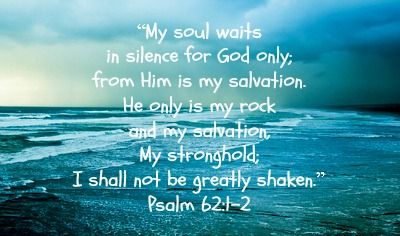
I shall not be greatly shaken

Psalm 62 “My Soul Waits for God Alone”

Our family is in the midst of packing up for a move across the ocean and phase one of the move (shipping our belongings to Italy) is only a few days away.

The Middle of the Night

I’ve been waking up around 3:00AM-4:00AM in a sweat almost every day these last couple weeks. Mind and heart racing. Lists growing, deadlines approaching. Fear. Panic. What ifs. Worry. Stress.

Then I pray and eventually come to repentance when I remember all this worry and fear is not Godly. It is me selfishly trying to control things.

Regardless of any earthly, human outcome, God has it. He holds you and me in his hand. He is a refuge.

Trust in him at all times, O people;
  pour out your heart before him;
  God is a refuge for us. (Psalm 64:8)

The Peace of Dawn

Then morning brings a new day, a new perspective, a new opportunity to get it right and continue to learn to lean on Jesus.

Today’s Sermon on the Mount Content… lust!

Today’s verses from the Sermon on the Mount are Matthew 5:27-30 where the topic of lust is addressed. I posted on this on February 9th, 2016. Here’s a link:

Do Not Open This Door

Substance over Form

Today’s reading:  Matthew 5:21-26, Psalm 61

Substance over form is an accounting principle used to help ensure that financial statements give a complete, relevant, and accurate picture of an organization’s transactions and events. The root of this principle is in accounting theory, but it applies to so much more than financial statements.  In fact, I challenge my team with this quite often – are we more interested in looking like we “follow the rules”, or are we truly committed making informed decisions that are in the best interest of our customer?  Almost every time, the answer is the latter.  We are responsible for looking below the surface, making sure the substance of our decision is rooted in our company mission and shared values.

Throughout Jesus’ ministry, he often taught through the use of parables. If his audience didn’t pay attention to the substance over simply the form of his teaching in this method, or had hardened hearts, they couldn’t understand his message.

Jesus’ Sermon on the Mount, recorded in Matthew 5, was different. It was much more straightforward, as Jesus categorically outlined key principles for leading a Godly life.  Jesus began our passage for today in Matthew 5:21 by quoting the law of Moses – Do not commit murder.  If we stopped right here, most of us would walk away feeling okay about ourselves.  I have never even come close to taking the life of another person, so I’m good on this principle, right?  Not so fast.  We must stop and reflect – like the Pharisees, are we more interested looking like we “follow the rules”, or are we committed to Jesus and are we passionate about changing our hearts to look like his?  If the latter, we must go beyond the first sentence of this passage to get to the substance of this message.

In the very next verse, Jesus dug deeper and shared context on the true purpose behind God’s law against murder. “But I say to you, if you are angry with someone, you are subject to judgment! If you call someone an idiot, you are in danger of being brought before the high council.  And if you curse someone, you are in danger of the fires of hell” (Matthew 5:21-22).  The substance of Jesus’ message isn’t simply on the physical act of murder, it is about anger.  Hmm…that hits a little closer to home.

Jesus did not say that anger itself is sin. In fact, we can be angry without sinning, as Jesus himself demonstrated (see the story of Jesus and the money changers in John 2).  It is what we choose to do with anger and what we choose to do because of anger that makes it sinful.  Unresolved anger and bitterness eventually lead us to intentionally harm the people who made us angry, which is sin.  Even if we never get to the point of actually taking action, however, harboring anger in our heart is still sin because it draws a wedge in our relationship with others and our relationship with God.  We cannot claim to love God while we hate other people.

Whoever claims to love God yet hates a brother or sister is a liar. For whoever does not love their brother and sister, whom they have seen, cannot love God, whom they have not seen (1 John 4:20).

Do you struggle with unresolved anger? Don’t gloss over the substance of these verses thinking they don’t apply to you.  Will you consider the counsel in verses 23 and 24, and make it a priority to reconcile with the person(s) that caused your anger?  It isn’t easy, but God promises to make a way (Isaiah 43:16).

Christ Came to Fulfill

The readings this morning are Matthew 5:17-20 and Psalm 60

“Christ Came to Fulfill the Law”

In this short passage, Jesus makes it abundantly clear that he is not here to abolish the law…but to fulfill them. They are here to stay! I think seeing the definition of “fulfill” makes it clear of what Jesus is saying.

ful·fill
fo͝olˈfil/
verb
1. Bring to completion or reality; achieve or realize (something desired, promised, or predicted).

2. Carry out (a task, duty, or role) as required, pledged, or expected.
When I look at the definition, the words really jump out as to the purpose of the Old Testament laws and how they pointed to Jesus: desired, promised, predicted, required, pledged, and expected. All six of these words, combined, provide a great indicator…Jesus was to be all of these things.

Jesus also made it clear that just because he had arrived to fulfill the laws, that they were not to be taken any more lightly: “Therefore, whoever relaxes one of the least of these commandments and teaches others to do the same will be called least in the kingdom of heaven, but whoever does them and teaches them will be called great in the kingdom of heaven.” Not mixing words! Personally, I think it goes along with a phrase I heard from the great philosopher Gary York one Sunday morning: “Action follows faith.” If you have faith in Jesus…and that you believe He is Who He says He is…your actions will be in alignment with the laws. In John 14:6-7, Jesus tells us: “I am the way the truth and the life, no one comes to the father except through me. If you had known me, you would have known my Father also. From now on you do know him and have seen him.” Who can you introduce Jesus to today? He is the only way. Have a blessed day!

Salt Life

SALT

• Adds Flavor to Life,

• Purifies Set apart,

• Preserves  the souls of man for the Kingdom of God

Good Morning,

Today we get a chance to look at Matthew 5:13-16. The Salt Life image that we see on cars or shirts is imprinted my brain. Verse 13 says how we are the salt of the earth. A couple characteristics of salt that can be seen as a parallel to our Christian life includes the ability to make me thirst.   Last week as I battled a cold and went to the good ole’ gargling of salt water,  it made me thirst.  That even as I poured the salt into liquid it never lost its saltiness.  As we are living in this world do we lose our flavor? As we are watered down by worldly pressures do we keep our saltiness  in every part of our life? Colossians 4:6  says Let your conversation be always full of grace, seasoned with salt, so that you may know how to answer everyone. 

Salt also adds seasoning. It makes a better taste. Does the flavor of being a Christian make others come back for seconds? Seasoning brings out the best flavor of our foods.  Do we bring out our best and point it all back to God?


I have learned I can’t always control the circumstances I face, but I am the keeper of my “saltiness.” Will I be bitter, broken down or better and making a difference? Less seasoned or more flavorful? When God comes back, what good am I if I’ve lost my flavoring?


Light of the World

If we all understand that the light of the world is God we will be able to see. Matthew 5:14-16 what living for Christ is like. That God’s light should be in full display in our hearts, minds, works and actions. That as we let our light shine others will see the reality of God in us.   God’s light will guide us as we speak to Him and for Him. God’s light will shine when we are trying to avoid a situation.  Let’s not let sin dim our light.  Let’s not put our light to the side when others need to see.

Ephesians 5:8 says For you were once darkness, but now you are the light of the world. Live as children of the light.

Have a blessed day being the salt and the light.

Today’s Readings: Matthew 5:13-16, Psalm 59

But I will sing of your strength, in the morning I will sing of your love; you are my fortress , my refuge in times of trouble.

To Be Blessed


Today’s Reading : Psalm 58; Matthew 5:3-12

In today’s reading we are at the top of the mountain in close quarters with Jesus.  We have a private audience with Jesus and the disciples before the Sermon on the Mount.   As the crowds are gathering, Jesus pulls all of his close associates into a small huddle and preps them on the future possibilities of their ministry and life.  He tells them how blessed their life will be following Him, but it is not the typical blessing that they would expect.  I have read the Beatitudes many times in my life, but I have found a new understanding of them as I studied and write this blog.  Below is the The Message form of the Beatitudes:

Matthew 5:3-12

 “You’re blessed when you’re at the end of your rope. With less of you there is more of God and his rule.

“You’re blessed when you feel you’ve lost what is most dear to you. Only then can you be embraced by the One most dear to you.

“You’re blessed when you’re content with just who you are—no more, no less. That’s the moment you find yourselves proud owners of everything that can’t be bought.

“You’re blessed when you’ve worked up a good appetite for God. He’s food and drink in the best meal you’ll ever eat.

“You’re blessed when you care. At the moment of being ‘care-full,’ you find yourselves cared for.

“You’re blessed when you get your inside world—your mind and heart—put right. Then you can see God in the outside world.

“You’re blessed when you can show people how to cooperate instead of compete or fight. That’s when you discover who you really are, and your place in God’s family.

10 “You’re blessed when your commitment to God provokes persecution. The persecution drives you even deeper into God’s kingdom.

11-12 “Not only that—count yourselves blessed every time people put you down or throw you out or speak lies about you to discredit me. What it means is that the truth is too close for comfort and they are uncomfortable. You can be glad when that happens—give a cheer, even!—for though they don’t like it, I do! And all heaven applauds. And know that you are in good company. My prophets and witnesses have always gotten into this kind of trouble.

Last night, as I was putting my son to sleep I read these to him and he said “Dad, that really makes sense. I can see how God blesses people in all of those situations”.  It really makes sense and my seven-year-old son gets it.  We have the fortune to see this and live this post sermon, but could you image the impact that these words had on the people of Jesus’ time? These were people who had been treated without regard of their religion, citizenship, physical capacities, and so much more.  In that society, the more powerful you appear to have the more force you have, but Christ is showing the complete opposite side of this argument.  The more that you relinquish the power or pursuit of said power and submit to Christ the more you are given and more peace you are granted.   In our society we can see remnants of this ideology of more force and more power makes the better person or entity.  This is contrary to Jesus’ teachings.  The more that we can allow God to give use Shalom (completeness), the more we are in His power and his peace.

Be Blessed


Sermon on the Mount

How can we live a life that pleases God??

This will be our focus over the next 5 to 6 weeks. We are going to take an in-depth look at the Sermon on the Mount. We will explore Mathew 5,6,&7 and hear exactly what it looks like to live as a follower of Christ.

Matthew 5:1-2 is the reason that this passage is known as the Sermon on the Mount: “Now when He saw the crowds, He went up on a mountainside and sat down. His disciples came to Him, and He began to teach them…” The Sermon on the Mount is the most famous sermon Jesus ever gave, perhaps the most famous sermon ever given by anyone.

In many ways, Jesus’ teachings during the Sermon on the Mount represent the major ideals of our daily Christian walk. In these 3 chapters we will see Jesus teaching about prayer, justice, care for the needy, handling religious law, divorce, fasting, judging other people, salvation, and much more. The Sermon on the Mount also contains both the Beatitudes (Matthew 5:3-12) and the Lord’s Prayer (Matthew 6:9-13).

Jesus addresses our heart in these chapters. How we will live in the reality of our world and all that happens in our daily lives. In the She Reads Truth Devotional, the reference is made that “Jesus transformed the law from a back-breaker to freedom-maker.” Jesus Christ came to fulfill the law so that we may experience freedom. “Freedom from sin, freedom from self. Freedom from hopelessness and death. Freedom from rule-based religion. Freedom to love and be loved by a holy and merciful God.” (She Reads Truth)

Lets look with an open heart over the next weeks as Jesus speaks to us from the hill above. He is not telling us what to do, but how to live. Jesus wants us to be close to Him. To experience freedom in this life, these chapters show us that we will only find freedom in Him.

Also, read Psalm 57

Focus Time

Thank you for following BibleJournal.net.  To date, we have 817 journal entries with more than 48,000 views!  Our focus, has been reading entire chapters so that we can experience the Bible in its entirety.  Starting tomorrow, we are going to make a small change.  Our daily scripture reading is going to be drastically reduced.  The goal is intimacy rather than broad understanding.  Our topic for the next 45 days is the Sermon on the Mount from Matthew 5-7.  As always, you will continue to receive a link to the day’s reading along with a journal entry from one of our 12 writers.

I hope you enjoy the new format.  Either way, we would love to hear from you.  Leave a comment, or email me directly at bj@bjarmstrong.com.

Blessings,
BJA

Valuable Consideration

2 Samuel 24, Psalms 56

Contracts often include language like “valuable consideration.”  It identifies the price, or the cost (not necessarily in monetary terms) that is required for the exchange of goods.  The amount of consideration provided is dependent upon the item changing hands.  To complete the contract, both parties must agree that the compensation offered will result in full payment for whatever is received. 

Today, in 2 Samuel 24, David receives something incredibly valuable from God.  Forgiveness.  In return, God asks for consideration.  He sends his servant Gad to ask David for the payment.  In this case, David’s payment takes the form of a burnt offering.  Gad instructs him to, “Go up, raise an altar to the Lord on the threshing floor of Araunah the Jebusite.  Araunah the farmer, attempts to give David the parts for the altar, the wood, even the oxen from his own stock.  But, David knew better.  He knew that any offering without personal cost, would not be an offering at all.  It is, as Dietrich Bonhoeffer puts it, “cheap grace.”  Without payment, David knows that his agreement with God would be null and void.  

So, how is it that we receive forgiveness without a costly sacrifice? the answer is that we don’t.  Thankfully, the full price was paid, for us, in advance.  According to Hebrews 10:14, Jesus is our “single offering” and  “he has perfected for all time those who are being sanctified.”  What does that mean?  It means that our agreement with God is paid in full.  There is no more consideration due.  It is worth pausing here.  Think about how valuable Jesus’ consideration was.  He effectively paid for all sins, for every person for all time.  It is promised in 1 John 2:1-2.  It says, “if anyone does sin, we have an advocate with the Father, Jesus Christ the righteous.  He is the propitiation for our sins, and not for ours only but also for the sins of the whole world.”

If the valuable consideration for our sin has already been given, then the only thing remaining is our agreement.  How does that work?  Romans 10:9-10 says that “if you confess with your mouth that Jesus is Lord and believe in your heart that God raised him from the dead, you will be saved.  For with the heart one believes and is justified, and with the mouth one confesses and is saved.”

Legacy

Legacy. What do you think of when you hear the word legacy? Do you care about yours or not? Well, I believe you should because we all leave a legacy and your leadership example determines your legacy. We are all leaders, definitely as parents and spouses and often professionally, but even those that aren’t married, don’t have kids, or don’t have a defined professional leadership role are still leaders. Other friends and co-workers are always watching and following you whether you intend them to do so or not so that makes you a leader. John Maxwell says leadership is influence. Your leadership example determines the impact you have on others which ultimately determines your legacy.

Our small group is currently reading The Resolution for Men and The Resolution for Women. This is my 3rd time through the men’s version, and I would highly recommend every man read it. It is like an instruction manual for being man, husband, and father by translating and breaking down what God instructs us to do in the Bible. It tells men how He created and empowers us to fulfil His leadership vision. Having children, when I think of legacy, I think of the legacy I want to leave for them first and foremost.

The book challenges us to think about how we define success for our children. It is human nature for us to define the success of our children by whether they achieve big things academically, athletically, and even socially with friends or being on homecoming court or in school leadership roles for example. However, this book challenges us that success for our children is only defined by them loving God and knowing Him as their Lord and Savior. Period. End of story. Thus, the legacy we leave in this way through our leadership by example is all that matters.

David tells us in his last words in 2 Samuel 23:3-5..

“The God of Israel has spoken,

the Rock of Israel has said to me:

When one rules justly over men,

ruling in the fear of God,

he dawns on them like the

morning light,

like sun shining forth on a

cloudless morning,

like rain that makes grass to

sprout from the earth.”

How do we lead our children in this way by our example so they know and love Jesus as their Lord and Savior?

  1. First, we must be in the Word daily. This keeps us centered and focused on God so we can know and understand Him and His will better making better decisions daily. This must be visible to them so they know you are in the Word. We should also look to be in the Word together as a family. Try a weekly family devotional on a certain day each week.
  2. They must see you in prayer. They must know you go to God throughout your day in prayer to draw closer to Him as a source of wisdom. Talk about how you go to Him for your challenges and to praise him, and pray together as a family.
  3. They must see you praising and worshipping God in adoration. This can most commonly be done in song as we read about in many Psalms, throughout the Bible, and just yesterday with David in 2 Samuel 22. If your kids go to their own church service, consider bringing them into church with you occasionally so they can see you praising and worshipping Him. Recently, we had a night of worship music only at our church where we brought our kids, and it was awesome singing along with them praising God. It doesn’t have to be planned though. Singing along to Christian music in the car or while cooking out or eating dinner at home spontaneously can be just as impactful for them to see God is more than worthy of your praise all the time..any time.
  4. Speaking about God and his creations of beauty all around us in the world and about how God worked in your life today and asking them how God worked in theirs today is tremendously impactful. Simply put..talk about God. Daily. Not just on Sundays on the drive home from church.

Lastly, if you want to lead someone, most notably your kids as we are speaking of, you must have their heart. If you have their heart and they know you care about and love them, they will follow you. The Resolution for Men discusses if you don’t have your child’s heart, you must do WHATEVER it takes to get it back..even if it takes the rest of your life. 2 Samuel 23 tells about David’s mighty men and all the things they did in battle. While it might be neat to be known for personal or professional successes in life, we should strive for our kids to say when we are no longer on this Earth our legacy was this…”My Mom/Dad loved Jesus with all their heart, and I’m forever grateful they helped me do the same.” Our children must make their own decision to follow Jesus, but nothing is more important than the eternal legacy we strive to instill in and leave them.

Carpe Momentum.