Fear

Today’s reading is Leviticus 1-3, Psalm 27, and Hebrews 2.

What do you fear?

This last week I had the privilege of hearing author and speaker Ryan Leak talk at a conference for our company. While it was not a Christian, faith-based talk, it was one of the best talks I’ve ever heard. He shared that we are only born with 2 fears which are the fear of loud noises and the fear of falling. This means all other fears are learned.  He said we have 6,000 thoughts per day with 80% being negative and  with 95% of our thoughts being repetitive. He also shared that every successful person we look up to has failed, yet we were taught not to fail..but I digress.

Ponder this question, is it a sin to fear?

The Bible tells us Jesus was without sin multiple times (1 Peter 2:22, Hebrews 4:15, 2 Corinthians 5:21, 1 John 3:5). We also know from Luke 22:39-46 on the night Jesus was betrayed, when He knew He was about to be scourged and nailed to the cross, He was in agony and was in so much stress in fearing for what would happen that he sweated drops of blood (Luke 22:44). To me, this answers our question and fear itself is not a sin.

In reflecting on this, it seems to me that fear can become a sin when….

  • It consumes our thoughts and lives
  • We don’t trust in God and His plan
  • We try to find our hope and trust in things of this world which are separate from God

Jesus taught us exactly how to face fear in Luke 22…

  • Kneel down and pray (Luke 22:41)
  • Ask for what you want (Luke 22:42)
  • Pray that ultimately the Father’s will be done and not your will… trusting in Him no matter what (Luke 22:42)
  • Pray again even more earnestly (Luke 22:44)

So, what did God do as a result? He sent angel from Heaven who gave Jesus strength (Luke 22:43). Notice God did not stop Jesus from going to the cross. And you and I should be thankful for that. We should be thankful God’s plan to save us from our sin and give us eternal life through Jesus’ death on the cross was bigger than Jesus’ pain.

I can’t promise you God will remove the pain or problems which may be causing your fear. But what I can promise you is that God will give you strength and that He is bigger..and His plan is bigger! We know in the end…we win through eternal life with Him.

“The Lord is my light and

 my salvation;

whom shall I fear?

The Lord is the stronghold of

my life;

of whom shall I be afraid?”

Psalm 27:1

I would encourage you to read more of Psalm 27 and Hebrews 2 on fear and how Jesus understands us because He suffered and faced fears just like you and me.


Glorious

Exodus 38-40 and Hebrews 1

This past weekend at Church a friend asked if I knew of someone. He described what the person looked like and did for a living and then he added that this person was “glorious.” I loved his description of him. I have never referred to a person as glorious. That word has stuck with me for the past few days and then in reading my passage today, the word “glory” jumped out at me again!

According to vocabulary.com, “when something is fabulous and wonderful it can be described as glorious, like the glorious sight of the first flowers in your yard after a long, cold winter.” We all know that when we see that first tulip pop through the ground, that is a glorious sight. I did not get to meet this “glorious” person on Sunday as he already left, but I sure look forward to meeting him myself.

Exodus 38-40 gives lots of instructions. Instructions on how to construct the tabernacle and how to make priestly garments. Over and over in these chapters you read the words, “As the Lord had commanded Moses.” The Lord gave Moses all of the details to be included in the tabernacle and Moses passed the instructions to the people. The people obeyed and the tabernacle was finished. What was the result of the tabernacle being finished just as Moses had commanded? Glory.

Then the cloud covered the tent of meeting, and the glory of the Lord filled the tabernacle. Moses could not enter the tent of meeting because the cloud had settled on it, and the glory of the Lord filled the tabernacle.
Exodus 40:34-35

The cloud was a symbol of God’s presence. When the cloud came down upon the tabernacle it was a visible way of saying that God had come down upon the tabernacle to dwell with His people. We also see this referred to as Shekinah Glory.

The word Shekinah is a Hebrew word which means dwelling or settling. It represents or means the presence of God dwelling or settling over you. It describes the experience you have in the presence of God. The Israelites experienced God’s presence through the cloud by day or the fire by night. The cloud covered the tabernacle.

So how do we experience God’s glory in our life today? By the grace of God we have the gift of the Holy Spirit. The glory of God went from dwelling in tents to dwelling the hearts of men. Our bodies are now the temples of the Holy Spirit.

Do you not know that your bodies are temples of the Holy Spirit, who is in you, whom you have received from God?
1 Corinthians 6:19

If we know Jesus and have asked Him to dwell within us we have the Shekinah Glory living in us because the Holy Spirit lives in us. God’s presence will never lift or leave because He is with us wherever we go. We experience more glory in our lives when we take the time to lean into the Holy Spirit. Spending time reading the Word of God, communicating in prayer to God, and worshipping God is when we experience the Glory of God in our life.

God’s glory will illuminate from us when we spend time in His presence. We will have a glorious presence about us and others will wonder what it is. We will reflect who He is in our actions and our reactions to others. I can’t wait to meet this person that was described to me as “glorious.” When someone describes me, I would love to be portrayed as glorious. Because of Jesus we are given the freedom to choose how we live. Today I will choose to see the glorious beauty around me and pray that others see God’s glory in and through me.

Stop It!!

Exodus 35-37, Psalm 26, Philippians 4

“Don’t worry,” people say.  I do, anyway.  They try, “You shouldn’t worry.”  That doesn’t work, either.   It makes it worse.  Now I’m worried about being worried!

I’ve tried many things to quell my anxiety, to no avail.  Attempting to steer my thoughts in another direction leaves me wanting solutions, and engaging distractions delays the inevitable.

I am sure that you have some advice for me, but is it as good as Paul’s?  Paul knows that this is a battle for our minds.  He also knows that there is a real and permanent solution.  It starts with taking our thoughts captive.

Once we identify that our thoughts have gone astray, we must do something with them.  Since we can just forget them, we need to transform them.  In Philippians 4:8, Paul hands us a simple framework.  In this situation, what is:

True – consider what is true from a Biblical context.  Truth exposes lies

Honorable – what is correct and righteous

Just – right, equitable

Pure – free from defilement, holy, sacred

Lovely – what is beautiful, pleasing, and agreeable

Commendable – well reported of, spoken in a kindly spirit, laudable, reputable

Excellent – moral goodness and virtue

Worthy of praise – what would God be proud of

Every time I filter my worry through these words, it resolves.  Not because I have put it off or quenched it with a temporary elixir but because I’ve brought it into the light.  The darkness dissolves, and I find peace.  At that moment, I see clearly that the Lord is at hand (v5), and the peace of God that surpasses all understanding guards my heart and mind (v7).

What are our idols?

In the Book of Exodus, we read the chronicles of the Jewish people after God appointed Moses to rescue them from Egypt.  We read conversations Moses had directly with God to hear God’s wishes and expectations for the Jewish people.  Let’s not forget that the Jewish people were in bondage and slavery of the Egyptians because they had sinned against God in previous generations.  The Jewish people were sinful and turned their backs on God, so He punished them for generations through their captivity and enslavement in Egypt, of which He rescued them when He appointed Moses as their leader.

We learn in Exodus 32 that while Moses was on Mount Sinai for forty days, receiving unbelievably specific directions and expectations regarding how the Lord wanted the Jewish people to worship Him, the Jews influenced Moses’ brother Aaron to build a golden calf to worship.  Even amid their rescue and “exodus” from the Egyptians, they had quickly lost sight of the God that saved them, in just a matter of days.  The Jews yearned for something to worship, but unfortunately, they had already strayed from God’s wishes to worship Him and instead created a false idol in a golden calf.

How do we stray from God and devote time, money, and effort to our own “idols?”  Idols come in many forms and are not necessarily a physical object like a golden calf described in Exodus 32. Our idols can be our occupation, our hobbies (golf, hunting, exercise and fitness, etc.), alcohol, drugs, or simply spending time doing something that pulls our hearts and minds away from God.

Since you are reading this journal a day after the Super Bowl, I thought a football reference would be appropriate.  I use this example not to judge or mock Tom Brady.  I wish nothing but the best for him as a father and a man. I point out this quote that appeared in US Magazine in April 2022.  As you may know, Tom Brady announced his retirement in February 2022, and six weeks later announced his un-retirement. Here is what Tom Brady was quoted as saying in the article.

“I know I’m not as good a dad to my kids that my dad’s been to me. I think maybe what I’d wish for my children is to find something that they really love to do like I have, but I think I have taken it to an extreme too. You know, I hope they don’t take things as far as I’ve taken them. I want them to experience great success in whatever they do, but there’s a torment about me that I don’t wish upon them.

Wow.  A “torment about me that I don’t wish upon them.”  Arguably the most decorated professional football player of all time, who is an actor, has accumulated great notoriety and wealth, and is “tormented.”

I don’t know if Tom Brady is a man of faith, but his statement is incredibly honest and endearing.  Even with what looked like the perfect life of wealth and professional success, he has endured torment that derives from his drive for competition and achievement.

In our own lives, with our own examples, we can point to “idols” or afflictions that pull us away from worshipping God.  I encourage us to recognize our “idols” and pay attention to the manner in which they pull us away from our faith and our family.  I am guilty of taking our kids to Sunday morning sports rather than attend church, playing golf on Sunday morning, being too focused on my profession, or spending time on things that pull my heart away from Christ.  Guilty as charged.

A brother in Christ recently reminded me of a verse in Mark 9:24, where a father was begging Jesus to heal his son who was afflicted by a condition in which he had violent seizures, and the father exclaimed, “Lord, I believe, help my unbelief!”

The great news is that God has been patient, loving, and merciful to us for thousands upon thousands of generations.  God created you and I and He knows your heart, He knows your afflictions, and He knows of your struggles.

Exodus 33:6-7 reads “…the Lord, the Lord God, merciful and gracious, longsuffering, and abounding in goodness and truth, keeping mercy for thousands, forgiving iniquity and transgression and sin, by no means clearing the guilty, visiting the iniquity of the fathers, upon the children and the children’s children to the third and fourth generation.”

Today, without hesitation, I encourage you to pray to God and acknowledge your “idols,” and recognize the need for change.  He already knows what they are.  He is just waiting for you to acknowledge them and take action to address them.

In the Details

The saying, “the devil is in the details” is commonly used to convey a message as to what may seem simple on the surface, details can be quite complicated and problematic. After using this phrase I decided I’m going to remove it from my vocabulary as it tends to deflect the conversation from what should really be discussed.

After reading today’s scriptures I thought, a better, true, and uplifting statement is “God is in the details” and we should praise him for it. In Exodus 28-30 God gives very specific, detailed instructions regarding:

  • What priests should wear (Chapter 28)
  • The consecration of the priests (Chapter 29)
  • The altar and incense, a census tax, a basin for the priests to wash in, and anointing oils/incense (Chapter 30)

While those garments and procedures may not be something we think about today (and perhaps a bit of a struggle to read through), they are good reminders that God is in the details business. He has very specific plans (for our good), and he designed us for a very specific purpose (to know him, love him, and lead others to him). The details of our DNA are nothing short of astonishing; genetic code making each of the billions and billions of humans unique with no chance of duplication. He’s in the details of your worries, your joy, and your pain. He’s in the details of your yesterday, today, and tomorrow. You my friend were uniquely created and he loves you more than you know.

13 For you formed my inward parts;
    you knitted me together in my mother’s womb.
14 I praise you, for I am fearfully and wonderfully made.
Wonderful are your works;
    my soul knows it very well.
15 My frame was not hidden from you,
when I was being made in secret,
    intricately woven in the depths of the earth. (Psalm 139:13-15)

Also in the details of God’s knowledge and design, our days are numbered.

16 Your eyes saw my unformed substance;
in your book were written, every one of them,
    the days that were formed for me,
    when as yet there was none of them. (Psalm 139:16)

  1. What are you going to do with the days you have left?
  2. What details of your life are you trying to push God out of?
  3. What details of your life do you need to be more thankful for?

As you consider the answers, reflect on the details of God’s perfect plan, fulfilled in Christ Jesus. Do your responses reflect the instructions set by God and the example set by Christ?

Let each of you look not only to his own interests, but also to the interests of others. Have this mind among yourselves, which is yours in Christ Jesus,[a] who, though he was in the form of God, did not count equality with God a thing to be grasped,[b] but emptied himself, by taking the form of a servant,[c] being born in the likeness of men. And being found in human form, he humbled himself by becoming obedient to the point of death, even death on a cross.  (Philippians 2:4-8)

Today’s reading: Exodus 28-31, Philippians 2

Live on purpose

Today’s reading:  Exodus 25-27, Psalm 90, Philippians 1

As we’ve been reading the story of the Exodus (Moses leading the Israelites out of captivity in Egypt), have you noticed God’s people grumbling a lot?  I joke with my husband and friends that one of my core competencies is complaining (especially about the weather in central Illinois).  But even I, a master complainer, am shocked at how often the Bible tells us God’s people were whining to Moses.

The Israelites had been oppressed in Egypt for 430 years (Exodus 12:40).  They were eyewitnesses to 10 plagues God brought on to convince Pharoah to let them go.  Then, at the beginning of Exodus 14, God miraculously parted the Red Sea so they could cross over and get out of Egypt.  God’s people had barely gotten to the other side of the sea when they looked in their rearview mirror and saw Pharoah’s army coming after them.  Immediately they started whining.  “They said to Moses, “Is it because there are no graves in Egypt that you have take us away to die in the wilderness? What have you done brining us out of Egypt (Exodus 14:11).” Seriously?  After all the miracles God performed to deliver them from 430 years of oppression they had the guts to grumble?  But it didn’t stop there.  Soon they complained about not having water, so God provided water.  Then they grumbled about not having food and God provided manna.  Then, when they were tired of the manna and wanted some meat, they grumbled again and God provided quail.   Do you wonder why these people wandered in the desert for so long?  God was sick of it.  He let them wander around for 40 years until the entire generation of complainers died.  Only then was he was ready to usher them into the Promised Land.

Psalm 90, our scripture for today, was written by Moses. It was his prayer asking God to help the Israelites learn a lesson he had learned during 40 years of wandering in the wilderness with them, experiencing defeat, discouragement, and death. The Psalm begins with recognition of God’s sovereignty.  Then acknowledges the aimless, self-absorbed, sinful ways of God’s people.  Moses’ ask of God comes in verse 12 – to teach his people to live purposefully with eternity in mind.

Teach us to number our days, that we may gain a heart of wisdom (Psalm 90:12).

Here I pause and look at my own life.  Like the Israelites,  I have a tendency to grumble and be so focused on myself that I forget about God. What a timely reminder that my days on earth are not unlimited.  Whether I die or Jesus returns first, I will stand before the God of the universe and account for how I lived my life.  You will too.  Today, will you join me in praying Moses’ prayer for God to teach us to live on purpose with eternity in mind?

Be very careful, then, how you live—not as unwise but as wise, making the most of every opportunity, because the days are evil (Ephesians 5:15-16).


GO, Fight, Win!!

Exodus 22-24, Psalms 109, Ephesians 6

We fight every day in the physical world.   Money, pleasure, and power are the primary objectives.  We have it wrong.  Paul tells us clearly in Ephesians 6.  There is another war, and it is not physical.  It’s spiritual.  In the spiritual battle, war is not waged against our bank account or in a competition for the next customer, it’s for our hearts and minds.  That means we are fighting against ourselves.

Evidence suggests that we are lousy at waging this spiritual war.  James 4 points us toward murder, fighting, and quarreling as the symptoms.  What’s really happening, according to James, is that our physical and worldly passions are going unfulfilled.  The only way to satiate our hearts and minds is to act out.  If we want freedom, we must wage this spiritual war.

Two things make this war especially hard.  First, we must surrender.  Jesus said it this way, “If anyone would come after me, let him deny himself and take up his cross daily and follow me.” (Luke 9:23).  Note that he added the word “daily.”  That means surrender is not a one-time event.  Our passions and desires will continue to bubble up in us.  Even worse, our adversary, the devil, prowls around like a roaring lion, seeking someone to devour. (1 Peter 5:8).  Thankfully, we are not left to be wimpy fighters, which leads to the second reason that this war is hard.  We simply do not know how to wage a spiritual battle.

Thankfully, we get a great picture of waging the battle in Ephesians 6.  The message is hidden in the armor of God.  While it’s easy to focus on the pieces of armor, it is far more fruitful to see what they do.

Truth – the purity of the gospel ought to remove from our minds all deception, pride, and hypocrisy.

Righteousness – blameless, above reproach.  Our actions matter.

Readiness – the gospel of peace – the gospel that brings peace, even in great uncertainty.  Armed with it, we are ready and prepared for anything.

Helmet – salvation.  Our most valuable asset that can never be taken away.

Shield – Our faith.  Remember Hebrews 11:1? Now faith is the assurance of things hoped for, the conviction of things not seen.

Sword – the word of God.  For the word of God is alive and powerful. It is sharper than the sharpest two-edged sword, cutting between soul and spirit, between joint and marrow. It exposes our innermost thoughts and desires. Hebrews 4:12 (NLT)

It’s one thing to know how our armor functions, but it’s quite another to use it.  Today, I am going to start by putting it on.

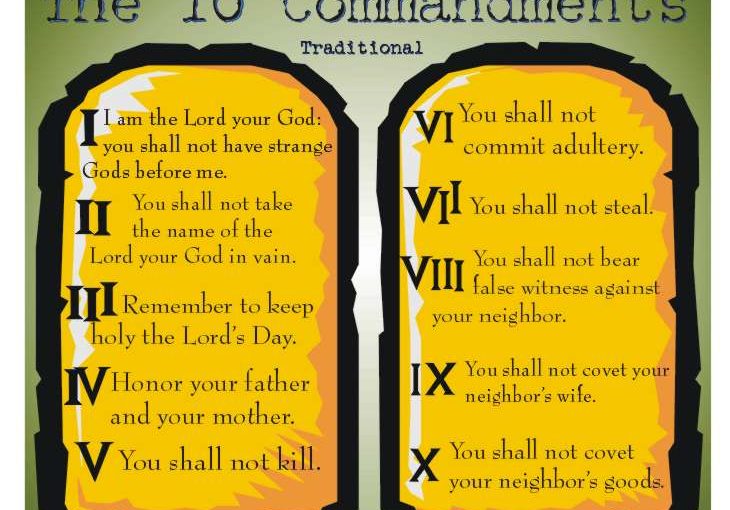
Ten Commandments Then and Now

Today’s Reading: Exodus 19, 20, 21, Psalm 33, and Ephesians 5

As we read through today’s readings, we come upon the Ten Commandments. I pause and meditate to remind us of them and connect some of the new testament verses to the old.

“You shall have no other gods before[a] me.

“‘You shall worship the Lord your God, and him only shall you serve.’” Matthew 4:10 
“You shall not make idols.” “No servant can serve two masters.” Luke 16:13
You shall not take the name of the Lord your God in vain.” But I say to you, Do not take an oath at all, either by heaven, for it is the throne of God, Matthew 5:34 
“Remember the Sabbath day, to keep it holy.” “The Sabbath was made for man, not man for the Sabbath. Mark 2:27 
“Honor your father and your mother, that your days may be long in the land that the Lord your God is giving you.” Whoever loves father or mother more than me is not worthy of me, Matthew 10:37 
“You shall not murder” But I say to you that everyone who is angry with his brother[c] will be liable to judgment; Matthew 5:37 
“You shall not commit adultery. But I say to you that everyone who looks at a woman with lustful intent has already committed adultery with her in his heart. Matthew 5:28 
“You shall not steal.” And if anyone would sue you and take your tunic,[h] let him have your cloak as well. Matthew 5:40 
“You shall not bear false witness against your neighbor. I tell you, on the day of judgment, people will give account for every careless word they speak, Matthew 12:36 
“You shall not covet your neighbor’s house; you shall not covet your neighbor’s wife, or his male servant, or his female servant, or his ox, or his donkey, or anything that is your neighbor’s.”

“Take care, and be on your guard against all covetousness, for one’s life does not consist in the abundance of his possessions.” Luke 12:15 

Psalm 33:4  For the word of the Lord is upright,
    and all his work is done in faithfulness.

Trust, believe, and obey His words.  If you fall short, turn to Him, repent, and learn to live again.

Ephesians 5:1-2 Therefore be imitators of God, as beloved children. And walk in love, as Christ loved us and gave himself up for us.


Dear Lord, we pray for obedience.  Your laws were first created to provide us wisdom on how to live and show us how to serve one another.  Yet we often do fall short.  Lord, you then sent your son to model and spoke the truth.  Help us to live these commands out for You and a future place in your Kingdom.  Amen

Wise Men Seek Counsel

Today’s Reading: Exodus 14-16; Ephesians 4 

Countless times as a child, many of us wish that we could just grow up. Many times we did not want to hear the guidance that many people would give us. We could not wait for the day to come when we will be adults and we don’t  have to listen to anybody or ask for help. But as we grow up and become adults, we understand that we do need assistance and help. Sometimes it is hard to ask for help and assistance. Sometimes it can be difficult to hear the advice, but when we become true adults and mature to understand we are able to get to a new level of maturity.  

Some of our most recent ideas of Moses come from “ The 10 Commandments” movie. In the movie we observe Moses’ transformation overnight. This seems like a week or months journey but it actually was 40 years from when Moses left pharaoh until he returned.  The next installment that we see is the “Prince of Egypt”, which was the Disney adaptation. In this, it still seems as if it was a matter of months or years from Moses’ escape from Egypt to his return. The reason for this timeline realization is due to the passage from today’s reading.

As we read the story of Moses and the exodus of the Israelites we have had different perspectives on the timeline. When Moses fled Egypt the first time he was 40 years old. When Moses came to deliver the Israelites from Egypt, he was 80 years old. When the Israelites left the wilderness and entered the Promised Land Moses was 120 years old. This new understanding of the true timeline can bring to light new thoughts of Moses from our past experiences.

In today’s reading, Moses is met with his father-in-law, Jethro. This meeting takes place after Moses has been blessed at the burning bush. This meeting happens after the Israelites have been in the wilderness for sometime. So Moses is about 80+ years in this scenario.

In this scenario, we see three things happening.

  • Jethro comes to Moses and blesses him and gives him encouragement on the things that he has done. Jethro also observes Moses in his leadership of the Israelites. 
  • Jethro gives Moses some amazing advice. He has observed Moses, and is concerned for his welfare and his livelihood and his relationships between his family and his duty to his people. Jethro gives advice on how to separate and delegate his stewardship and authority that this has been given to him by God. Jethro is a man who has had a lot of experience and leadership himself. Moses is a product of Jethro’s leadership and mentorship.
  • Jethro also understands that God has given Moses this position. Moses also understands Jethro’s love for him. Moses is considered one of the most influential individuals in Judeo-Christian law.  But he still seeks council for his leadership.

Many times in the Bible we are giving glimpses into how very wise and influential men have been given counsel to help them to elevate to the next level. In this passage, Jethro gives great counsel to Moses. Earlier in Genesis, Abraham receives great counsel from Melchizedek.  And countless times in and through the Old Testament and New Testament God has given counsel through prophets and apostles.

In all areas of our life, we have to understand that there are other individuals who are able to give us insight and wisdom that we may not be aware. But we need to be understanding and aware of how God works in those individuals he puts in our lives. Is there someone in your life who is giving you wisdom today? Is there someone who is breathing words of counsel into you? Lord, allow us to understand and hear your words to many videos that you were giving us. May you bless us this week so that we may be blessings upon others, and to show your glory.

Be blessed.

Can I Please Have Your Attention?

Today’s reading as part of our journey through the Bible this year is Exodus 10-12 and Ephesians 2.

Who do you most relate to in the story of the Israelites being enslaved in Egypt and their ultimate departure? Do you relate to Moses who did not think he was capable because of his past sin and lack of confidence in his ability to take on a significant leadership role? Do you relate to Aaron who played a key role in the communication with Pharoah on behalf of the Israelites but who maybe didn’t get the credit his brother Moses did? Or do you relate to the Israelites being enslaved for many years?

Most of us probably would not say we are most like Pharoah. However, we may be more like him than we would like to admit. After the 7th plague..yes 7th…Moses and Aaron went and delivered a message from God to Pharoah in Exodus 10:3 asking, “How long will you refuse to humble yourself before me?” He would either refuse to let the Israelites go like God instructed or he would say he would release them but later change his mind or refuse to let them all go along with their property…even after 7 plagues!

Do you feel like nothing is going your way? Do you like you just keep taking right hook after right hook? If so, I think it should really cause us to pause and reflect on if we are humbling ourselves before God and giving our problem(s) and life to Him. Is it possible that He’s just trying to get our attention?

We must ask ourselves…

  • Am I putting God first in my life?
  • Am I giving my problem(s) to Him in prayer?
  • Do I think my problems are too big for God?
  • Or do I think my problems are too small for God to care?
  • What is God trying to teach me through these challenges?
  • Could He be letting things happen in my life to draw me closer to Him?
  • Could He also be using my challenges for His bigger purpose and glory in ways I might not be aware of yet or even ever will be on this side of eternity?

Ultimately, what God wants is our heart. He wants our faith in Him. He wants us to trust and rely on Him. He wants us to put Him first and humble ourselves before Him so that we cannot brag about anything but Him and His provision and grace.

Ephesians 2:8-9 reads…

“For by grace you have been saved through faith. And this is not your own doing; it is the gift of God, not a result of works, so that no one may boast.”