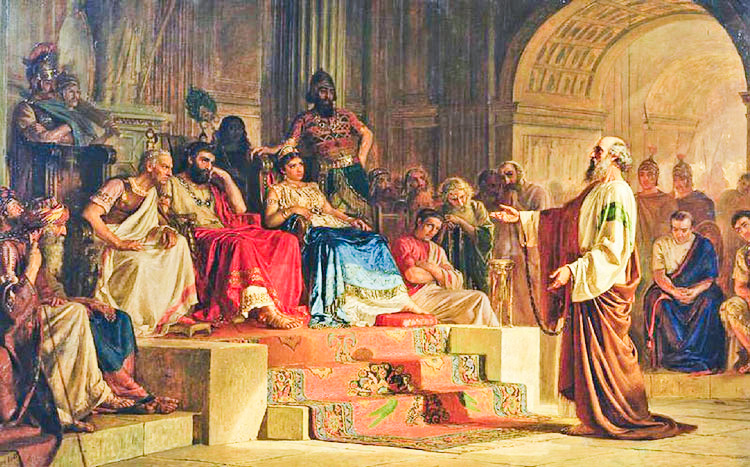
King Agrippa II

And Agrippa said to Paul, “In a short time would you persuade me to be a Christian?”[ 29 And Paul said, “Whether short or long, I would to God that not only you but also all who hear me this day might become such as I am—except for these chains.”

King Agrippa had asked to hear Paul’s case.  What he heard was Paul’s testimony of transformation and the essence of why he tells of the glory of God.  Today’s reading is from  Acts 25-26

Paul is brought before King Agrippa and other prominent men to tell his case even though no one has been able to find any charges against Paul.  King Agrippa II was the brother of Drusilla, Felix’s wife. He was responsible during much of his rule for appointing high priests. Although he was Jewish by religion, the Jewish people disliked him, because he sided ways with Rome. He was a major political and religious person who had alternative motives in hearing Paul’s case to benefit future political maneuverings.

Like many people, King Agrippa stopped within the hearing distance of the Kingdom of God. He heard the Gospel but decided it wasn’t worth responding personally. Many of us still can hear or read a story and stop right there without believing.

28 Then Agrippa said unto Paul, Almost thou persuadest me to be a Christian.

Almost… how many almost times have you been part of an almost story? Times where you have shared the Gospel or an offering into a relationship with God and it was left at that. For myself, growing up I heard many caring individuals share their testimony of faith with me and didn’t accept the invitation.  Like King Agrippa, I was too worried about what others would say or think. Only by God’s grace did He still provide testimonies and acts of true love providing me with a truth of a genuine relationship with God.  Every testimony I hear through our bible journal provides daily reminders of how great and loving our Lord is.

How has hearing the Gospel impacted you? Has it turned your life around and given you the hope of eternal life, or a message of resistance. I wish it would have taken a short time. But God’s perfect timing is and was just in time.  I’m grateful for the many people who share their testimony with others.  Paul shared his testimony.  He spoke the truth that King Agrippa had known, still, the King wasn’t going to let this testimony change what Agrippa wanted the world to see.

Paul shares his testimony for all who are listening.  Do we shy away from sharing ours?

To this day I have had the help that comes from God, and so I stand here testifying both to small and great, saying nothing but what the prophets and Moses said would come to pass: 23 that the Christ must suffer and that, by being the first to rise from the dead, he would proclaim light both to our people and to the Gentiles.”

It’s not easy to share our testimony when we let our own human thoughts and worries get in the way.  But we have a Lord that will help provide the words and courage to share with others the hope of an eternal Kingdom.  We are all sinners.  But the two categories of sinners include saved and unsaved.

Romans 10:9 If you declare with your mouth, “Jesus is Lord,” and believe in your heart that God raised him from the dead, you will be saved. for it is with your heart that you believe and are justified, and it is with your mouth that you profess your faith and are saved… v13″ Everyone who calls on the name of the Lord will be saved.” 

It may seem hard and scary to give your whole life to God, but the price will seem minimal compared to an eternity without Him.  Take time to share your amazing testimony with someone today.

Prayers for a great day today!
Priscilla and Aquila

Wonder and the Extra-Ordinary

Today’s Reading: Acts 18

December 1, marks the beginning of the Season of Advent, the anticipation of the coming of Christ.  This has been a very cherished and waited season for my children and my wife and I.  It is a season of wonder and excitement and dreams.

This past week, I have been reading several devotions and bible studies that highlight the notion of wonder and expectations.  Sun Stand Still, gives several amazing and powerful devotions in where situations that seems ordinary, actually are a setup for God to do something extra-ordinary.   This season brings to thought of how the ordinary items and people can change the mindset and hearts of many: cattle trough, stable, baby, swaddling(burying) cloths, a birth scene, and shepherds.  God also uses our situations and circumstances to perform miracles in the midst of dire situations.  In the reading, we can see how unexpected and unprepared situations can be used to grow some of the most profound founders of the early church .

In Acts Chapter 18, Paul is on his missionary journey and has traveled from Athens to Corinth.  In Corinth, he meets an exiled couple from Rome, Priscilla and Aquila.  The three of them found a common trade, tent-making and go into business together. While in Corinth, Paul forms a church for both Jews and Gentiles.

 Acts 18: 1-4

After this Paul[a] left Athens and went to Corinth. And he found a Jew named Aquila, a native of Pontus, recently come from Italy with his wife Priscilla, because Claudius had commanded all the Jews to leave Rome. And he went to see them,and because he was of the same trade he stayed with them and worked, for they were tentmakers by trade. And he reasoned in the synagogue every Sabbath, and tried to persuade Jews and Greeks.

After eighteen months, Paul and the couple sailed to Syria and then to Ephesus.   In Ephesus, the couple helped to establish the church and minister to the people.

Acts 18 :18-19

 After this, Paul stayed many days longer and then took leave of the brothers[c]and set sail for Syria, and with him Priscilla and Aquila. At Cenchreae he had cut his hair, for he was under a vow. 19 And they came to Ephesus, and he left them there, but he himself went into the synagogue and reasoned with the Jews.

Acts 18:24-26

24 Now a Jew named Apollos, a native of Alexandria, came to Ephesus. He was an eloquent man, competent in the Scriptures. 25 He had been instructed in the way of the Lord. And being fervent in spirit,[d] he spoke and taught accurately the things concerning Jesus, though he knew only the baptism of John. 26 He began to speak boldly in the synagogue, but when Priscilla and Aquila heard him, they took him aside and explained to him the way of God more accurately. 

This trio of saints is an exhibit of how God can utilize and assist us in seeing the wonder and extra-ordinary gifts and scenarios for those who are about his will.  God has taken an ordinary introduction and trade, tent-making, into a profound group of church builders.  The ordinary has become extra-ordinary, the situation of the two set of people, both being exiled because of their belief in God.  Both are looking for sanctuary and find a common belief and friendship and relationship in each other.  This friendship doesn’t stop when the climate dictates that they must flee again, this friendship persist until they are called to a greater cause: Paul to Greece and Macedonia and Priscilla and Aquila in Ephesus to minister and mentor Apollos.


As we continue in this season of Wonder and Extra-ordinary can we allow ourselves to:

  • Open our minds and spirits to the possibility of God doing extra-ordinary things in our ordinary day?
  • Is there a potential relationship that you have not created yet that will produce greater results to show God’s love and awesomeness in wonder?
  • Are we willing to accept the unknown that God has presented us with and allow him to lead us in ways and place that we have not imagined?
  • Where has God welcomed us to be bold and courageous in his Word?


Father,

Thank you for the Wonder and performing miracles in the ordinary situations.  Allow us to be aware and open to the way you speak to us.  Allow us to expect the unexpected and listen for the extra in the ordinary. Amen

John Mark

Can you recall a time in your life when you failed?  Did you rebound from that failure and learn from it?  Or did you let it dictate your future and decide that you would never amount to much?

Today in our reading, Acts 13:1-13, we see how John Mark recovered from a failure.  We have to read beyond our reading for today to see the full story, but it is sure nice to know that his story does not end at the end of Acts 13.

John Mark was brought up in a prayer filled home.  In Acts 12:12, we read that after Peter was miraculously rescued from prison                          

“he went to the home of Mary, the mother of John Mark, where many were gathered for prayer.”  

As a young man, he was surrounded by the greatest men and women of the New Testament church.  He grew up listening to these men and their stories of the times they had spent with Jesus.  All of their prayers and struggles would have been shared with him.

John Mark may have grown up dreaming of the day that He too would be able to travel throughout the world preaching the gospel.  His uncle was Barnabas, and so when Paul and Barnabas were appointed to go on their missionary journey, John Marks’ opportunity to preach the gospel came to be.

There, in the town of Salamis, they went to the Jewish synagogues and preached the word of God.  John Mark went with them as their assistant. Acts 13:5

He would accompany them on their trip to take care of the work behind the scenes so that Paul and Barnabas could focus on their ministry.  John Mark had to be so excited to be doing what he had only dreamed of!

But, only 8 verses later in Acts 13:13 we read

Paul and his companions then left Paphos by ship for Pamphylia, landing at the port town of Perga.  There John Mark left them and returned to Jerusalem.

The word translated as “left,” in the original means “to desert”.  It means to leave in a negative way and to willfully abandon.  We do not know exactly why he left.  Maybe he was homesick?  Possibly he missed his wealthy lifestyle at home with servants to meet his needs.  Maybe he found he preferred to be served rather than to serve.  Or, maybe like many of us, he had unrealistic expectations.

No matter the reason he left, sometime later we read,

Barnabas agreed and wanted to take along John Mark.  But Paul disagreed strongly, since John Mark had deserted them in Pamphylia and had not continued with them in their work.  Their disagreement was so sharp that they separated.       Acts 37-39

Paul thought that he had messed up too bad the first time and was not prepared to give him a second chance.  John Mark probably thought that he had messed up so bad that he ruined his chance at ever being used by God on a missionary journey again.  

Thankfully John Mark did not give up even after a failure.  In the years ahead, John Mark proves himself over and over again.  Paul forgives him and goes on to recommend him to others.  We see this in Colossians 4:10 and 2 Timothy 4:9-11.  

John Mark had wondered if he would ever have another chance to fulfill his calling and be involved in ministry.  Now we see Paul confirming this, “He will be helpful to me in my ministry.”  From John Marks life we can take encouragement that failing at ministry or at anything in life does not erase the possibility of future use.  People may give up on us, but God never will.

Barnabas

Today’s reading is on Barnabas in Acts 11, 13, and 14.

One of the most supportive practices in marriage my wife and I maintain is the constant encouragement we provide each other. From helping each other manage the day-to-day routines when they wear us down, or from pushing each other to pursue our loftier aspirations and goals, the encouragement she has provided me has been invaluable in getting through tough times. Providing encouragement for her as well offers an interesting opportunity to build up people around us, not only in our own rapport, but in the experiences and paths they may encounter that lead them closer to God.

Enter Barnabas, member of the church in Jerusalem, moved when he heard the Lord’s word. According to Acts 11:24, Barnabas was “a g good man, full of the Holy Spirit and faith.” He was evidently adept at speaking and filling others with spiritual direction, as evidenced by how it’s further told after preaching to the church in Antioch, “a great number of people were brought to the Lord” after he spoke. In fact, Barnabas’s name itself, depending on the translation of the original Hebrew text, could mean “son of encouragement,” “son of exhortation”, or “son of consolation” – it’s clear this man had a talent for building up others.

So why is Barnabas so notable? It’s through his help we see Paul grow into the great missionary role he fills. It’s back in Acts 9 that Barnabas introduces Saul to the apostles after his revelation when no one else wanted anything to do with him. In Acts 13 they’re originally called by the Holy Spirit to serve as missionaries, we see Barnabas as the prophet and teacher originally mentioned, but quickly see Paul taking charge and growing into a great teacher in his own right. In Paul’s journey to spreading the word to countless people and eventually prison where the Epistles that would be included in the Bible were written, we see Barnabas helping all along the way, helping Paul along his path to his calling.

The importance of a good teacher can not be overstated – I’m sure some people reading this might be teachers, and to you I say thank you for your work. In Barnabas’s journeys across Israel, we see the power of spiritual teachers and encouragers, those who help others along their spiritual paths. Clearly, the importance of this spiritual assistance was not lost on Paul, who wrote about this very thing multiple times in his letters to the churches. In Colossians 3:16, “Let the message of Christ dwell among you richly as you teach and admonish one another with all wisdom through psalms, hymns, and songs from the Spirit, singing to God with gratitude in your hearts.” In Titus 2:7, “In everything set them an example by doing what is good.” And in 1 Thessalonians 5:11, he says “Therefore encourage one another and build each other up.”

Being encouraging and kind to others is simply the decent thing to do. But beyond that, building up and helping others learn and grow in their faith in the Lord does magnitudes for the Kingdom. Your sharing in spiritual wisdom and teaching empowers not only your fellow believers, but brings God joy from the gratitude and servitude your actions show. Building up others and strengthening their connection with the Lord reaps lifelong effects, bringing them ever closer to God. And when they grow closer to God, their lives with be more full of joy and peace that would ever be possible otherwise. So in all times, look to how you can advise and build up your brothers and sisters in Christ in order to further God’s glory.

Nobody But Jesus

Today’s reading is Acts 10:1-11:18 as we focus on Cornelius.

The Bible tells us Cornelius was a centurion in the Roman army meaning he commanded at least one hundred men and held an important social status. Despite his non-jewish, Gentile background, we are told in Acts 10:2 that he was devout, feared God, and gave alms or money to the poor and needy. Being a believer, Cornelius likely thought he was already being used by God for a purpose with his favorable position of power. However, we serve a big God who has bigger vision for each one of us and the people of this world than we can see. Cornelius is visited by an angel telling him to send a few of his men to get Peter who he’s never met and doesn’t know. Not coincidentally when Cornelius’ men show up, Peter just had a vision from God (Acts 10:9-15) telling him that the Gospel was available to all nations. Peter then went with Cornelius men to Caesara helping bring the Gospel through the Holy Spirit to them and all the Gentiles.

As I read these verses, I could not help but think of and look back on my notes from a sermon Pastor Mike Baker from Eastview Church did a few years ago on Genesis 12 where Abram is called to leave his country. Pastor Mike said, “Faith is not a ‘stay’…it’s always a ‘go.’” If you ‘stay,’ you don’t need faith and you can’t grow to be all God’s called you to be. God doesn’t give us the details of the future even when we are in turmoil wanting to know His plans for two reasons. First, we would likely freak out if we knew everything that would happen. Second, we would try to take over and mess it up thinking we can do it better than God can. Cornelius could have just said, “Hey God..I’m doing good things here as a centurion. I’m giving to the needy and using my position for good, and I have 100 men here under me I can witness, too.” However, God called him for bigger things..to bring the Good News of Jesus through the Holy Spirit to all the Gentiles and letting them know that His forgiveness through the cross was available to all people and all nations (Acts 10:34-35, Acts 10:44-48 Acts 11:18). He called Cornelius to “go” and do bigger things, he obeyed, and look what happened.

Today, on Thanksgiving, I’m grateful for Cornelius, the Holy Spirit, and the big God we serve that is always working on our behalf.  Sadly, I don’t know much about my genealogy, but likely similar to many reading this, I don’t think I have any Jewish roots. I’m thankful that Cornelius obeyed God’s command so we non-Jews know that we are also one of God’s people through the grace of our Lord and Savior Jesus Christ. We can be thankful Romans 8:26-28 tells us the Holy Spirit is always working on our behalf and interceding (just like here to come to the Gentiles and make Jesus’ forgiveness available and known to everyone). Despite whatever challenges and changes in your life you may be going through today, you can be thankful that He working ALL things for His good. Be grateful you don’t know and can’t control the future because through His power within you, He can do more than you can ever ask or imagine, and He will be glorified (Ephesians 3:20-21), so that ultimately through you the world can see “nobody but Jesus.” How blessed are we that He uses us for His purpose.


Ananias


Todays reading is Acts 9 1:18

If you feel like you read this passage recently, you are right. We read these exact same verses in October while looking at Paul’s life. This story is an awesome account of God’s calling on Saul’s life and also includes some amazing circumstances for a man named Ananias.

Have you ever wished you could hear directly from God? Do you feel like it would be so much easier to follow His plan if He would give you step-by-step instructions on how to proceed in a certain situation? I’ve got to be honest, I have wished for a vision or instructions from God many times in my life. I have reasoned with myself that I would be willing to do anything for God if I could be positive I was doing exactly what He asked of me. I’ve told myself that I could be braver than ever before, willing to put my life on the line if I was assured that I was working His plan. Ananias’s willing and obedient response to God’s instruction is God’s desire for our response to the promptings and instructions He gives to all of us.

Hopefully we remember from October that Saul was a zealous and well-known Christian killer. He was feared for his persecution of anyone professing Christ instead of Judaism. He made it his job to try to extinguish anyone who followed Jesus. He had a reputation that struck fear into the hearts of Christ-followers because they knew he had the power to take action against them. We learn in these verses that God personally met with Saul on his trip to Damascus and Saul had a change of heart after his encounter with God. God left Saul on that road blind and helpless, dependent on others for everything. Saul’s friends took him into the town of Damascus and he remained there blind for three days.

“Now there was a believer in Damascus named Ananias. The Lord spoke to him in a vision.” Ananias replied, “Yes Lord”. Ananias recognized his Lord’s voice and had a willing heart, immediately. The Lord said, “ Go over to Straight Street, to the house of Judas. When you get there, ask for a man from Tarsus named Saul. He is praying to me right now. I have shown him a vision of a man named Ananias coming in and laying hands on him so he can see again.” “But Lord” exclaimed Ananias, “I’ve heard many people talk about the terrible things this man has done to the believers in Jerusalem! And he is authorized by leading priests to arrest everyone who calls on Your name.” But the Lord said, “Go, for Saul is my chosen instrument to take my message to the Gentiles and to kings, as well as to the people of Israel. And I will show him how much he must suffer for my name’s sake.” Ananias trusted God and obeyed God. No matter how scary or dangerous his circumstances seemed, he trusted God’s words and did what God asked him to. Verse 17, “So Ananias went and found Saul. He laid his hands on him and said, “Brother Saul, the Lord Jesus, who appeared to you on the road has sent me so that you may regain your sight and be filled with the Holy Spirit.” Instantly, something like scales fell from Saul’s eyes and he regained his sight.”

I know that this is one day in Ananias’s life. We don’t know how he managed the rest of his life, but I think it is safe to say that he had practice in trusting in and obeying God. He probably wouldn’t have been asked by God to do his part in this day if he hadn’t proved himself faithful earlier in life. I want to be characterized by answering, “yes Lord” when God calls me. I want my normal response to be obedience to Him when He gives instruction or makes me aware of something I need to do. I want to be usable to God no matter how much fear I’m tempted to fill with when I understand His plan. I want my first response to be “trust in Him” rather than thinking through how I am going to manage a situation. These responses seem so simple and natural while I’m in God’s presence. When I am communicating with Him, I am crystal clear on who He is; Power, Perfection, Unconditional Love, Above all, He knows everything, and He is mine. In this place, nothing seems hard because I know Who is with me. The problem is that I get distracted by my agenda. When my focus moves to me and my stuff, I start relying on my power and my ability instead of His.

Simon the Sorcerer

Today’s reading is Acts 8:9-25 which provides the account of Simon the Sorcerer.

Sorcery is a means of working magic with the assistance of the devil or evil spirits – which is specifically forbidden by God in the Old Testament. Simon the Sorcerer had bewitched the people of Samaria for a long time. The people of that city mistakenly thought that he had the power of God. Simon’s probably felt like his “celebrity status” was at risk when Philip came and people starting believing in Christ and following Philip as he preached. So, Simon ended up joining in the crowd and being baptized. We read that he was “amazed” at the miracles being done through the power of God.

Specifically, Simon saw the apostles laying hands on those being baptized and them receiving the Holy Spirit. He offered them money, trying to buy that power. Peter wasn’t fooled. He knew Simon wasn’t truly seeking God. Following Simon’s offer is a fairly harsh reaction by Peter. Simon’s reaction to that was to simply ask to be prayed for so that he would be okay from all that Peter had said he deserved for his instead of actually repenting of his sin, he just asked Peter to pray for him that “none of the things which you have spoken may come upon me” (verse 24). In correcting Simon, Peter told him, Your heart is not right in the sight of God. Repent therefore of this your wickedness, and pray God if perhaps the thought of your heart may be forgiven you”.

What Peter knew, that Simon didn’t, is that God expects us to serve Him FULLY – in thought and deed. We cannot expect to have the full benefit of salvation while not truly repenting or changing our behavior. Saying the words and going through the motions is not enough. God isn’t looking for us to be perfect – He knows we can’t be. But he does know our hearts, and if we truly repent, salvation is freely given.

Philip

What does the holy spirit do?  In How To Be Filled With the Holy Spirit, AW Tozer says “the Holy Spirit came to carry the evidence of Christianity from the books of apologetics into the human heart and that is exactly what He does.”  Today, we get a clear picture of how the Holy Spirit works.  Acts 8:4-12, 26-40 documents his works through Philip, a committed follower.

Simply put, the Holy Spirit lives inside those of us who are willing to host him.  When we do, only one result is possible.  Transformation.  This transformation exists in the life of the believer.  As Galatians 5:22-24 puts it, the believer gets love, joy, peace, patience, kindness, gentleness and self-control.  Those, however, are only part of the picture.  Philip is proof.  The heart conditions created in the believer by the Holy Spirit lead to greater things.  To put it another way, being filled in that way results in action.

When believers are filled with the Holy Spirit, they will act.  But, appropriate action requires direction.  We see this clearly in Philip.  When persecution went wild in Jerusalem, the Holy Spirit scattered the disciples.  This was a safety measure.  It’s not the first time God leads his followers away from danger.  Remember Joseph and Mary?  In Matthew 2:13, an angel of the Lord prompts them to take Jesus to Egypt. There, they will be safe.  Philip wisely listens to the Sprit’s prompting and soon finds himself in Samaria.  Incredibly, the Holy Spirit didn’t just lead Philp to a safe place.  He also sent him to a place where he could live fully.

In Samaria, Philip’s heart overflowed.  He could not contain the joy of Christ and did exactly what Christ-followers are called to do. Share the good news.  Verse 5 says he “proclaimed to them the Christ.”  Guess what?  It worked.  The crowds “paid attention,” resulting in healing and “much joy.”  In other words, an entire community was transformed.  This kind of change is not possible by a man.  Philip may have done the sharing and the preaching, but the Holy Spirit changed their hearts.

As I reflect on today’s scripture, I am captured by ONE thing that explains who Philip was.  You see, this post was supposed to be about who him.  Ironically, this post is about Philip and who he was.  Its just that who he was is best described by the Holy Spirit.  To summarize, Philip gave up everything for God.  He became nothing so that the Holy Spirit could become everything.

Voice Recognition

In a recent conversation with a friend, I recounted a situation that left me feeling kind of yuck in my heart. Ninety-nine percent of the time, running brings a lot of joy and goodness to my world. Time to commune with the Lord, escape from the worries of the day, and work hard. But in this particular scenario, I allowed my frustration to get in the way and have a negative attitude about someone in a race. As time went by, instead of feeling content with my effort or even victorious of the outcome, I was left feeling pretty blah and embarrassed about the thoughts going through my head about this other athlete. It definitely took away from the joy of the hard work.

Most friends, when hearing this story, would brush it off and say hey, that other athlete has issues. Don’t worry about it, we all have negative thoughts. She said some pretty rude stuff in the past, anyone would think those thoughts. Shake it off.

But not this friend. She’s a wise truth-teller. She made a point of saying, ‘if you’re feeling that press on your heart, I’m not going to speak contrary to the work the Holy Spirit is doing in your life’. She asked me some really insightful questions to help me get to the root of why the Holy Spirit was working on me in this area. Multiple times I have recalled the conversation, mostly her example to allow the Holy Spirit to work, and not gloss over it, justify it, or try to absolve my conviction. There’s definitely a time to lift someone up, and there’s a time to allow the Holy Spirit’s conviction to do his work. My friend had the wisdom to know the difference, and clearly she is filled with the Holy Spirit herself.

I’m reminded of this outline I came across years ago – which helped me pray and process through different thoughts. It can be HARD to distinguish between thoughts from the Holy Spirit, my own thoughts, or even thoughts from the enemy. I love this tool to help recognize the voice of the Holy Spirit:

When we recognize the voice of the Holy Spirit, we can continually empty our hearts and minds of other voices, and make more room for him.

Today’s reading is all about Stephen, Acts 6-7. He’s often remembered as the first martyr, stoned to death, but his testimony begins much before his stoning.

The early church was growing in size in Jerusalem and they needed to differentiate roles. Specifically, they sought out disciples that were filled with the Holy Spirit and wisdom, to coordinate the needs and sharing across the body of believers. Stephen was chosen, and recognized as a leader in the church. As the church grew and multiplied, Stephen kept showing up, with more grace and Holy Spirit power, miracles following. Fear spread across the Jewish leaders. They made false accusations against him (claiming he was going against Moses), and chapter 7 outlines Stephen’s response. Picture a courtroom setting and this is his closing statement to the Sanhedrin (the same Jewish council that sent Jesus to his death). Again, so filled with the Holy Spirit and wisdom, Stephen rehearses for them how they are behaving just as their fathers did and resisting the Holy Spirit. From Abraham, to Jacob, to Joseph, to Moses, to Joshua, to David… he pointed out salvation through Christ, and their history over time of disobeying God and persecuting his prophets. Stephen’s testimony of Jesus hit them right between the eyes. Verse 55 tells us that in that moment, being full of the Holy Spirit, he gazed into heaven and saw the Glory of God and Jesus standing at his right hand. This enraged the Sanhedrin and they took him out and stoned him.

Because of this persecution, the church scattered, and the salvation through Jesus was brought to more parts of the world. Instead of Stephen being shut down through his death, instead his impact was multiplied! His witness of living a Holy Spirit filled life and boldly proclaiming the truth of Jesus, was the catalyst for the church growing outside of Jerusalem.

Yes, Stephen was stoned to death and the first Christian martyr. But much more than that is the life he lived, recognized for how the Holy Spirit filled him, equipped him, and strengthened him.

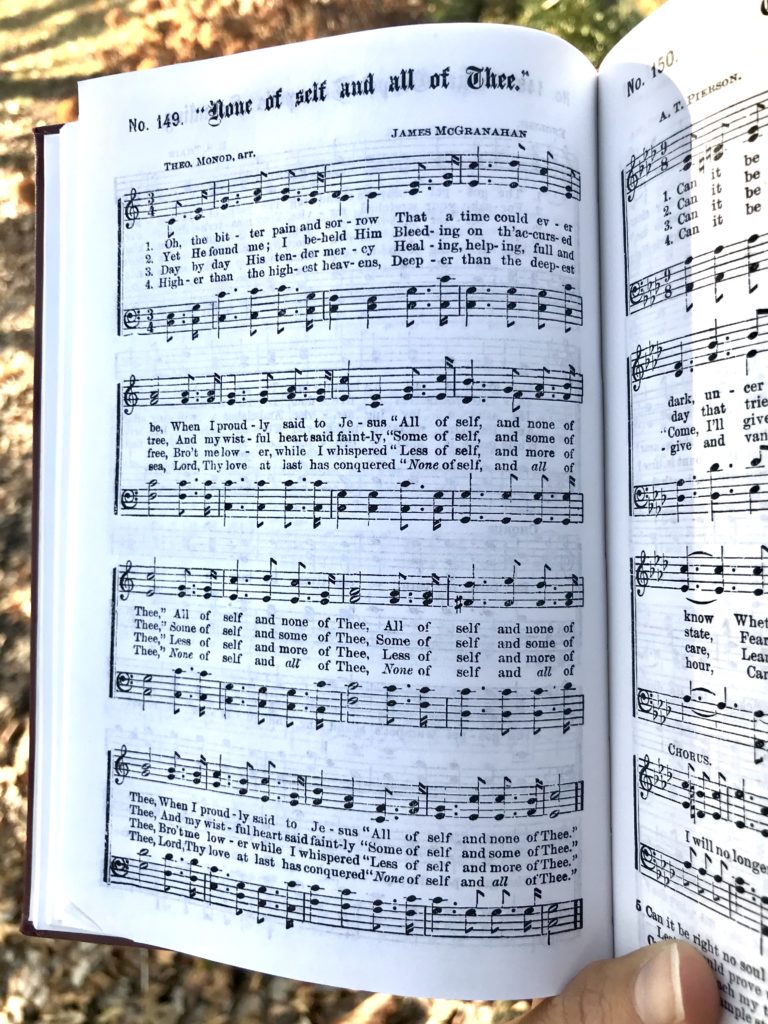
I can’t help but think of this hymn, All of Thee, that verse by verse shows the process of sanctification, from a life of pride and self, to a Spirit-filled life.

God, You are so faithful and abundant. Show me areas I need to surrender so I can continually be filled with the Holy Spirit. Amen


Truth, lies, livelihoods, lives

Recently an interview candidate shared some potentially incriminating historical information about himself and while on the surface it was negative, it left me with a greater feeling of trust toward the individual. Skill and personality are easier to identify, but trustworthiness is something more difficult to gauge. And no trust, no job.

The candidate “Lorenzo” (fake name to keep it private) had an engaging personality and possessed the necessary skills to perform the job. He was energetic and passionate and seemed like great fit for our company. The interview was going great!

Lorenzo then shared that he learned a foreign language through his experience at the school he attended. Inquiring further, I asked him what year he graduated and he said “I didn’t, they kicked me out!”

As Lorenzo continued to talk about his experience I realized the school that kicked him out happened to be the same school my kids attend. He didn’t realize this because he thought I resided elsewhere and he had very little information about me.

If Lorenzo would have lied about graduating I would have found out, and it would have been over for him. Instead, the situation gave me insights as to who this person is, and he earned further respect and trust. The truth set him free. The fact that Lorenzo made some life choices at the age of 15 (over 10 years ago) do not change the fact that he’s a highly skilled and likable individual.

In today’s reading Acts 4:32-5:11 we find two people who conspire to lie and it costs them their lives. One lie and they dropped dead on the spot. Yikes!

A few takeaways and thoughts about truth, lies and sin as we go about our day and pray for those who have not yet accepted the truth about Jesus:

  • God is serious about sin.
  • Lies are sinful and cause pain, distrust and even death.
  • We’ve all lied. Sin deems us guilty before our creator. This guilt demands punishment.
  • Jesus is the truth. One day will will stand before our creator (The Father) to give an account of all of our lies and other sins. On our own we cannot stand, but because Jesus already sacrificed himself as a penalty for our sin, we can then be deemed clean and forgiven. Jesus said to him, “I am the way, and the truth, and the life. No one comes to the Father except through me. (John 14:6)
  • The truth (Jesus) sets us free. Jesus answered them, “Truly, truly, I say to you, everyone who practices sin is a slave to sin. The slave does not remain in the house forever; the son remains forever. So if the Son sets you free, you will be free indeed. (John 8:34-36)