Daniel

As Usual!

What is something you do as usual??  Something that is part of your normal day?  Something you never skip or forget?  Is it working out, eating breakfast, having a cup of coffee, watching a favorite show, checking your phone, or having a daily quiet time?  Today we read about Daniel and learn the most important thing he did as usual.

When I saw that my assigned post for this week was Daniel, I thought about what I already knew about him.  The first story I recalled is Daniel being thrown into the Lion’s Den.  I remembered that he interpreted the kings dream. I also remembered how he and his 3 friends got thrown into the fiery furnace (thank you to a church musical I participated in back in the day, the song of Shadrach, Meshach, and Abednego will always be in my mind).  The last story that came to mind is that Daniel interpreted the handwriting on the wall.  

Daniel was a faithful man of God.  He faced these incredible situations and managed to live through them!  

Out of all these amazing stories about Daniel.  There is one verse that stands out to me the most.

Daniel 6:10

But when Daniel learned that the law had been signed, he went home and knelt down as usual in his upstairs room, with its windows open toward Jerusalem.  He prayed three times a day, just as he had always done, giving thanks to his God.  (NLT, bold print mine)

AS USUAL!!  This is what Daniel did!  He prayed!  Just as he had always done!  Giving thanks to God.  That is it!  We don’t read about his worries or his complaints about the incredible situations he was put in.  Can you imagine standing in a fiery furnace or amongst hungry lions and not wavering in your faith?  Daniel looked to God to provide an escape, and He did.  Every.  Single.  Time.  We see that Daniel did what he usually did – PRAYED!  

It seems so simple.  Pray – as usual.  Do we trust God’s promises as Daniel did?  

Daniel’s habits of prayer were known to all the people around him.  He prayed as usual openly before all who saw him.  There was no question of Daniel’s faithfulness to God.  Daniel glorified God by the life he lived.  His faithful walk allowed God to give him power and wisdom.  Daniel took a stand for the Lord and the Lord used his faithfulness to magnify His own name.  

Pray – AS USUAL – and see how God will magnify His name through you.

Take it Easy-kiel

Today’s reading is on Ezekiel (Ezekiel 1-3).

Think back to a time when you were forced to deliver bad news to someone. Bonus points if you were not the first person to deliver them bad news in a row. The difficulty of having to inform someone of something extremely unpleasant or devastating can be frightening, especially so if it’s directly a consequence of their own actions. This is especially true if you’re a non-confrontational person like me, a problem that tends to get exacerbated the closer you are with someone. Now imagine that scenario, directed to thousands of your fellow exiles after watching their homeland get ransacked and ravaged.

This offers a basic summary of the position of Ezekiel, one of many captives from the Babylonian’s siege on Judah way back in 2 Kings. Ezekiel had been training to join the priesthood at the time, but plans had changed slightly after Nebuchadnezzar had destroyed his hometown. Now, stuck in the desert with about 10000 other exiles, God appears to Ezekiel with a very convicting command – to go and tell his fellow Israelites about how their downfall had been a direct consequence from God for their disobedience in Him and turning away from Him.

Talk about salt in the wound. These people had watched their home been destroyed and their leaders slaughtered before their eyes, and Ezekiel the priest comes along to inform them it is their fault this all happened. While we know it to be the truth and the obvious results of generations of sin, I can not imagine the Israelites would have accepted this so easily or quietly. In situations where warning non-believers about the consequences of sin and the result of separation from God arise, it can be easy to feel incompetent or unable to express the Lord’s word properly, or to invite their often harsh or derisive responses upon ourselves.

But from this passage, and Ezekiel’s tale of captivity in Babylon, we know the Lord equips us to handle whatever may happen when we spread His word. As the Lord says in chapter 2 verse 7-8, “…the house of Israel is not willing to listen to you because they are not willing to listen to me, for the whole house of Israel is hardened and obstinate. But I will make you as unyielding and hardened as they are.” The Lord equipped Ezekiel in his unique circumstance of preaching to those with hearts angry and deaf to God by giving him tough, unshakeable faith and an equally tough disposition.

In 2 Timothy 4:2, Paul instructs this: “Preach the Word; be prepared in season and out of season; correct, rebuke, and encourage – with great patience and careful instruction.” To share the Word of the Lord is of utmost importance; to spread the Lord’s message and bring hope to those who need it through Him brings Him immeasurable joy. More so, the Lord has equipped us each with our own special way of reaching someone’s heart who needs it. Only the Lord knows how, when, and where exactly your talents may come in handy, but He has given each of us tools to share the Gospel effectively to someone responsive to your talents. He has given us each a mission, to go out and tell others about His good news, but not without planning and thought.

Ultimately, Ezekiel’s tale serves as a reminder of the necessity for sharing the Lord’s word with those who need to hear it. As believers, the Lord calls us as He did Ezekiel to help direct others away from sin and towards Him. It is as Peter says in Acts 10:42 of Jesus’s command to His disciples and to us: “He commanded us to preach to the people and to testify that he is the one who God appointed as judge of the living dead.” We are called as Christians to testify about our savior, and that even when difficulties arise from it, God has already given us everything we need to endure. Let’s all pray today for hearts and tongues of love and wisdom, and to be filled with His spirit, ready to share the good news with a world that desperately needs to hear about Him.

Baruch

Today’s reading is Jeremiah 36, 43, and 45 with a focus on Baruch.

Who was Baruch? Most know of the prophet Jeremiah, but may not know of Baruch, his scribe. Not only was Baruch given the task of writing down the prophecies God gave to Jeremiah, but he was also given the task to tell the Jehoiakim, king of Judah, and his officials what the prophecies said about the fall of Jerusalem to King Nebuchadnezzar when they would be taken into exile as a result of their idolatry and turning away from the Lord. I have to imagine Baruch’s thoughts when he was writing this down for Jeremiah. He was likely thinking this not good and probably wondering who the pour soul would be that had to risk his life to deliver this message….only to find out that pour soul was him!

What else was Baruch thinking? Was he scared for his life? Was he wondering why it had to be him? Was he bitter that although these were Jeremiah’s words, he was the one who had to risk his life and deliver the news? Was he thinking…why me? Whatever fears, anxieties, and maybe even bitterness Baruch had about delivering this message, he must have faced them and let God use him as His servant because he did in fact deliver the message. While we don’t know his thoughts, we are potentially given some insight that he may have been wondering some of these things and really thinking, “What’s in it for me?” In Jeremiah 45:5, God speaks directly to Baruch through Jeremiah and says, “And do you seek great things for yourself? Seek them not, for behold, I am bringing great disaster upon all flesh, declared the Lord. But I will give you your life as a prize of war in all places which you may go.”

Is your life in a spot right now where you are wishing you had accomplished more worldly success and you are not where you thought you would be at this point? Have you been a “behind the scenes” guy or gal like Baruch without much notoriety? Let us remember what the world, and what we being in the world, view as success is not what God views as success. Jesus tells us in Matthew 19:30 and Matthew 20:16 that the last will be first. I’m not saying we shouldn’t have big goals and aspire to be all God’s called us to be and use the talents and gifts He’s given us. If that means we are to be CEO, then that’s great. These verses also tell us the school cafeteria worker, the garbage person, the ditch digger, and the retail worker are viewed just the same in God’s eyes and potentially must greater if they are living for God’s purpose and His Kingdom instead of the world. Jesus says in Matthew 21:28 that even the Son of Man (Him) came to serve and not be served.

If we have not achieved the worldly success we desire or have faced financial or health hardships in our lives despite the fact that we believe we are doing most things right and living for Him and wondering why and “what’s in it for me?”, let us remember that God has given us “life” like Baruch and everything we truly need which is forgiveness from our sins through Jesus so we can live with Him for eternity. This is the greatest gift we could ever be given….for eternity is much longer than the life we are given on this Earth, whatever suffering or challenges we face or lack of worldly success and accolades while here. Do you also believe you have not been living for Him to this point? Well, He gave His life for you and forgives you, and now you have the option to give your life to Him from this day forward. Let us all pray for clarity on where we are today in our relationship with Him and for wisdom on where He wants us to go from here.

We Have to Decide

“The Lord of Heaven’s Armies says this, Come and learn a lesson about how to obey me.”

In Jeremiah 35, Jeremiah is trying to warn the people of Israel to stop disobeying God and return to him as their leader and one true God. For hundreds of years leading up to this chapter, the Israelites had worshipped other Gods and ignored God and His principles. They were living the way they wanted to live, serving the gods they wanted to serve and turning a deaf ear to God’s warnings to them that consequences would follow if they didn’t change their hearts. Sounds like a lot of people in this world today, and if I’m honest, my own heart at times in some instructions from God.

Way back in Numbers 6, Jehonadab took a special vow of dedication to God. He and his family for the next three hundred years, abstained from wine, did not build houses or plant crops or vineyards. They lived in tents. God promised them that if they dedicated themselves to Him, they would live long, good lives in the land. And while I don’t know exactly how they supported and fed themselves, they kept true to their commitment to God and lived for three hundred plus years. I guess it might be debatable how large of a sacrifice living without wine for a lifetime actually is, but not being able to plant and grow food, and not being able to have a home is definitely a hardship and an unsettling way to live. The point is, the vow this family made to God was not simple or easy, and it wasn’t just for a short time. This vow was obeyed for lifetimes, generation after generation. So I have to ask myself, how do I measure up? Do I fall in the camp of the Recabites, (Jehonadab’s family) obedient to my commitments to God, or am I like the Israelites, living the way I want to live and not caring what God thinks?

As usual when we read about the Israelites turning their backs to God, it is easy to judge their wicked hearts and selfishness. It seems so glaringly obvious to us as we read through the Old Testament, how stupid the Israelites seem (Don’t they ever learn?) and how much they replaced God with other gods and idols. “Other gods and idols” seem ridiculous and irrelevant to us in this country and during this age, until we put our own version of “gods and idols” into the story. Our “other gods and idols” might be called, money, self promotion, power, travel, selfishness, homes, pride, electronics, accomplishments, a gluttonous desire for food and drink, our children’s achievements, a boss…the options are endless for what we can replace God with in our own lives. If I listed something that is a specific struggle for any of us, the Israelites look a bit less foolish, right? We are more like them than any of us wants to admit. It is easy to see the lesson and who God wants us to learn from in this chapter.

I can’t help but wonder, how did these people do it? How, for generation after generation did they refrain from wine, live in tents and never grow food to feed them selves? It seems impossible in the culture they lived in to have kept this vow. While the Bible tells us that the Recabites kept their vow to God for generations, we know that they were not perfect people. They certainly had sin in their lives, but they were faithful in their vow to God, which mandated the bulk of who they were.   We don’t have other information that tells us what the rest of their lives looked like. Were they good husbands and wives, were they honest people, did they grumble and complain about their situations, did they get angry easily, were they proud because of the vow they took, did they envy others who lived differently, were they bitter inside because of their lifestyles?…the list goes on and on with possibility of what could have been in their hearts at certain times throughout their lives, but God still valued their vow/commitment and the fulfillment of that commitment. He valued it enough to have Jeremiah teach the Israelites and us what obedience looks like through the Recabites story.  People are imperfect, but we can still be faithful to God and keep His commands. I think sometimes we get bogged down by the sin in our lives. We feel defeated when we see it and may be tempted to overlook all of the areas where we are being obedient, because of sin in another. We can learn from the Recabites that it is possible to be obedient to God while still missing His mark in other areas of our lives. So this morning, where do each of us land? How much of our lives are we willing to commit to God? What areas are we faithfully obeying like the Recabites, and what areas are we like the Israelites, turning away from God so we can live as we please?

Jeremiah

Today we are in the book of Jeremiah – chapters 1, 18 and 32.

But the Lord said to me, “Do not say, ‘I am only a youth’; for to all to whom I send you, you shall go, and whatever I command you, you shall speak. Do not be afraid of them, for I am with you to deliver you, declares the Lord.” Jeremiah 1:7-8

God was calling Jeremiah to declare the coming of His judgement on the nation of Judah. This isn’t the kind of news a young guy – or old one, for that matter – probably feels good about spreading around. Jeremiah had never done this before,  and it seems that he wasn’t an eloquent speaker (1:6). But, God assured the young Jeremiah he would be with him. And isn’t that the most important to any calling – that God be with us? Jeremiah didn’t have to worry, because God called him to speak. And not on his own authority, but on God’s.

We each have a calling and a part to play as members of the Body of Christ. This can be a scary thought for us too, as we face the responsibility we have to other believers. Thankfully, God’s call never requires us to lean on our own talents and abilities first and foremost.

And the vessel he was making of clay was spoiled in the potter’s hand, and he reworked it into another vessel, as it seemed good to the potter to do. Jeremiah 18:4

In Chapter 18, God helps Jeremiah understand what was happening and why with the people of Judah. He sent Jeremiah to the house of a potter where Jeremiah saw the skill of the potter as he formed and fashioned a pot on his turning wheel – and as he fired and baked the pot in the furnace of fire.

Through all the twists and turns of the rotating wheel as well as the heat of baking kiln, the artistry and skill of the potter was used to shape and mold and form and complete whatever vessel the potter chose to make. If the clay in the hands of the potter was ruined in process – he would start right over again, turning it into another vessel – a good vessel – a vessel that seems right to him.

The picture of the potter demonstrates that the vessel that stays patiently in the hands of our heavenly Potter, as He carries out His best purpose in our lives, is the one that will be formed and fashioned the best way for us.

Behold, I am the Lord, the God of all flesh. Is anything too hard for me? Jeremiah 32:27

Here, God asks Jeremiah to buy land in Jerusalem. At the time this seemed crazy because Jeremiah was in prison, Jerusalem was under attack and disease filled the streets. But Jeremiah trusted God and bought the land without delay. The action showed his confidence in God’s ability to fulfill His promise of restoring Jerusalem and bringing His people back.

As Christ-followers, we can have the same confidence knowing that nothing is too hard for God. The same God who fulfilled His promise to rebuild Jerusalem is the same God who will keep His promises to us. Our steps of faith look different from Jeremiah’s, but our willingness to obey should be the same. By trusting and acting, we will grow in our relationship with Jesus and move boldly into God’s plan for our lives.

He may call us to quit a job, move to a new town or start a small group, but no matter how big or small the step, we have to have faith.

Faith Under Fire

Isaiah 36 & 37

Trouble will come.  Even to the faithful.  Hezekiah proves that in our reading today.  He had been a faithful king, returning the land to God.  He restored the temple and reorganized the priests to present it as a holy place for God.  He brought worship back, providing sacrifices and burnt offerings to God.  He reinstituted the Passover, commanding all of Judah to participate.  Hezekiah was faithful in all he did.  “He did what was good and right and faithful before the Lord his God. And every work that he undertook in the service of the house of God and in accordance with the law and the commandments, seeking his God, he did with all his heart and prospered” (2 Chronicles 31:20-21).  And yet, trouble came.

As we read today, Hezekiah’s faithful kingdom came under attack by Sennacherib, the king of Assyria.  He attached them where they were most vulnerable, in their faith.  Threatening to take their city and kill everyone, Sennacherib argued that God could not and would not save them.  That he would be just like the god’s of other cities that he had easily overthrown.  Why would it be different, he asked.  His talk rattled the city and sent fear through their leader, Hezekiah.  This is where faith and leadership collide.

While he may have been overcome with fear, Hezekiah knew where to put his hope.  First, as we see in Isaiah 37, Hezekiah seeks wisdom.  It is important to note who Hezekiah seeks wisdom from.  It was Isaiah, his most trusted prophet.  He knew that Isaiah was a Godly man that would give him direction from the Lord.  When the words of Isaiah were brought to him, Hezekiah’s faith was quickly restored.  This restored faith resulted in further action.  Prayer.

Something strikes me about Hezekiah’s prayer.  It is all about God.  Hezekiah is reaffirming who God is.  He acknowledges his most high position and sovereignty.  Hezekiah invokes God’s power not for his own salvation and maintenance of his kingdom, but for God’s sake alone.  Hezekiah’s true faith allowed God to prove to the world that He alone is Lord.

As I reflect on Hezekiah’s actions, I wonder about my own faith.  When I encounter trouble, do I invoke God for my own salvation, or do I see the opportunity for God to expand his kingdom?  If you have trouble in your life today, consider praying, as Hezekiah did.


With Wings Like Eagles

This weekend, over a hundred people are gathering from Central Illinois to run a charity half marathon to benefit families living in poverty in Central America. It’s been a really neat journey, from the spring when everyone signed up, learning about the communities we would be supporting… to then training through the warm and humid summer months, and now getting ready to toe the start line.  We will run the 13.1 mile victory lap of all the miles already run. The work is done. They hay is in the barn. The runners have done the hard training, and race day is the icing on the cake.

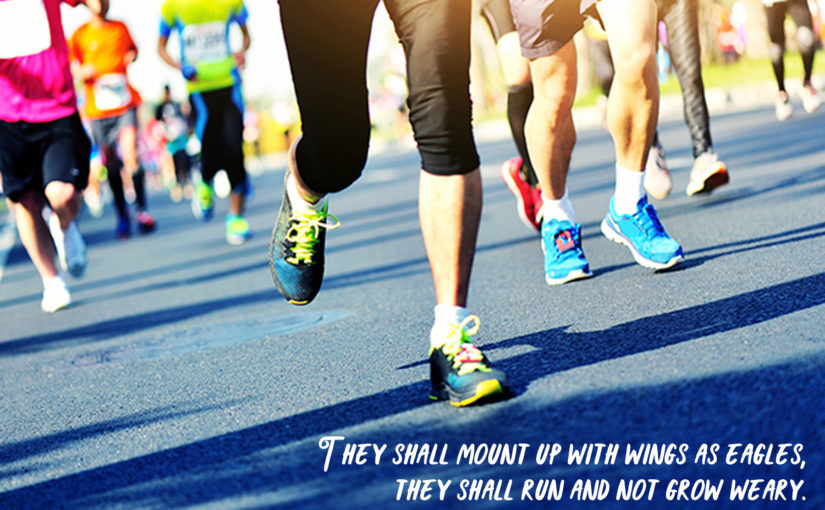
When I visualize running a successful race, it always comes with this image of leaping, and bounding, and flying – literally flying like an eagle. Isaiah 40:31 says we will mount up with wings like eagles, run and not grow weary!

When I thought about today’s journal entry post of Isaiah  – of course I was going to share the parallels of this run supporting Central Americans and our strength from God. As I was packing and prepping for the race weekend, there were several things that came to mind and I was looking forward to putting pen to paper.

Right in the middle of all of this – I received some really awful news. One of our runners has a serious health condition that came on and definitely can’t join us. Our entire team is amazing…  but this runner is also SO INSPIRING. She is new to distance running, and this would be her first half. The runs didn’t always come easy to her. And yet she continued to focus on the bigger mission, fundraised to help others, and week after week, she logged her workouts, coming back for more even when she wasn’t loving it. When it got hard, she showed up. She has encouraged and led others this summer, and I had no doubts she would cross that finish line – and I couldn’t wait to witness it.

I wish I knew why this isn’t her weekend, why this has happened. And why now? I wanted her to wrap up her summer with a big bow – that finish line ribbon! Having made this hard decision myself two years ago for a race I had to pull out of, I know she’s feeling sad, hurt, and discouraged. And it’s kinda lonely when everyone you’ve been planning and prepping with is moving forward and you’re not.

When I go back to our scripture – it’s that first part of this passage that I struggle with… you know, the WAITING.

For they that wait upon the Lord will renew their strength.They will mount up with wings like eagles, run and not grow weary, walk and not faint.

Have you had situations where you had the wisdom to make the hard decision to wait? Or, if you’re like me, sometimes you don’t wait, you keep pushing forward, and God has a way of forcing the waiting!! I can think of a few of those… and God knew that more time was needed.

Do you believe in the strengthening power of the Lord, that comes in the timing of waiting? Yielding? Listening? Being still?

Or do you view the waiting as a waste of time… unnecessary, or uncomfortable even?

Will you join me in praying for my friend that wisely made the hard decision to wait, that she will feel God’s comfort and strength in the process.

So why do you think God call us to wait? What has happened during your seasons of waiting?

From big things to little things, from waiting on medical test results, to a relationship to start, or for the promotion we’ve been working toward… there is a LOT of waiting.

On the other side of these waiting periods in my life, I can look back and see how waiting has grown my patience and perseverance. Waiting has taught me how to rely more on the Lord. Waiting has transformed me. Think of Moses – from the start of his journey with the Israelites, through the end. All the waiting, yes, but also all the growth he experienced!

If you have a moment today, reflect with me on the waiting seasons you’ve experiences and write down what happened. How you handled it, what you learned, how your perspective changed. The next time you are in a season of waiting, dust off these notes and get encouraged by your own personal testimony of waiting.

Here are additional scriptures on waiting on the Lord:

I waited patiently for the Lord; he inclined to me and heard my cry. He drew me up from the pit of destruction, out of the miry bog, and set my feet upon a rock, making my steps secure. He puta new song in my mouth, a song of praise to our God. Psalm 40:1 

The Lord is good to those who wait for him, to the soul who seeks him. Lamentations 3:25

For the Lord is a God of justice; blessed are all those who wait for him. Isaiah 30:18

I wait for the Lord, my soul waits, and in his word I hope; my soul waits for the Lord more than watchmen for the morning. Psalm 130:5

If you’d like to learn more about the prophet Isaiah, check out chapter 6, which outlines his calling from God as a messenger to the people – and his quick and willing response! Isaiah 53 is the chapter of the prophesy of Jesus, including his rejection and suffering, for our salvation.

 

Seeking wisdom, seeking Christ

Today’s reading is all about the pursuit of wisdom, the benefits of wisdom as well as the ensuing disaster that comes from a lack of wisdom.

Above all else, guard your heart,
for everything you do flows from it. (Proverbs 4:23)

Two personal stories were shared with me during the time I was reading today’s chapters (Proverbs 2-4):

  1. A highly-skilled person with a world-class education was terminated from employment due to behavior that was detrimental to the team.
  2. Another person who was highly-skilled and integral to the success of an extremely important business made some very selfish choices therefore put the company at risk.

Both of these scenarios had nothing to do with the person’s skill or even their passion for the job. The results were due to a lack of wisdom.

Jennifer wrote about Phinehas yesterday and the first thing that came to mind upon reading her post: Phinehas was wise and had he not been wise, it would have been really, really bad for a lot of people.

Similar for us today, we need wisdom, we need Jesus. In our schools, churches, government and most importantly in our homes as it starts with us seeking wisdom through Christ. We suffer from a lack of wisdom in others and our own as well. Please take the time to read today’s chapters, they are fascinating and filled with God’s truth and wisdom.

My goal is that they may be encouraged in heart and united in love, so that they may have the full riches of complete understanding, in order that they may know the mystery of God, namely, Christ, in whom are hidden all the treasures of wisdom and knowledge. (Colossians 2:2-3)

My own faith has strengthened from reading today’s chapters and writing the lists below because it becomes clearer how true God’s word is. I know the peace and joy of wisdom, and unfortunately have experienced too much pain from a lack of wisdom in myself or others.

Summary of the benefits of wisdom from Proverbs 2-4:

  • Understanding the fear of the Lord. 2:5
  • Knowledge 2:5-6
  • Understanding 2:6, 4:7
  • Success 2:7
  • Protection 2:8, 4:6
  • Discernment 2:9
  • A pleasant soul 2:10
  • Keeping existing assets (remaining in the land) 2:21
  • Prolong life, long life 3:2, 16, 4:10
  • Peace 3:2, 17
  • Prosperity 3:2, 10
  • Win favor & a good name 3:3
  • Keep a straight path 3:6
  • Health 3:8, 4:22
  • Nourishment 3:8
  • Discipline 3:12
  • High return on investment 3:14
  • Long life 3:16
  • Riches 3:16
  • Honor 3:16, 35, 4:8
  • Blessings 3:18, 33
  • Life 3:22, 4:4, 22
  • Safety 3:23
  • Fearlessness 3:24, 25
  • Sweet sleep 3:24
  • Held in confidence by God 3:32
  • Shown favor 3:34
  • Exaltation 4:8
  • Crowned 4:9
  • Run without stumbling 4:12
  • Path like the morning sun 4:18

Implications of a lack of wisdom from Proverbs 2-4:

  • Wickedness 2:12
  • Perversion 2:12
  • Darkness 2:13
  • Evil 2:14
  • Adultery 2:16
  • Death 2:18
  • Damnation 2:19
  • Lose assets (cut off from the land) 2:22
  • Detested 3:32
  • Cursed 3:33
  • Mocked 3:34
  • Shame 3:35
  • Deep darkness 4:19

Father God, your are holy and perfect and all wisdom comes from you!  We repent for our lack of wisdom, for our sins which lead to brokenness, for times of relying on our own understanding instead of seeking you first. We beg of your forgiveness. We ask for healing in situations where unwise choices of others have hurt us or the ones we love. We ask you to intervene in the lives of those who do not yet know you or acknowledge Jesus as their savior. Show them the way. Open our mouths to speak to the lost. Open our hearts to love the lost. Please grant us wisdom. We thank you in advance because we know you want us to seek wisdom and you want to give this to us. In the name of your son Jesus Christ, amen.

Phineas

Today’s reading:  Psalm 106, Joshua 22:10-34

Have you ever heard the phrase, “the eyes see what the mind wants to see”?  “Scotomisation” is the psychological tendency in people to see what they want to see, or what they are expecting.  Similarly, perception involves seeing and processing information through the filter of our personal intellect and emotions.  So, scotomisation sometimes shows up as a false denial or a false affirmation of our own perceptions.

In Joshua 22:10-34, our text for today, scotomisation almost caused a war.

It’s been a few weeks since we studied Joshua, so let me remind you of the setting – a good portion of the book of Joshua details how the Promised Land was divided amongst the nation of Israel.  The tribes of Rueben, Gad and half the tribe of Manasseh were the first to receive their land allotment on the east side of the Jordan River.  Before they could get settled, however, they had to help the remainder of the tribes conquer the land on the west side of the Jordan.  When they had fulfilled their duty and were finally able to head home, they stopped on the west side of the Jordan to build and altar to the Lord.  If you go to Eastview, you should remember this scripture. This is what Witness Rock, on the north side of the building, is modeled after.

When the remainder of the Israelite tribes saw the altar, they automatically assumed the tribes of Rueben, Gad and half of Manasseh had started their own pagan religion.  Why did they think this?  The altar, combined with their recent experiences in Canaan, led to scotomisation.  Remember, while God gave the Israelites the Promised Land, he didn’t just serve it up to them on silver platter.  Instead he made them work for it by fighting battles and taking the land city by city.  In the course of their battles, the Israelites had seen many altars to pagan gods.  So when they came upon the altar Reuben, Gad and half of Manasseh had built, they automatically assumed the worst and were ready to take out their unfaithful relatives, just like they had conquered the pagan-worshipping Canaanites.

One man stopped them – Phineas, the Priest.  Instead of jumping in to join the eastward-bound march to war, Phineas asked the Israelites to wait while he investigated what was really going on.  He assembled a small delegation of representatives from each tribe and went to east side of the Jordan to find out the truth.

“The whole assembly of the Lord says: ‘How could you break faith with the God of Israel like this? How could you turn away from the Lord and build yourselves an altar in rebellion against him now” (Joshua 22:16).

Fortunately, he found out the altar was NOT what they thought…

On the contrary, it is to be a witness between us and you and the generations that follow, that we will worship the Lord at his sanctuary with our burnt offerings, sacrifices and fellowship offerings (Joshua 22.27).

Does this story sound familiar to you?  Do you struggle with jumping to conclusions or making incorrect assumptions?  How do you overcome this tendency?  Slow down.  Seek to understand before taking action.  Even if done for the right reason, acting on wrong assumptions still brings hurt.  Heed the advice of James the brother of Jesus.

My dear brothers and sisters, take note of this: Everyone should be quick to listen, slow to speak and slow to become angry, because human anger does not produce the righteousness that God desires. (James 1:19-20).

Asaph

Today’s reading is Psalm 73-77 .

Do you ever sit down to pray but lack words? Has there been a time when you wanted to praise God for all He has done but somehow fall short in forming the right thing to say? The book of Psalms is 150 chapters of poetry for the expression of praise, worship and confession to God. It is full of honest struggle, sin, and confusion that turns into beautiful praise and the reminder of who God is and all He has done for us. Today’s reading is focused on chapters 73-77. Asaph, a leader of one of David’s Levitical choirs, has been accredited with writing Psalms 73-89. This third section of Psalms parallels the third book of the Pentateuch – Leviticus.

In these chapters we get to know Asaph and his struggles. In chapter 73 he is struggling with the feeling that the wicked are prospering all around him while he is being so “good” and not having the same kind of outward success. Sound familiar? In the first 16 verses he is complaining to God, asking how this could happen. He struggling to find the answers on his own. Finally in verse 17 he took some action and gained new perspective.

Then one day I went into your sanctuary, O God, and I thought about the destiny of the wicked.”

He stopped complaining and questioning and went to God. In his “sanctuary” he was reminded of God’s promises. As he worked through his questions he realized that their reward is temporary and his reward will be eternal. The reward is not on this Earth. He goes on to praise God for not turning away from him in the midst of his questioning and still belonging to him. When we recognize this in our own lives our perspective changes drastically in how we work, spend our money, spend our time. Do we have an eternal perspective or is it only success in the here and now? Are we mad and envious of other people’s success in comparison to our own? Thankfully, God allows us the opportunity to question and even complain a little. He is waiting to provide the answer but we may have to take a step towards his “sanctuary” and out of our heads to get it.

Psalm 73:21-28 “Then I realized how bitter I had become, how pained I had been by all I had seen. I was so foolish and ignorant. I must have seemed like a senseless animal to you. Yet I still belong to you; you are holding my right hand. You will keep on guiding me with your counsel, leading me to a glorious destiny. Who have I in heaven but you? I desire you. More than anything on earth. My health may fail, and my spirit may grow weak, but God remains the strength of my heart; he is mine forever. But those who desert him will perish, for you destroy those who abandon you. But as for me, how good it is to be near God! I have made the Sovereign Lord my shelter, and I will tell everyone about the wonderful things you do.”

Then in Psalm 77 we hear Asaph again in turmoil. He is in deep distress and holds nothing back in telling God all about it in verses 1-10. He is crying out to God. He feels rejected, overwhelmed, and lost. And then his thoughts turn around again in verses 11-20 and he starts acknowledging all God has done in the past and all the ways He has proven himself faithful. Reminding ourselves of Gods provision in the past is a great way of dissolving our current state of discontent.  He changed his focus from his present situation to worshipping God for all he has done and it changed him.

Even though I did not write the words in these Psalms I am amazed and how they resonate with me. I feel like I could have written them for my present situations. And I am thankful they are here to remind me that it is ok to question and struggle but also to teach me to worship in the midst of my struggle and to remember all that God has done.