Moses Prays for the People

Today’s reading comes from Exodus 32. Here’s a quick summary:

  1. Moses has been gone up on Mt. Sinai talking to God (for 40 days)
  2. While Moses was gone, the people get restless and think Moses isn’t coming back, and they start pestering Aaron (who’s left in charge) to give them a tangible god (idol) to worship.
  3. Aaron makes the people a golden calf.
  4. God sees this and becomes angry, and tells Moses he is going to destroy the people of Israel.
  5. Moses intercedes – he begs God’s mercy and forgiveness – for the people, and reminds God of the promises He’s made regarding the nation’s future.
  6. God agrees to spare the Israelites.
  7. Moses returns to the camp with the tablets written by the Lord and confronts Aaron and the people.
  8. After all of this, Moses asks who in the camp is on the Lord’s side and then instructs those that are to kill “his brother and his companion and his neighbor”.
  9. Moses speaks to the people about their sin and promises to go back up the mountain to beg God’s forgiveness for the people’s actions.

This chapter has quite a bit going on with its story and from a theological standpoint. For this Tuesday’s devotion though, I want to focus on Moses’ willingness to speak to God on behalf of the very people who have given up on him and begun worshiping a cow. (Seriously – can you imagine just how foolish these people looked to Moses who had just spent more than a month in God’s presence? They’re bowing down to a cow made of metal???)

Moses’ first response to God’s anger was to beg for mercy for the people. Then, after going down and seeing what had happened during his absence with his own eyes, he has an even better understanding of the gravity of the people’s sin. I’m imagining on a personal level there were likely feelings of hurt, betrayal, anger, frustration, sadness, embarrassment, etc.

But Moses didn’t respond to the people in a way that indicated he was thinking about himself at all. He cared for the people. He knew they had messed up but wanted them to be back in God’s favor again. He prayed for them, begged for mercy, and even reminded God of past promises in hopes of salvation for the people.

This isn’t a natural way to pray (at least for me, it isn’t). But as I reflect on these words, there are at least three very specific people in my life that I am convicted to go to God to fight for. Two are believers, one is not. But each has something (a golden calf, if you will) that is separating them from the Lord. Going to God and praying for his forgiveness and mercy on their behalf isn’t something I’ve thought to do – but just as Moses was willing to intercede for his people, shouldn’t we be willing to do the same?

The Ten Commandments

Exodus 20

Like many Bible stories, the 10 commandments have become something we don’t think much about.  Maybe we have just heard them too many times, or maybe we think we have them mastered.  Some even argue that the 10 Commandments are no longer relevant.  I found my answer as I read through them, preparing for today’s post.  They are indeed relevant. They are each necessary and, in fact, while they all work together. As I studied, one that stood out to me more than the others.  There is one, that if we sincerely focus on it, will make all the others easier.  Unfortunately, it is the hardest one for me to keep.  It is found in verse 8 and is seemingly simple.  It reads, “remember to keep the Sabbath, and keep it holy.”

What is the Sabbath?  It’s a day of rest.  We’ve all been taught that.   That’s the easy part.   I mean, we are all in for a day of rest.  Who doesn’t want a vacation; a break from all their troubles?  Of course, there is more to a Sabbath.  We are also commanded to “keep it holy.”  Merriam-Webster describes holy as “devoted entirely to God.”  That makes things a little tougher, doesn’t it?    You see, a Sabbath isn’t about sleeping all day, or escaping reality through the television, or laying by the pool.  Neither is it about being refreshed and “gathering strength to continue the ongoing competition of life.”  Those are not bad things, but they may not be a Sabbath.  Those things are about me.  A Sabbath is about God.

When we Sabbath, we are asked first and foremost to spend time with God.  Yes, prayer and scripture reading are part of that.  During this time, He will reveal himself to us.  This revelation establishes God as the deity and reminds us of his sovereignty.  This will produce worship.  Unfortunately, most of us will not get there.  We will fail to experience God the way he commanded us to.  Why not?  A simple answer is, fear.  Specifically, we are afraid of being alone with God.

Two amazing authors document this fear.  First, Henry Nouwen explains that “to truly Sabbath, we must also be silent, and silence, he says, provokes anxiety.  Ruth Haley Barton Corroborates this.  She refers to silence and solitude as a ‘fearsome’ place.  They know and have experienced it, first hand.  Of course, our fears are unfounded. In fact, until we finally confront this place of transparency and vulnerability with God, we may always consider ourselves for God, but we will never be with God.

Nouwen, Henri, The Way Of The Heart. HarperOne. 1981

Ruth Haley Barton;R. Ruth Barton;Dallas Willard. Invitation to Solitude and Silence: Experiencing God’s Transforming Presence (The Transforming Center Set) (Kindle Location 398). Kindle Edition.

Would You Rather

Four and a half years ago, my Moses (aka Nancy) sat on my couch and listened as I poured my heart out and shed all the tears about the crossroads I faced.  My marriage was in shambles and the options I was left with were equally awful. My life felt like a game of Would You Rather and I kept going back and forth in my mind with the decision to make. 
Nancy brought so much wisdom. She encouraged me to wait and see what God was doing in this situation. She opened the Bible and walked me through Exodus 14, our reading for today.

She connected me to the Israelites, standing at the Red Sea they could drown in, or the Egyptian army to be murdered by. When you read the text, you can feel their anguish and fear. They didn’t know what to do – and it feels like they were living their own real life game of Would You Rather. And like me, the Israelites were limiting their decision to the two options at that moment in front of them – drown in the Red Sea or be killed by the Egyptians. They cried out to Moses and in verses 13 and 14 you see his reply, which was exactly what I needed to hear that day from my Moses:

“Fear not, stand firm, and see the salvation of the Lord… The Lord will fight for you, and you have only to be silent.”

The Israelites didn’t want to choose either of those two options, and didn’t see a third different option. We don’t know exactly how much time spanned between them being at the Red Sea and realizing that the Egyptian army was after them, until the point God gave them a third option – parting the Red Sea. Some bible scholars think it was days… can you imagine each day the army getting closer and closer to you? Feeling so trapped and afraid? The enemy closing in? 

In my marriage, I felt pressure to make a quick decision, and honestly, I myself wanted to make a decision quickly and start moving in some direction, as awful as both options felt. But my Moses encouraged me to wait. Wait and let the Lord work, and He will provide a third option, or transform one of my current options. Do you think the Israelites thought the very Red Sea that they saw as a drowning death barrier, would actually become their escape route? 

This real event that took place 3,500 years ago brings us hope today that God can make a way when we see no way.  Is your back against a wall today and you see no way out? My prayer is that you will be patient with yourself, and let God lead you, like He has the Israelites, and like He has led me. Don’t let the world rush and worry you to a hasty decision, let the Lord work. Let Him lead. Let Him heal. Let Him provide. 

As we study Moses and the Israelites journey to the Promised Land, it’s easy to scratch our heads and wonder why they continue to doubt the power and provision of the Lord. He shows up every time for them, always coming to their rescue. And yet, every time trouble comes their way, they anguish and have so much fear. It’s humbling to think that all these years later I do the exact same thing. When I’m in the middle of a trial, do I first trust that God is going to bring me an escape route? Do I always trust that He will provide? Or do I try to solve and control everything quickly on my own?  I can look back at my life and time and time again He was working when I didn’t know it. He was preparing me in ways I didn’t see at the time. He surprised me with provisions right when I needed them. I want to better leverage my testimony of faith, into the next battle, knowing God will show up with a better option than I could have dreamed!  I’m encouraged and challenged to respond more like Moses and less like the Israelites. 

Heavenly Father, Thank you for sending people like Nancy into my life, who have served me like Moses, to remind me of your goodness and faithfulness. Thank you for the escape route that you provide when we feel like our back is against the wall. You are the best Defender, Protector, and Provider. Amen. 

The Ten Plagues

Writing Bible Journal posts is one of my favorite things to do. It isn’t easy, but the process of writing provides much needs spiritual food and direction for me, and I pray that our readers find it worth their time. After reading the assigned verses, for nearly ever post, I verbalize “I have nothing to say”.

After taking a deep breath it usually becomes clear that while I have nothing to say, God absolutely has something to say. So I wait, pray some more, read some more, pray, read, wait… then certain phrases start to speak to me.

This cycle puts me into detective mode which leads to asking questions like:

  1. Why did God do this or say this?
  2. Where is Jesus in this Old Testament narrative?
  3. In what ways am I like the sinner in the story?

That we may know that He is the Lord

and that you may tell in the hearing of your son and of your grandson how I have dealt harshly with the Egyptians and what signs I have done among them, that you may know that I am the Lord.”

Exodus 10:2

In Exodus 10:2 the words “that you may know that I am the Lord” stood out as the answer to “why”. On the surface we have Pharaoh, easily identifiable as the bad guy. Yay God, yay Moses, boo Pharaoh!

Digging in, the story is all about the explicit and powerful example that God is the Lord. He is all powerful. He has our days, nights, and every breath under his realm. He can move the mountains. He has control over the sun and moon, the wind, and tiny creatures such as locusts. If he has power over that, we can sure trust he has power over everything.

He wants us to know that he is the Lord so that we will stop trying to do things all on our own and look to put him in his rightful place, otherwise our lives will continue to get more messed up.

That we may serve him

So Moses and Aaron went in to Pharaoh and said to him, “Thus says the Lord, the God of the Hebrews, ‘How long will you refuse to humble yourself before me? Let my people go, that they may serve me.

Exodus 10:3

Another message for us: He wanted his people to be released from slavery so that they may serve him. Not so they would be happy. Not so they would be rich. Consider the metaphor, God wants us to be released from the bondage of sin so that we may serve him with full hearts. The enemy wants us to remain in the bondage of sin to keep us from doing the good work that God has in store.

The enemy continues to lie

No! Go, the men among you, and serve the Lord, for that is what you are asking.” And they were driven out from Pharaoh’s presence.

Exodus 10:11

Does this remind you of anything? A crafty serpent twisting the truth perhaps? Pharaoh attempts to deceive by suggesting that Moses was asking for only the men among them to serve the Lord. Fortunately Moses stood firm on God’s direct commands. No bargaining with Pharaoh. All or nothing. Go Moses!

Trusting what He has in mind

Our livestock also must go with us; not a hoof shall be left behind, for we must take of them to serve the Lord our God, and we do not know with what we must serve the Lord until we arrive there.” 

Exodus 10:26

Pharaoh again tried to find a loophole by suggesting that Moses leave the flocks and livestock behind. Moses didn’t know what God’s plans were specifically. All he knew is that he needed to patiently obey and the Lord would provide and guide.

Set apart

But not a dog shall growl against any of the people of Israel, either man or beast, that you may know that the Lord makes a distinction between Egypt and Israel.’

Exodus 11:7

Our neighbors have dogs that bark all day and all night. They bark at us when we leave and when we return.

Thinking of the time period that this verse was written there were probably a lot of nasty snarling dogs barking all over the place. I would love to just walk out one time and have a stare-down with the neighboring dogs and then we both go silently on our way. Like when Jesus called to the waves in Mark 4:39, “Quiet! Be still!”

Finally, this “setting apart” points to Jesus Christ. We are either with him or apart from him. Rick Jebb posted on The Passover on this site back in 2012… Dive into this post if you haven’t already. https://www.biblejournal.net/2016/02/28/passover/

Father God, thank you for your living breathing words in the Bible. Prepare our hearts for this day to receive your word on fertile soil. Give us wisdom. May we honor you and your son Jesus Christ today through obedience, humility, love, and selflessness. Amen.

Redefining God

Today’s reading: Exodus 32

Our scripture today opens with Moses on the mountaintop receiving the Law from God.  He’d been gone from the Israelite camp for 40 days and nights, and his people were wondering where he was.  In his absence, they grew impatient (or perhaps just manipulative) and convinced Aaron the high priest to build them a god they could see and touch, much like the gods of their Canaanite contemporaries.  Aaron obliged and built them a golden calf to which they bowed and worshipped.  God’s anger burned against his people.     

Honestly, I don’t think about idols very much.  Even though we, in 21st century America, don’t routinely build and bow down to idols made of precious metals, there is no doubt we struggle with idolatry.   I contend that anything we are we elevating to be more important than God is definitely an idol.  Anything, other than the Kingdom of God, in which we are investing our time and money has the potential to be an idol also.  Would you consider your job, house, higher education, relationships, vacations, cars, etc, to be idols?  As I contemplated each of these examples, I quickly realized they all lead to the exact same place.  They are all about glorifying me.  My struggle with idolatry is quite simply my tendency to make me and my selfish desires a higher priority than God.

In his book Radical: Taking Back Your Faith from the American Dream (2010), David Platt challenges his readers to consider how they have manipulated the gospel to fit their cultural preferences.  Do you think molding God to fit our cultural or personal expectations / desires / circumstances, rather than what the Bible tells us about who he is, is idolatry?   Platt contends that this behavior leads us to worship ourselves rather than the God who created us.  He wrote,

“We have this dangerous tendency today to create God, redefine God, to be who we want Him to be. And really we create a god who looks a lot like … us. He’s a nice, middle-class, American God. He looks like us, and he thinks like us, and he’s quite comfortable with our lifestyles. We think He’s comfortable with our self-saturated lukewarm faith. He’s comfortable with our apathy. He’s comfortable with half-hearted devotion to him. He’s comfortable with materialistic indulgences. We think He’s comfortable with all those things, because we are. We fashion a god who looks … a lot like us.”

If we are re-defining God to be who we want him to be, are we any different than the Israelites who re-defined God to look like a golden calf?

Great Joy

How popular would some of the great Bible stories be, if they could be made into reality TV shows?!  This would be one of the most watched.  The story of Joseph and how God used him to save his people and the people of Egypt.  I don’t know about you, but I could not pull off what Joseph did…especially when you consider the time line…it didn’t take a couple of hours to get from place to place.  I don’t think I could keep my identity hidden, much less treat my brothers with the compassion that Joseph did.  However, Joseph was so in tune with God’s plan (Genesis 45:5):  “But don’t be angry with yourselves that you did this to me, for God did it.  He sent me here ahead of you to preserve your lives.” 

Are you one of those people that gets great joy in giving to and taking care of others?  Can you imagine the amount of joy in Joseph’s heart when he gets to spoil his family with everything Egypt has to offer with the orders from the Pharaoh?!?!  Can you imagine the amount of joy in Jacob’s heart…not only to hear that his son was alive, but how well he was doing and that he would get to see him again.

I pray that joy finds you today.

Behind the Scenes – Genesis 41

Today’s Reading Genesis 41

Good Morning Bible Journal Readers. Happy Tuesday!

Today, as we read through Genesis 41,  it is truly amazing about all the events that take place in this chapter with Joseph.  There are so many moving pieces and ways God is able to show us His presence through it all. Without a faith you may find parts of it hard to believe. As believers though,  In reading this part of Josephs story I can be reassured knowing that God is always at work. Even in my shortcomings, or times that I think I have things in control.  I truly don’t, and need to remind myself, He does. God is  Behind the Scenes…always.  Thankfully, God is always working and directing us closer to Him. Think of Joseph, just in this chapter as he goes from sitting in a jail cell, to interpreting dreams,  to being in charge of Egypt. God always working behind the scenes to make His work move forward.

Genesis 41:16 Joseph answered Pharaoh, “It is not in me; God will give Pharaoh a favorable answer.”

How has God done this for you? Let’s take a minute to reflect.  For me, I think about my walk to and into faith. This included God orchestrating a move from one neighborhood to another. At this point I’m approached by a neighbor (Chet & Shannon Bandy)  to attend a service with them and consider joining their small group.  For a second we thoughts to ourselves, with a brand new mortgage, a struggling marriage, and a toddler. and two new jobs. Our ways were not working so well.  Faithfully, God was working behind the scenes. God orchestrated a life long friendship, a small group that I’m humbled to co-lead, an amazing transformation in both of us. God changed a “me first” marriage to a loving “one another”  marriage that now is formed around God and not ourselves.  I couldn’t of planned any of it.  But God can!  God is at work behind the scenes right now in you.  Marriage, friends, jobs, kids, medical situations… you name it.  It may not seem like He is to us at times because we are wanting things according to our plans and our timing.  But when we have faith, and trust in Him, his plans will work out way better than we can ever imagine.  God’s timing is always perfect. 

Proverbs 3:5  Trust in the Lord with all your heart,  and do not lean on your own understanding.   6  In all your ways acknowledge him,  and he will make straight your paths.

What is God orchestrating today? Trust His will! Remember Behind the scenes isn’t usually where we can see it or put our hands on it. Hebrews 11:1 Now faith is the assurance of things hoped for, the conviction of things not seen.

Family Battles


Todays Reading Genesis 37

Good Monday Morning, the story that will take place here could easily be portrayed in a melodrama or soap opera for today.  The setting is just after the beautiful vision of heaven, Jacob has and the ladder to Heaven.  Jacob has just witnessed the promise that his entire linage will lead to God, through Christ. The destination is seen, but the journey is not known.   Directly after the vision, Jacob travels north to escape his brother, Esau, from killing him because he deceived his brother from his birthright.  

Once in Paddan Aram with his uncle Laban, Jacob finds work as a shepherd. Jacob promised to work for his uncle for seven years for the hand of Laban’s daughter, Rachel.  After working for seven years and having a wedding and feast, Laban tricks Jacob and slips his first daughter, Leah, into Jacob’s wedding tent.  The next morning, Jacob realizes the deceit and questions the validity of the transaction and finds out that in the new country where he resides the first daughter must be married before the younger daughter.  So Jacob gives Laban an additional seven years to be married to Rachel. With each daughter, Laban gives a servant.  To Leah, Laban gave Zilpah and to Rachel, Laban gave Bilhah.  In total Jacob works for Laban twenty years: seven for Leah, seven for Rachel, and six working flocks. 

Jacob had twelve sons and one daughter by theses women: Leah: Reuben(1), Simeon(2), Levi(3), Judah(4), Issachar(9), Zebulun(10), Dinah (technically 11) ;  Bilhah: Dan(5), Naphtali(6); Zilpah: Gad(7), Asher(8); Rachel: Joseph (11); Benjamin(12). Leah was Jacob’s first wife; Rachel was the second wife; Bilhah was the third wife given to Jacob from Rachel; and Zilpah the fourth wife given to Jacob by Leah.  

After twenty years under his uncle’s watch, Jacob decides to leave Paddan Aram and return to his home of Canaan.  As Jacob attempts to leave Laban, Laban pursues Jacob and tries to kill him.  Once Laban catches up to Jacob, they made a truce to never cross paths again.  As Jacob returns home to Canaan, he sees his brother, Esau, advancing with 400 men and he again is afraid for his life.  The night before he meets with Esau whom he stole the birthright; he is placed in a battle against an angel for the entire night.  He then is crippled from his wrestling match, but given a new name Israel. After Jacob has reconciled with his brother, his daughter is kidnapped and raped by the new neighbors at Shechem. His sons, Simeon and Levi, take vengeance on the men at Shechem. Then Jacob’s true love, Rachel, dies in childbirth giving birth to Benjamin.

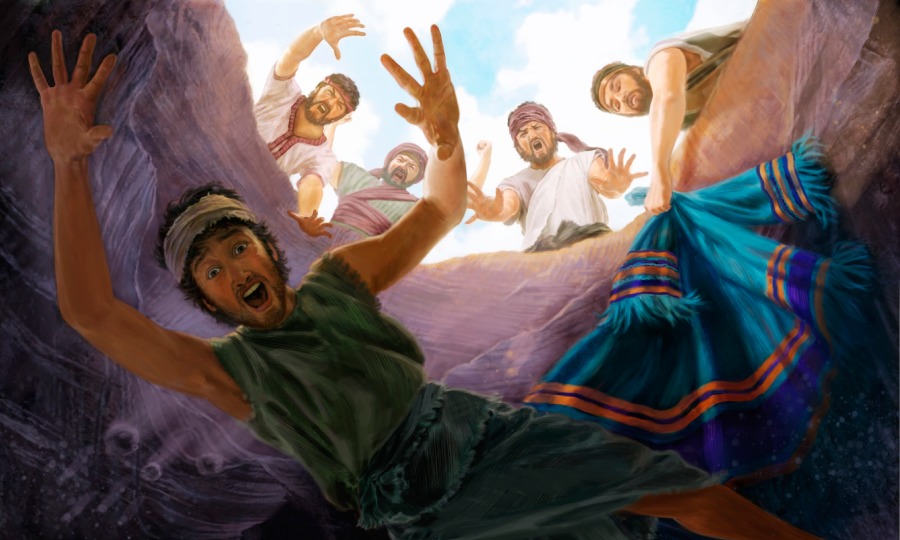
This brings us to the seventeen-year-old Joseph and his brothers and coat of many colors.  Joseph is one of the favorite son’s of Jacob because he is the offspring of Rachel.  He has been treated differently his entire life because he has not really had to share or live in the same tent as his other siblings his entire life. He has now the opportunity to interact act with them and trying to fit in he tells them the different dreams that he has about grandeur and prestige.  He fails to realize that these dreams would have harmful implications for him. Joseph then is deceived and sold into slavery by his brothers.  His brothers then deceive their father into believing his precious son is mauled and killed by animals.  

There are many themes that run through the story of Jacob and Joseph: 

  1. Be careful whom you share your dreams with. It is good and necessary to have dreams and goals.  This allows us to set a target and make plans to achieve the target and adjust our sights if we do not make the mark.   We must be thankful for our dreams and blessings and not brag or boast.
  2. Good intentions are good if they are put into action and followed through.  Genesis 37:21-30

.   21 But when Reuben heard it, he rescued him out of their hands, saying, “Let us not take his life.” 22 And Reuben said to them, “Shed no blood; throw him into this pit here in the wilderness, but do not lay a hand on him”—that he might rescue him out of their hand to restore him to his father.

29 When Reuben returned to the pit and saw that Joseph was not in the pit, he tore his clothes 30 and returned to his brothers and said, “The boy is gone, and I, where shall I go?” Rueben had the opportunity and the position to stop this entire scenario of the killing or entry into servitude for Joseph, but he did not act.  When we have the authority and the knowledge to act, we must be bold and not allow others to suffer because of our negligence and fear.

3. Model the behavior you seek.  Jacob had modeled the behavior of deceit from the beginning of his life.  He deceived his brother from his birthright.  His uncle with his brides deceived him.  He deceived his uncle when he ran away.  His sons deceived the men of Shechem.  His sons deceived Joseph.  His sons deceived him about Joseph.  We have to be mindful of our character and true nature.  We can perpetuate human nature or we can ask God to create in us a new creation daily to be more like Christ.  We will continually have these inner struggles, but with the Holy Spirit we are able to be strengthen for God’s work and glory.  

Lynden

Jacob’s Ladder


So, how did you sleep last night? Did you sleep in a bed? Do you have a favorite pillow? And, did you have any dreams? If you did, do you even remember what you dreamt?

Yesterday in our Bible reading, Ross did an amazing job of describing how Jacob schemed his own plan to steal the birthright from his brother Esau. Of course, Esau was furious with Jacob, so Jacob fled from his home and family. Jacob had to be exhausted from all that he had just experienced. His mind had to be swirling with many thoughts of what his future held. He was traveling to a place he had never been. Would he ever be able to return home?

Today, we will look at Genesis 28 and the story of Jacob’s dream.

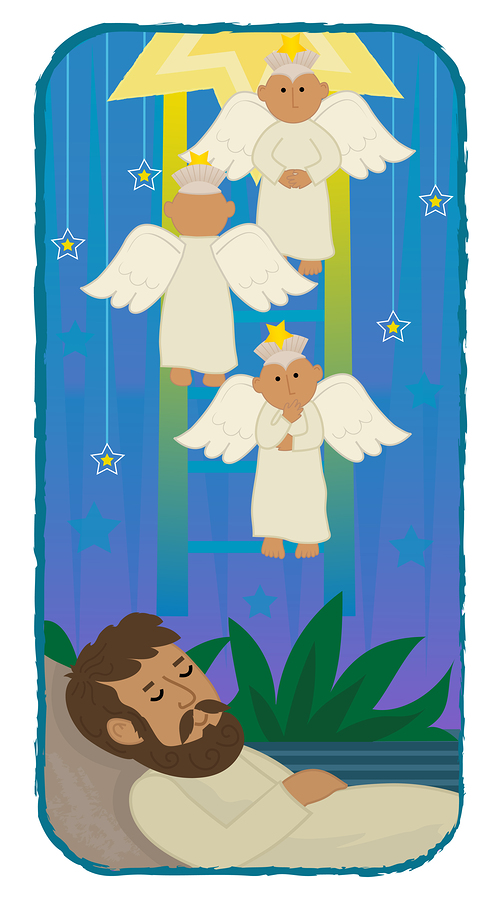
“Meanwhile, Jacob left Beersheba and traveled toward Haran. At sundown he arrived at a good place to set up camp and stopped there for the night. Jacob found a stone to rest his head against and lay down to sleep. As he slept, he dreamed…” Genesis 28:10-12

As Jacob slept, the Lord revealed Himself to Jacob in a dream. This vision opened up heaven for Jacob to see angels ascending and descending on a ladder from the throne of God. The Lord promised that Jacob’s descendants would return to the land, would multiply in population, and would bless all people on the earth. In addition, the Lord promised to be with Jacob for the rest of his life.

After all of the fear and anxiety that Jacob had felt, God gives Jacob this dream to say, “I will be with you.” There is no more guilt, fear or anxiety. Jacob is shown that there is no place he can go where God is not already there. “I am with you, and I will protect you wherever you go. One day I will bring you back to this land. I will not leave you until I have finished giving you everything I have promised you.” Genesis 28:15

In Jacob’s dream, God was at the top of the ladder and Jacob was at the bottom. The angels were going up and down the ladder to the throne of God. We still have the ladder from Heaven, but now Jesus is our ladder to Heaven. In John 1 Jesus the Son of God is at the bottom of the ladder. Jesus Christ has come down the ladder to join us here on earth.

Jesus Christ is himself the stairway that leads back to heaven. If you want to go to heaven, Jesus is the way. He is the ladder that will take you from here to there. “I am the way, the truth and the life. No one comes to the Father but by me.” (John 14:6) “Very truly I tell you, you will see heaven open, and the angels of God ascending and descending on the Son of Man” (John 1:51)

We all can see ourselves in the life of Jacob. Trying to scheme our own plans, running, anxious and fearful. We are not promised an easy life here on earth without struggles and pain. But God promises us that He is with us and will protect us wherever we go. God is waiting for us just as He was waiting for Jacob.

Jacob Gets the Blessing

Today’s reading is Genesis 27. We’ve been following the story of Abraham, seeing how God first promises great things to the progenitor of His chosen people and watching how miraculously God works through those who have faith in Him. Now Abraham’s son Isaac, having lived a long an accomplished life, is preparing to pass on his substantial birthright and inheritance to his son. But in what should be a celebratory family occasion in the blessed lineage of Abraham, we instead relate to a family struggling with selfishness and sin.

In Genesis 27:29-34, we see Esau, in a fit of feverish hunger, offer up his birthright to his deceiving brother Jacob in exchange for a simple meal of bread and lentil stew to sate his appetite. Again in Genesis 26:34-35, we see Esau marrying two Hittite brides, violating the laws of Abraham which forbid God’s people from finding brides among the local Canaanites. Not only does this endanger his legal claim to his firstborn birthright, but makes life “bitter” for his parents in the process, causing great stress and concern. While I’m sure this last sentiment may resonate with some readers, we see Esau tends to take as he wants in the moment, despite the blessing and direction of God.

In the climactic moment of our passage, as Isaac readies to pass on his blessing to his favored son Esau, his wife Rebekah attempts to control the situation through her own doing, fulfilling the promises God gave her: her sons would begin two nations, the older serving the younger. Taking advantage of her husband’s old age and loss of faculties, Rebekah creates a scheme of her own volition to instead pass the birthright to Jacob, her own preferred son. Dressing himself to more resemble his brother, Jacob tricks Isaac into believing he is in fact Esau, bringing his favorite meal and covering himself in goat skin to replicate Esau’s hairy skin. As Esau finds out about this injustice and cries out in bitter anger, he comforts himself with sinful thoughts of revenge and murder and his father passes.

Even as the tale of Jacob and Esau begins, I am convicted by how this passage forces me to confront my own sinful pride. We see it in Rebekah’s plan to bestow Isaac’s blessing upon Jacob. In an attempt to fulfill God’s promise through her own volition, she creates her own plan for transferring the blessing through deception and trickery. When Jacob learns of this plan, the only objection he raises is the fear of being caught and rebuked! I for one often find myself wondering what is right to do, and wondering how to do it in my own way under my own will. Not even the most fool-proof plan we craft could be more rewarding and gratifying than what God has planned for us, and he can do so in ways far more just and righteous we could plan. Rebekah was explicitly told by the Lord that she held the beginning of a nation in her womb, and had every right and reason to believe God would provide the means to enact His will. Yet she and Jacob attempt to do what they believe is “right”, without regard for honor or honesty, showing a lack of trust in the Lord’s work and unwarranted confidence in her own ability.

We also see our own pride and short-sightedness in Esau’s brash, upfront behavior. Esau was to receive the blessings and birthright of his accomplished father – a great responsibility as well as a magnificent gift. Without thinking of his future and without respect for his position, he tosses it aside for momentary satisfaction and physical fullness. He goes so far as to despise this wonderful birthright! Like Esau, we, as troubled sinners, are excellent at tossing aside the love and inheritance of our Lord without a second thought for a moment’s satisfaction. Without realizing it at the time, our clouded judgement forces us to focus on trivial, meaningless frivolities in an attempt to satisfy our hunger for more – a hunger only He can satisfy. We toss aside the incredible birthright God has given us in exchange for moments of sin and weakness. 

Ultimately, this self-reflection points us to the greatest truth we see in this passage: that God is greater than our pride and deception and short-sightnesses and bitterness. We have access to a priceless birthright: being the children of an incredible God whose plans are perfect and infallible, and who can use us, even in our most sinful moments, to further His kingdom. We know we never have to give up our inheritance into the kingdom of God for a moment’s happiness, for unlike Esau’s fleeting birthright, ours is eternal: the guarantee of our Lord and Savior being by our side for all time. We know we will never need a humble momentary meal to sate our appetites, for we now know as Jesus said in John 6:35, “I am the bread of life; whoever comes to me shall not hunger, and whoever believes in me shall never thirst.”

Today I will be praying for you, that when you are thinking of how to fill and soothe your own soul, that you would joyfully keep your mind and heart on your birthright, knowing that the Lord’s plans and gifts are far greater than fleeting pleasures. I pray that by spending time in the Scripture and in prayer when you are in need, that you would listen to the Lord’s plans for you and hold to the blessings He has planned for you. God bless.

-Ross B.