Focus Time

Thank you for following BibleJournal.net.  To date, we have 817 journal entries with more than 48,000 views!  Our focus, has been reading entire chapters so that we can experience the Bible in its entirety.  Starting tomorrow, we are going to make a small change.  Our daily scripture reading is going to be drastically reduced.  The goal is intimacy rather than broad understanding.  Our topic for the next 45 days is the Sermon on the Mount from Matthew 5-7.  As always, you will continue to receive a link to the day’s reading along with a journal entry from one of our 12 writers.

I hope you enjoy the new format.  Either way, we would love to hear from you.  Leave a comment, or email me directly at bj@bjarmstrong.com.

Blessings,
BJA

Valuable Consideration

2 Samuel 24, Psalms 56

Contracts often include language like “valuable consideration.”  It identifies the price, or the cost (not necessarily in monetary terms) that is required for the exchange of goods.  The amount of consideration provided is dependent upon the item changing hands.  To complete the contract, both parties must agree that the compensation offered will result in full payment for whatever is received. 

Today, in 2 Samuel 24, David receives something incredibly valuable from God.  Forgiveness.  In return, God asks for consideration.  He sends his servant Gad to ask David for the payment.  In this case, David’s payment takes the form of a burnt offering.  Gad instructs him to, “Go up, raise an altar to the Lord on the threshing floor of Araunah the Jebusite.  Araunah the farmer, attempts to give David the parts for the altar, the wood, even the oxen from his own stock.  But, David knew better.  He knew that any offering without personal cost, would not be an offering at all.  It is, as Dietrich Bonhoeffer puts it, “cheap grace.”  Without payment, David knows that his agreement with God would be null and void.  

So, how is it that we receive forgiveness without a costly sacrifice? the answer is that we don’t.  Thankfully, the full price was paid, for us, in advance.  According to Hebrews 10:14, Jesus is our “single offering” and  “he has perfected for all time those who are being sanctified.”  What does that mean?  It means that our agreement with God is paid in full.  There is no more consideration due.  It is worth pausing here.  Think about how valuable Jesus’ consideration was.  He effectively paid for all sins, for every person for all time.  It is promised in 1 John 2:1-2.  It says, “if anyone does sin, we have an advocate with the Father, Jesus Christ the righteous.  He is the propitiation for our sins, and not for ours only but also for the sins of the whole world.”

If the valuable consideration for our sin has already been given, then the only thing remaining is our agreement.  How does that work?  Romans 10:9-10 says that “if you confess with your mouth that Jesus is Lord and believe in your heart that God raised him from the dead, you will be saved.  For with the heart one believes and is justified, and with the mouth one confesses and is saved.”

Legacy

Legacy. What do you think of when you hear the word legacy? Do you care about yours or not? Well, I believe you should because we all leave a legacy and your leadership example determines your legacy. We are all leaders, definitely as parents and spouses and often professionally, but even those that aren’t married, don’t have kids, or don’t have a defined professional leadership role are still leaders. Other friends and co-workers are always watching and following you whether you intend them to do so or not so that makes you a leader. John Maxwell says leadership is influence. Your leadership example determines the impact you have on others which ultimately determines your legacy.

Our small group is currently reading The Resolution for Men and The Resolution for Women. This is my 3rd time through the men’s version, and I would highly recommend every man read it. It is like an instruction manual for being man, husband, and father by translating and breaking down what God instructs us to do in the Bible. It tells men how He created and empowers us to fulfil His leadership vision. Having children, when I think of legacy, I think of the legacy I want to leave for them first and foremost.

The book challenges us to think about how we define success for our children. It is human nature for us to define the success of our children by whether they achieve big things academically, athletically, and even socially with friends or being on homecoming court or in school leadership roles for example. However, this book challenges us that success for our children is only defined by them loving God and knowing Him as their Lord and Savior. Period. End of story. Thus, the legacy we leave in this way through our leadership by example is all that matters.

David tells us in his last words in 2 Samuel 23:3-5..

“The God of Israel has spoken,

the Rock of Israel has said to me:

When one rules justly over men,

ruling in the fear of God,

he dawns on them like the

morning light,

like sun shining forth on a

cloudless morning,

like rain that makes grass to

sprout from the earth.”

How do we lead our children in this way by our example so they know and love Jesus as their Lord and Savior?

  1. First, we must be in the Word daily. This keeps us centered and focused on God so we can know and understand Him and His will better making better decisions daily. This must be visible to them so they know you are in the Word. We should also look to be in the Word together as a family. Try a weekly family devotional on a certain day each week.
  2. They must see you in prayer. They must know you go to God throughout your day in prayer to draw closer to Him as a source of wisdom. Talk about how you go to Him for your challenges and to praise him, and pray together as a family.
  3. They must see you praising and worshipping God in adoration. This can most commonly be done in song as we read about in many Psalms, throughout the Bible, and just yesterday with David in 2 Samuel 22. If your kids go to their own church service, consider bringing them into church with you occasionally so they can see you praising and worshipping Him. Recently, we had a night of worship music only at our church where we brought our kids, and it was awesome singing along with them praising God. It doesn’t have to be planned though. Singing along to Christian music in the car or while cooking out or eating dinner at home spontaneously can be just as impactful for them to see God is more than worthy of your praise all the time..any time.
  4. Speaking about God and his creations of beauty all around us in the world and about how God worked in your life today and asking them how God worked in theirs today is tremendously impactful. Simply put..talk about God. Daily. Not just on Sundays on the drive home from church.

Lastly, if you want to lead someone, most notably your kids as we are speaking of, you must have their heart. If you have their heart and they know you care about and love them, they will follow you. The Resolution for Men discusses if you don’t have your child’s heart, you must do WHATEVER it takes to get it back..even if it takes the rest of your life. 2 Samuel 23 tells about David’s mighty men and all the things they did in battle. While it might be neat to be known for personal or professional successes in life, we should strive for our kids to say when we are no longer on this Earth our legacy was this…”My Mom/Dad loved Jesus with all their heart, and I’m forever grateful they helped me do the same.” Our children must make their own decision to follow Jesus, but nothing is more important than the eternal legacy we strive to instill in and leave them.

Carpe Momentum.

Praise Him!

David’s Song of Praise

2 Samuel 22

When I started to read this chapter in 2 Samuel, I thought I made a mistake as it reads like one of our many Psalms. Isn’t it interesting to have this chapter in the middle of this complex and sometimes graphic book?  It seems to me that most of 2 Samuel (and 1 Samuel too) has been about David’s story of continuous reign over more people and more land.  I found this chapter captured my attention enough to reread it several times. David must have been down on his knees praising God for all he had been given and the protection God offered him. David’s reign continued. He was full of Thanksgiving and demonstrated a grateful heart. He made a list of all the reasons to offer praise as he walks through all God had done for him lately. He gave examples of God’s actions and then he again praised him. Let’s walk through the outline of this song together:

God is the Rock, the Shelter:The Lord is my rock, my fortress, and my deliverer;
3 my God is my rock, in whom I take refuge,
my shield[a] and the horn[b] of my salvation.
He is my stronghold, my refuge and my savior—

God heard his cries in time of need: “In my distress, I called to the Lord;
I called out to my God.
From his temple he heard my voice;
my cry came to his ears.

God appeared like a storm when needed: He parted the heavens and came down; dark clouds were under his feet.
11 He mounted the cherubim and flew;
he soared[d] on the wings of the wind.
12 He made darkness his canopy around him—
the dark[e] rain clouds in the sky.

God protected him: “He reached down from on high and took hold of me;
he drew me out of deep waters.
18 He rescued me from my powerful enemy,
from my foes, who were too strong for me.

God showed him the light at the end of a tunnel: You, Lord, are my lamp;
the Lord turns my darkness into light.

God is perfect: As for God, his way is perfect:
The Lord’s word is flawless;
he shields all who take refuge in him.

God carried him through his battles: “The Lord lives! Praise be to my Rock!
Exalted be my God, the Rock, my Savior!

As I was making this outline, it became clear that God could walk through our lives in this same manner. Do we believe he is our rock, our stronghold? Do we always call on him in time of need? He will protect us. He gives us hope during times of despair. He is perfect and carries us through our own battles, big or small. David certainly exalted God. He was thankful that God protected him in time of need and gave him the tools to succeed including strength. We can learn from this lesson and make our own outline of praise for God.  As Jillian stated on Monday “sometimes the details of our human lives are graphic, our truth isn’t always Easter white. ” We should offer praise and thanksgiving.

If you did not hear enough praise, we then turn to Psalm 54.

David called for God: Save me, O God, by your name;
vindicate me by your might.
Hear my prayer, O God;
listen to the words of my mouth.

God helped fend off evil: Surely God is my help;
the Lord is the one who sustains me.

God helped free David from his foes: I will praise your name, Lord, for it is good.
You have delivered me from all my troubles,
and my eyes have looked in triumph on my foes.

Let us remember to be filled with praise for God through our everyday lives. Alleluia. Christ has Risen!

Victims of a broken promise…

2 Samuel 21Psalm 53

This chapter of Samuel begins with a famine in Israel for over three years, with David finally asking the Lord why the famine is taking place in his kingdom. God answers that Saul  had broken a vow (or promise, or covenant) by killing the Gibeonites (see Joshua 9 for the origin of that vow – note that the Israelites were tricked into making the promise, but still God expects them to keep it!).

David approached the Gibeonites on how he can correct the broken promise. They demanded seven of Saul’s sons to be killed as an atonement. David had no choice but to deliver and did as they requested (except for Jonathan’s son, Mephibosheth, due to yet another promise). It was sad but necessary to stop the famine. After this, David went and retrieved the bones of Saul and Jonathan and buried them in the country of Benjamin with Saul’s father Kish.

The chapter ends with the Philistines going to war against Israel. In the battle, David grew faint and was nearly killed by the sons of the giants. Israel decided then that David should not come out to battle any more, so the light of Israel is not quenched – in other words, they didn’t want to lose their king because he was fighting in wars.  [Incidentally, in this war a man named Elhanan killed Goliath’s brother, and David’s nephew Jonathan killed a giant of Gath who had six fingers on each hand and six toes on each foot.]

David was no stranger to covenants with God, or man, for that matter. The 400 year old covenant broken by Saul caused famine and tragedy in David’s kingdom, even though David was not the one to break the promise. It is a good reminder that God takes our covenants seriously. The promises we make to each other, and the promises we make to God, are known by Him and remembered by Him.  It is comforting to think of that aspect when we think of the good things God has promised us in his covenants with us, but scary to think of that in light of all of the broken promises we see between each other and between ourselves and the Lord.

I cannot think of broken covenants without thinking of the covenant of marriage. We all know, some of us with intimate and first-hand knowledge, someone who is either divorced or going through a divorce. Regardless of who and/or what is to blame, the broken promises between two people that had promised to be together “till death do us part” does not affect only those two people. The children, extended families and even friends are all impacted by the separation of two people once married. Yet, even through the sorrow that follows divorce, we do not have to be separated from God. We can still seek forgiveness for the promises broken, we can offer forgiveness for the betrayal, and set an example to others of mercy and grace through a difficult time. Like David, we can seek out God’s will in the aftermath of the brokenness.

Father, thank you for being a loving God. Thank you for never breaking your promises and covenants with us. Please open our eyes and hearts to your word and allow it to speak to us where we are in our lives today. Help me to be faithful like you are faithful, keeping my promises. God, if there is any promise I have broken, please help me to see that and to make it right. Please help me to turn to you in times of trouble, and to reflect your grace and mercy to those around me. 

Restoration Monday


Today’s Readings: 2 Samuel 20 and Psalm 52

res·to·ra·tion

ˌrestəˈrāSH(ə)n/

noun

noun: restoration


  • the action of returning something to a former owner, place, or condition.
  • the process of repairing or renovating a building, work of art, vehicle, etc., so as to restore it to its original condition.
  • the reinstatement of a previous practice, right, custom, or situation.
  • a model or drawing representing the supposed original form of an extinct animal, ruined building, etc
  • the return of a hereditary monarch to a throne, a head of state to government, or a regime to power.

I wanted to start with this word today to give us some inspiration for the new year. It’s my third year as your Sunday night blogger and therefore my third Easter post! I like to think of the Monday after Easter as the beginning of a new year. The spiritual energy of the Easter season is far more captivating for me than the celebration of Christmas. We’ve just finished celebrating Christ’s resurrection and perhaps more importantly, we’ve mourned his death. I had the opportunity to be on the stage side of Eastview’s Night of Worship on Good Friday. As we lifted our hands and voices in worship, we witnessed hundreds of people literally cry out to God. We heard the sound of the nails being driven through Jesus’ hands and feet. We wept for his pain and suffering on our behalf. That sound of a hammer pounding a nail was so real, so palpable it stuck with me. Tonight, as I read through 2 Samuel 20 and prepared to write to you, that sound came right back to me. As we hear about the Sheba rebels trying to overthrow David we’re suddenly exposed to some really graphic details. First there’s the little encounter with Joab and Amasa:

“When they were at the great stone that is in Gibeon, Amasa came to meet them. Now Joab was wearing a soldier’s garment, and over it was a belt with a sword in its sheath fastened on his thigh, and as he went forward it fell out. And Joab said to Amasa, “Is it well with you, my brother?” And Joab took Amasa by the beard with his right hand to kiss him. 10 But Amasa did not observe the sword that was in Joab’s hand. So Joab struck him with it in the stomach and spilled his entrails to the ground without striking a second blow, and he died.” 2 Samuel 20:8-10

 I know right. Entrails. Not exactly the lily white Easter message you were expecting today. None of this seems very Godly and honestly it’s tough to read. Spoiler alert: it doesn’t get any better! Just a few paragraphs later, Joab is pursuing Sheba in order to restore justice and peace among the tribes of Isreal. A wise woman stops him from destroying the city by promising she will have Sheba killed and his head tossed over the city wall.

And the woman said to Joab, “Behold, his head shall be thrown to you over the wall.” 22 Then the woman went to all the people in her wisdom. And they cut off the head of Sheba the son of Bichri and threw it out to Joab. So he blew the trumpet, and they dispersed from the city, every man to his home. And Joab returned to Jerusalem to the king.” 2 Samuel 20:21-22

 When I first began studying this scripture I really worked at spinning it into a beautiful celebratory Easter message. But the word of God can’t be spun. It isn’t meant to be spun. Joab’s story is messy. His murderous act went unpunished and he went on to be the king of Jerusalem. The world we live in today is the same. There are acts of violence in our city and there are leaders that rise to power despite a sinful past. But there is also grace. 2 Samuel 20 is really about the restoring the stability of the 12 tribes of Israel. Because of Jesus’ death and resurrection, we too have the opportunity for restoration. We can begin our new year by identifying the structural cracks in our spiritual life that need repair. There might be a need for demolition and rebuilding but through Jesus we have the tools we need. Sometimes the details of our human lives are graphic, our truth isn’t always Easter white. By returning to prayer and restoring our relationship with Jesus we can be made whole.

Happy Easter New Year!


Not an April Fools’ Joke

After Jesus died and was buried, the priests and Pharisees went to Pilate and asked to secure the tomb until the third day. Pilate granted the request by sending “a guard of soldiers” and said to “make it as secure as you can”.

Roman soldiers were known for their precision, brutality, training, and being well committed to their assignment (or face severe consequences). We’re not talking about clown cops. These were tough dudes who didn’t mess around. Remember the brutal torture (scourging) from Friday? If you’ve seen “The Passion of the Christ”, you know what I’m talking about.

Except the guards were no match for God’s plans.

And behold, there was a great earthquake, for an angel of the Lord descended from heaven and came and rolled back the stone and sat on it. His appearance was like lightning, and his clothing white as snow. And for fear of him the guards trembled and became like dead men. (Matthew 28:2-4)

This brief account strengthens my own belief in the resurrection. No one was going to be able to steal the body. No one was going to roll away that stone. No one would dare attempt to overtake the guards.

We know that Jesus lived and his miracles were well documented. It is documented that he died on the cross and just to be sure, the soldiers pierced him with a spear (John 19:33-34). There were witnesses to the burial as well.

Up to this point we can say he was an amazing man. Humble, giving, peaceful, a good teacher, and even a miracle worker. All these are great qualities however without the resurrection, he would have been just another dead human.

He Has Risen!

But the angel said to the women, “Do not be afraid, for I know that you seek Jesus who was crucified. He is not here, for he has risen, as he said. Come, see the place where he lay. (Matthew 28:5-6)

The Old Testament foretold of him long before these events occurred and we must choose to believe it or deny it.

But he was pierced for our transgressions;
    he was crushed for our iniquities;
upon him was the chastisement that brought us peace,
    and with his wounds we are healed.
All we like sheep have gone astray;
    we have turned—every one—to his own way;
and the Lord has laid on him
    the iniquity of us all. (Isaiah 53:5-6)

Jesus walked out of that grave. In his death, he was the sacrifice for our sin. In his defeat of death, he proved his worthiness as a savior and allows us to run out of our own graves that we’ve dug through our sin.

Doubters Welcome!

What will you choose today? Doubters are welcome so start with a simple prayer as one who seeks. He knows your doubts so why not share them with him right now?

Jesus said,

“Ask, and it will be given to you; seek, and you will find; knock, and it will be opened to you. For everyone who asks receives, and the one who seeks finds, and to the one who knocks it will be opened. (Matthew 7:7-8) 

He Wants Us

2 Samuel 19 and Psalm 51 – Resurrection Eve

Have you ever wondered when the deniers, doubters, crucifiers, and liars had their moment of realization of who Jesus was and their role in His death? Was it immediate, like Peter when the rooster crowed the third time? Or did it take longer, after Jesus had been taken from the cross and put in the tomb? Or was it not until days later, when word got around that Jesus was alive, and Thomas even put his hand into his side.  Did they respond like David does, in his Psalms about his own sins? Had I been there, would I have realized it immediately, or would it have taken me awhile to understand? What would have been my response to knowing I put Jesus on the cross?

From an early age I learned about Jesus and have never doubted who He was or what He did for me.  As I got older, my heart to please God was challenged by my selfishness and temptations to sin. In high school especially, I was stuck on this hamster wheel of wanting to “be good” and do the right thing, but time and time again would fall into cycles of sin and rebellion. I would go through a period of mourning, praying, and vow to not fall into that junk again. I would “be good” for awhile and then it would start over. I was so frustrated with myself and lack of self control. Everything seemed so easy and made so much sense sitting in church on Sundays and at youth group on Wednesday nights.  But by Friday night – it all flew out the window.

I made a decision when I was 16 to try to get off that hamster wheel for good, and I wanted a REAL CHANGE. While I had always believed in Jesus, I needed to do something different and drastic in my life so that I could be more consistent in my choices to follow Jesus. I believed. I could talk the talk. I needed to WALK the WALK – even on the weekends.  I joined a conservative faith community that was rich in tradition and strong in holy habits.  The fellowship of the close-knit group was unmatched. The believers there invested time and energy in helping me understand God’s Word. I learned so much in this season of life and thank God for putting people into my path to draw me to Him.

One of the biggest things I learned is that even with all of the holy habits, fellowship, and accountability, I still sinned.  As much as I wanted to ‘be good’, I couldn’t. I wasn’t. And it took my early adult years to figure out that God doesn’t want me to ‘be good’. He wants me forgiven. This is why He brought us Jesus. In my youth I found myself categorizing sin and thought mine was the worst – if I could just stop those major sins, then I would be acceptable in God’s eyes. It took a lot of years to really believe that ALL sin is unrighteousness in God’s eyes. While sins may have greater or lesser consequences on earth – the sin itself is all the same: separation from God, no matter how big or small.

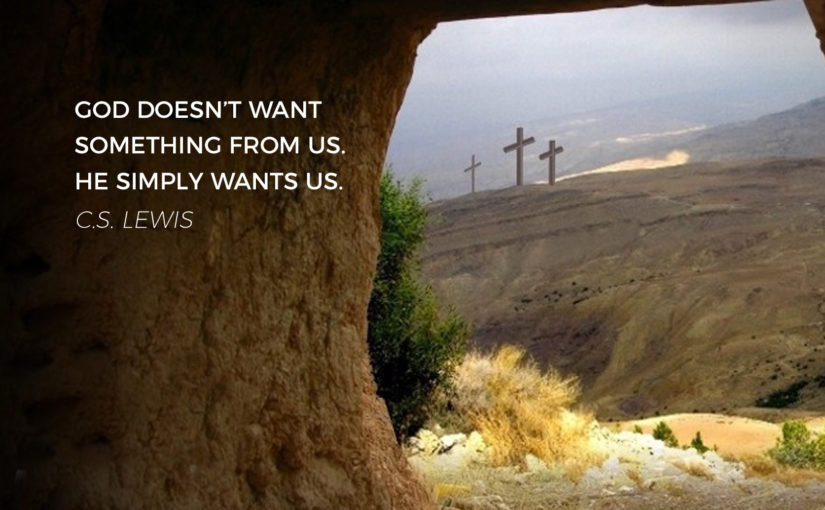
During this time of growth, the elder of our church, a kind and sweet man named Ervin, would point me back to Psalms 51. Over and over again, I would counsel with him, pour my heart out, trying to figure out why I would still from time to time fall back into those old sinful ways and make bad decisions.  He was so patient with me, and would read this scripture with me.  Even though it was twenty years ago, I can clearly recall our conversations.  He would encourage me to go home and pray the prayers that David did, a man who loved God so much and would still find himself in a mess of sin. And just like David, I would weap and mourn over my sins and ask God for forgiveness.  My quest to “be good” was a fruitless journey – and through prayers like Psalm 51, I found that a broken heart for my sin drew me closer to Him more than my checklist of ‘being good’ ever did.  As C.S. Lewis said: God doesn’t want something from us, He simply wants US.

Today, on Holy Saturday, the time between Jesus’ death on the cross, and His victory over the grave tomorrow, I can’t help but put myself there and walk through the range of emotions.

It is our sins against God that crucified Jesus that Friday vs. 4 and David calls his own sin what it is – evil.

Against you, you only, have I sinned
    and done what is evil in your sight;

I wonder how quickly we would have realized this and sought forgiveness and change. Would it have been the very next day, on Saturday?  Would we have prayed vs. 10?

Create in me a pure heart, O God,
    and renew a steadfast spirit within me.

And then to wake up Sunday morning and learn that HE IS ALIVE! Would we really believe? Would we spend the rest of our days living in the JOY that salvation brings (vs. 10)?

Restore to me the joy of your salvation
and grant me a willing spirit, to sustain me.

How would our lives be different if we lived everyday with the utmost JOY for Jesus conquering the grave and the utmost JOY for our salvation?


Crucified

2 Samuel 18 articulates the events that lead to the death of King David’s son Absalom.

Absalom rebelled against King David, waging war against him with the hope to take over the throne. Absalom ultimately hung on a tree alive then had three javelins thrust into his heart. King David mourned deeply for the demise of his son. It was a broken relationship, and much like most broken relationships, sin was at the heart of it all.

Like Absalom, we’ve all gone astray. We rebel, wage wars, seek selfish results, we have broken relationships, and we even put others at risk when with our sin, just like Absalom.

Today, Good Friday 2018 we reflect on another man who hung on a tree because of sin. Except the sin he was paying for was not his own; his name was Jesus and he was innocent.

Matthew 27 provides an account of Jesus being brought to trial, the crucifixion and his death. Can I ask you to read this today aloud with friends and/or family to reflect on who Jesus was and the price he paid to set us free from the bondage, death, and separation of sin?

Today’s reading: 2 Samuel 18 & Psalm 50

Bitterness

Today’s reading:  2 Samuel 17, Psalm 49

Get rid of all bitterness, rage and anger, brawling and slander, along with every form of malice. Be kind and compassionate to one another, forgiving each other, just as in Christ God forgave you (Ephesians 4:31-32).

Bitterness is defined as anger and disappointment resulting from unfair treatment; resentment. The definition of malice is the intention or desire to do evil; ill will.  Our scripture in 2 Samuel 17 today is a great illustration of the destruction caused when people hang on to bitterness and eventually allow it to turn into malice.

Earlier in the reign of King David, Ahithophel had been one of David’s most trusted advisers. In 2 Samuel chapters 15 and 16 this week, however, we saw him begin to take a lead part in Absalom’s revolt against David. What happened to turn Ahithophel from a trusted advisor in to an enemy?  Bitterness and malice.  In addition to being the King’s counselor, Ahithophel was also Bathsheba’s grandfather.  Because of David’s adulterous behavior with Bathsheba, his arrangement of Uriah’s death, and the family heartache it caused, Ahithophel was bitter with David.

In 2 Samuel 17, Ahithophel turned his bitterness into a plan to kill David.  Instead of just executing the plan, Absalom decided to get a second opinion from Hushai.  While Ahithophel’s plan was clearly more logical and would have resulted in fewer casualties, Absalom didn’t choose it.  Why?  Verse 14 tells us the Lord intervened in order to frustrate Ahithophel’s plan and bring disaster on Absalom.  What Absalom failed to recognize was that King David was still God’s chosen leader, and Hushai was still loyal to him.

When Ahithophel recognized that Hushai had outwitted him by getting Absalom to accept a plan that ultimately gave David the advantage, he foresaw the Absalom’s defeat. Verse 23 tells us that Ahithophel responded by going home, getting his things in order, and then hanging himself.  Ahithophel’s bitterness provoked him to create a plan to kill David, but in the end, Ahithophel was the one who ended up paying the ultimate price.

The moral of the story – God’s plans will always prevail.

Do you sometimes feel like you haven’t been treated fairly? I know I do.  Even though I’ve tried to do what was right, it isn’t uncommon for me to feel like I’ve gotten the short end of the stick.  Fortunately I have never found myself being bitter to the point of plotting murder, but overcoming bitterness and resentment after feeling like a victim of dishonesty and manipulation is really hard.  Taking the high road and choosing to forgive over harboring bitterness and seeking some kind of revenge is God’s plan, but often a place I cannot easily get to on my own.

Fortunately we serve an incredibly patient God who loves us and has our best interest in mind.  We can forgive others because he forgave us first.  We can love others because he loved us first.  Hanging on to bitterness and resentment eventually results in self-destruction.  Today, will you let go and trust God to help you make a different choice?  We may not have clarity on what every step of the journey will bring, but the final outcome is definitely certain.  God’s plans will prevail.  Always.

Give your burdens to the LORD, and he will take care of you. He will not permit the godly to slip and fall (Psalm 55:22).