Revisionist history – re-interpretation of the historical record.
According to Wikipedia, this term can be used to describe a positive situation, such as a time when new evidence has come to light and the accuracy of the historical record is improved. Or it can describe a negative situation, a time when the historical record is distorted so that certain events appear in a more or less favorable light; changing the facts of the situation to support whatever case you are trying to make.
I had never heard this term until a few years ago when a co-worker of mine used it. In the context of a performance review for one of HIS direct reports who was making the facts sound better than they actually were, the word made me snicker. Unfortunately over time, I found myself using the term more and more to describe some unhealthy behaviors regularly occurring on our team. A lot of needless time was being spent gathering evidence to either prove or disprove assertions made in our office. In a society that puts incredible value on being the best in class, I wasn’t surprised by the behavior, just disappointed.
“And do not take an oath by your head, for you cannot make one hair white or black. Let what you say be simply ‘Yes’ or ‘No’; anything more than this comes from evil” (Matthew 5:36-37).
As I read Matthew 5 this week, I thought about the time I spent with the leadership team I described above. I didn’t snicker this time. Jesus’ teaching here is specific to the use of vows or oaths, but the core message is simply about the goodness of truth telling. He says swearing, or making a vow, that something is true doesn’t make it so. In the same way, changing the facts of the situation to support your case doesn’t make it reality either. He goes on to remind his listeners that speaking truth is always the best approach. The Berean Study Bible says it this way, “Simply let your ‘Yes’ be ‘Yes,’ and your ‘No,’ ‘No.’ Anything more comes from the evil one.”
A consistent truth-teller never needs to say “I promise” or “I swear” to get others to believe him. His reputation speaks for itself. Other people want to be on his team.
What about you? Are you known as a person of your word? Are you fostering a truth telling environment?
Today’s journal entry is my own prayer to correspond to Psalm 119:57-64. The more I read these verses, the more they spoke to me. Perhaps some or all of this prayer applies to you as a reader so would you consider reading today’s post in prayer with me? Thanks for reading!
57 The Lord is my portion; I promise to keep your words.
Father God, you are enough. Forgive me for the many times when I seek to fill my soul with the empty things of this world. Instill in me a strong desire to choose you; your eternal truths and worthy commands.
58 I entreat your favor with all my heart; be gracious to me according to your promise.
Thank you God for showing us through this psalm that we can entreat (beg) you. That assures me that you will listen. I am sorry for doubting you. Let me not fall victim to the lies of the enemy; “this problem is too big”, “he will not answer that prayer”, “he will not smile upon you”, “there is not enough grace for you”. You promised grace, that which I don’t deserve, but yet you freely give; therefore I seek your grace right now, with my whole heart.
59 When I think on my ways, I turn my feet to your testimonies;
Lord, as you know, I was on a reckless path without you. When I think of this path I remember emptiness, despair, and guilt; I was lost. I run to you now; you fill the empty void in my life, you have given me hope, you have washed away my guilt from sin through your son’s one-time act of death, burial, and resurrection. My true identity is found now that I have you, your word, your rules, your promises, and I have a better understanding of your love.
60 I hasten and do not delay to keep your commandments.
Reveal to me my sins and equip me to immediately turn from them, to you. Teach me your commandments; let me remember them throughout the day in every situation. Give me a heart that cannot wait to do your will and follow you like the first disciples in Matthew 4:20:Immediately they left their nets and followed him.
61 Though the cords of the wicked ensnare me, I do not forget your law.
There are those who would like to attempt to steal your glory by making me stumble. Oh God, do not let me be deceived. Let me fully rely on your righteous commands. Protect me from all evil.
62 At midnight I rise to praise you, because of your righteous rules.
Thank you for waking me in the night and reminding me of your goodness. Let my first waking thoughts at all times be praise for you, your ways, your mercy.
63 I am a companion of all who fear you, of those who keep your precepts.
Thank you Lord for my christian brothers and sisters, they are truly my companions! They teach me, they pray for me, they share their insights into your word, will, and ways. I am truly blessed to have so many people who love me with the love of Christ. Let me be the companion to them that they need me to be. Please strengthen those who are persecuted for fearing you; especially those in other countries who risk torture and even death because they proclaim you as Lord.
64 The earth, O Lord, is full of your steadfast love; teach me your statutes!
We do not have to look far to see your love for us. You create a marvelous symphony morning and night through the birds of the air; let us close our eyes and listen, and give all glory to you. You enable this earth to spin, giving us glorious sunrises and sunsets. Sun and rain give life to our sustenance because you make it happen. You show your love by equipping us with a sense of humor; let us use it properly. You showed the ultimate act of love on this earth by sending your son Jesus. Amen.
Readers, tomorrow’s reading will start the Sermon on the Mount. Would you consider reading it in its entirety as a complete sermon? I fell in love with this sermon several years ago and it continues to have a special place in my life. My Christ-following journey in 2010 started with the reading of Matthew with a quest to learn who Jesus really was and what he really was asking of us. The sermon really answered that for me in a miraculous way. Here’s a link: Sermon on the Mount (Matthew 5-7)
In 2011, I attended the Global Leadership Summit. On the second day, after hearing a half dozen amazing speakers and leaders, the host Bill Hybels, introduced a sweet, unassuming woman named Maggie Gobran. His summary of her life was brief and, as I recall, unremarkable. He explained how Maggie answered God’s calling on her life. She was to serve the poorest of the poor in Cairo. In obedience, she gave up her upper-middle class life as an academic to become a servant to the children in the slums of Cairo. She founded an organization called Stephen’s Children that had become world-class. Her efforts even earned her a nomination for the Nobel Peace Prize. As Bill left the stage, all eyes were keenly focused on Maggie, eager to hear her story and to glean her leadership genius.
Words cannot describe the next several minutes. I remember standing, looking down on the stage and thinking about how small she was. Maybe 5’ tall and 80 pounds. I didn’t see an ear to ear grin, nor did I see a face of anger. I saw depth. As she stood there silently, applause erupted, bringing every person to their feet. Clearly, Maggie was someone special. Rather than dissipating like a normal standing ovation, this one continued to grow. The energy in the room had a presence. As the applause gave way to silence, she knelt and bowed her head. It was as if all the love in the world existed in that single auditorium. The best I can say is that it radiated from her, touching the core of every soul, overpowering even the hardest of hearts. Dry eyes were impossible.
I can’t help but wonder if John the Baptist was a bit like Maggie Gobran. Based on the description in today’s reading, he wore a garment of camel’s hair and a leather belt around his waist, most people would never notice him, just like Maggie. Even crazier, “John’s food was locusts and wild honey” (Matthew 3:4 ESV). Despite John’s oddities and seemingly repellent characteristics, people flocked to him, just like Maggie. This is the important thing. What is it that was drawing the people and where did it come from?
You probably already know the answer to that question. Of course, you are going to answer Jesus, right? To be honest, I am not happy with that answer. Of course, I believe that it is the right one, but it’s too simple. The answer is trite. It does not solve the riddle of how I get it. How do I get a pure heart that goes irresistibly into the world? I found the answer to that question in a short story that was originally presented to me by Dr. JK Jones. In his book What the Monks Can Teach Us, he summarizes Nathaniel Hawthorn’s story of The Great Stone Face. The story was so impactful for me that I wanted to share it with you exactly as Dr. Jones has written it in his book.
Hawthorne describes a people living in a valley, shadowed and surrounded by a huge rock formation. The rocks are shaped together in such a manner that if viewed from a proper distance, a great face can be seen. The face appears divine. It seems to express both warmth and sweetness while embracing all people who look upon it. Hawthorne’s main character, Ernest, is a man who has gazed upon the Great Stone Face day after day and year after year. His mother first passed on to Ernest the ancient legend when he was a boy. According to the story there would one day come an incarnation of the great rock. Throughout the narrative rumors surface that a man has appeared who resembles the great stone face. First, Mr. Gathergold, a shrewd and active man whose name identifies his chief ambition in life, is thought to be fulfillment of the prophecy. Though the people of the valley want ot believe that Gathergold is the image of the great face, Ernest knows he is not. Later, a war hero, Old Blood-and-Thunder, is heralded to be the one in whom the likeness is seen. Again, Ernest recognizes what the crowd does not. The general is only a war-worn, weather-beaten hero. Years go by, the people have settled down and now are able to admit the previous two men were not the prophecy’s fulfillment. A third character appears in the story, Old Stony Phiz, a man in whom is found a magical oratory skill. His spoken words are like the sweetest music ever heard. As is expected, the people of the valley once again see in this man the Great Stone Face, and once again Ernest is disappointed. Time reveals that Ernest is correct and the people in error. Years pass by. Ernest is quite old. People come to him from all over seeking the understanding of this simple man that cannot be found in books. From college professors to statesmen they visit with this gentle, sincere soul. One last time Ernest hopes he will meet that special one who has been foretold. A poet does appear that Ernest admires greatly, but both the poet and Ernest realize he is not the one. The story closes with Ernest being asked by neighboring villagers to speak to them and while the golden sun is setting, both the poet and people recognize what Ernest has not and cannot. Ernest, himself, is the fulfillment of the Great Stone Face! In his humility, constant gaze, and unquenchable seeking he has become that which he sought.
As far as I can tell, Maggie Gobran, John the Baptist, even Hawthorn’s Ernest became irresistible in the same way. In fact, it’s true for all of us. We become what we seek and serve every day.
When you are ready to seek hard after God, check out this awesome program presented by Dr. JK Jones and the incredible faculty at Lincoln Christian University.
Blessed are the undefiled in the way, who walk in the law of the Lord. Blessed are they that keep his testimonies, and that seek him with the whole heart. They also do no iniquity: they walk in his ways. Thou hast commanded us to keep thy precepts diligently. O that my ways were directed to keep thy statutes! Then shall I not be ashamed, when I have respect unto all thy commandments. I will praise thee with uprightness of heart, when I shall have learned thy righteous judgments. I will keep thy statutes: O forsake me not utterly. Wherewithal shall a young man cleanse his way? by taking heed thereto according to thy word. With my whole heart have I sought thee: O let me not wander from thy commandments. Thy word have I hid in mine heart, that I might not sin against thee. – Psalm 119: 1-11
To me the law is a beautiful thing. It is full of judgement, mercy and faith (Matthew 23:23-24). The law is love written on our hearts (Romans 13:10, Hebrews 8:10). In my estimation, so that we are hardwired with the ability to love others with the love of Jesus Christ. Like an operating system for our soul, when we divert from the law and choose not to love another, the system gets confused and pushes back; “processing, processing, processing…” God reboot my soul, reset my system anew with love. My soul longs for it. God’s law leads me, directs me, governs me and to the extent that I accept this truth, seek after it and hold to it moment-by-moment, my soul is at rest in the peace that transcends all understanding (Philippians 4:7).
Still from time to time I encounter a sort of push back amongst Christians when the phase God’s law is used. For some the word law carries with it evil connotations of the very worst sort. To the extent the word ‘law’ or phrase ‘God’s law’ is perceived as an enemy of love. A fear arises in some that God’s law will push non-believers away. The phase “old testament god” is used, as if there were such a thing. God is God and has always been, no shadow of turning (James 1:17, Hebrews 13:8). Oh how this saddens me. I hate this perversion of my Master’s holiness. My anger is with the evil that has managed to redefine the meaning of the word law through hypocrisy.
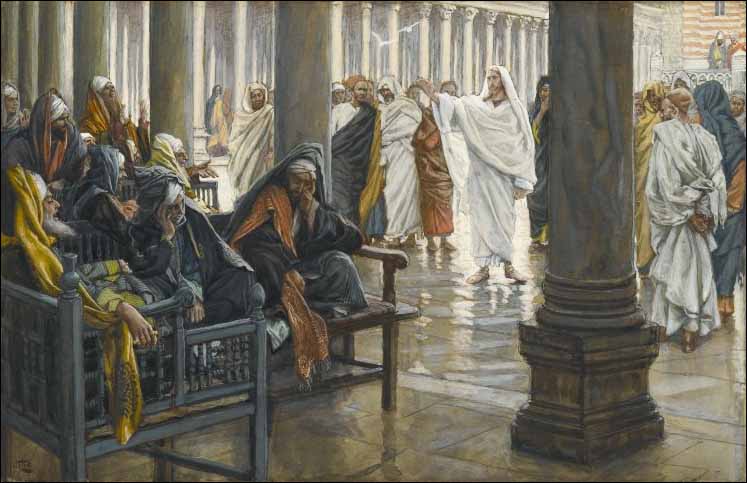
Woe unto you, scribes and Pharisees, hypocrites! for ye pay tithe of mint and anise and cummin, and have omitted the weightier matters of the law, judgment, mercy, and faith: these ought ye to have done, and not to leave the other undone. Ye blind guides, which strain at a gnat, and swallow a camel. – Matthew 23:23–24
James Tissot, Woe unto You, Scribes and Pharisees.
Gnats and camels alike where considered unclean. Camels were likely the largest unclean thing while gnats were likely among the smallest. Religious leaders would strain out gnats before drinking wine to be sure to uphold the law and not unknowingly consume something unclean. Jesus here describes a rather comical situation. Imagine watching someone meticulously straining wine through a linen to “be sure” to uphold the law in every way, the whole time a camels is somehow sitting in their cup, which they then gulp down proudly.
In my estimation, Jesus here criticizes the religious leaders for their blinding attention to detail that caused them to lead others astray from the truth of the law. My prayer is that the Pharisees’ and hypocrites’ perversions of the law will be untwisted and made straight. That we may dismiss the worldly definition of God’s law, wave God’s banner and return to the truth, proclaiming a biblical definition of His law. That we would all fall in love with God’s beautiful law. That we would never be deceived into a judgemental nor self righteous nature. That we would not be fear-driven conditional lovers and so pervert God’s law. That any inner Pharisees within us would be vanquished by God’s truth (Psalm 139:23-24).
Judgement is not about one person assessing another’s keeping of the law but rather the law helping one keep their own affairs in order (Isaiah 1:17, Jeremiah 22:3; Zechariah 7:9–10; Micah 6:8; Habakkuk 2:4). Praise God for writing His law on our hearts that we may live abundantly (Jeremiah 31:31-34)!
Keeping the law is beautiful
Straining out the gnat is not evil in any way. Jesus makes it clear that we should do it (Matthew 23:23). His criticism is that the Pharisees had done it to the dismissal of things that were more important and where lost thinking they had not only kept the law but kept the finer points that others had missed.
Loving the LORD thy God with all one’s heart and soul and mind and desiring to do His will in all things; Beautiful. Thinking one’s self capable of judging another’s love for God; Ugly. Deep concern for one’s own stewardship; Wise. Being overly concerned for someone else’s; Foolish.
Judgement is a gift from God to help us with our stewardship. Let us not pervert this gift by trying to unwrap it for another. Instead let us rejoice in it, praising God for His gift to us in humility as we are judged in grace and mercy to the glory of God as we are made whole and mature in Christ (1 John 4:17).
Let us also consider the inverse. If we pass by and see another straining out a gnat and think, “that hypocrite” are we not in judgement of another? By straining a gnat have they judged another? If so how is one to obey Jesus command to let their light shine? (Matthew 5:16)
Shine Your light oh LORD and vanquish darkness. Here is truth about the law:
Let us hear the conclusion of the whole matter: Fear God, and keep his commandments: for this is the whole duty of man. – Ecclesiastes 12:13
A new commandment I give unto you, That ye love one another; as I have loved you, that ye also love one another. By this shall all men know that ye are my disciples, if ye have love one to another. – John 13:34–35
Love worketh no ill to his neighbour: therefore love is the fulfilling of the law. – Romans 13:10
Master, which is the great commandment in the law? Jesus said unto him, Thou shalt love the Lord thy God with all thy heart, and with all thy soul, and with all thy mind. This is the first and great commandment. And the second is like unto it, Thou shalt love thy neighbour as thyself. On these two commandments hang all the law and the prophets. – Matthew 22:36–40
Therefore all things whatsoever ye would that men should do to you, do ye even so to them: for this is the law and the prophets. – Matthew 7:12
Golden Rule thought experiment on the power of God’s law in love
Scripture: Matthew 7:12, Jeremiah 31:31-34, Ephesians 2:10, 1 Corinthians 13:5
God gives us a simple and basic, at the most fundamental level, instruction on how to keep the law well. Many call it the Golden Rule (Matthew 7:12). I say it is most fundamental because it is by way of that which we are most intimate with than any other; ourselves. We know exactly how we should like to be treated and regarded and so forth. Even if not consciously, subconsciously we are hardwired to love ourselves well. Follow along for one simple illustration of this truth. We know that love thinketh no evil or, put another way, keeps no record of wrongs (1 Corinthians 13:5).
What if we were to apply how we feel about ourselves in this matter on to others? In order to explore this question I encourage you to join me in a thought experiment on your being wrong. Popular exercise, I know.
Name a time when you were wrong; no excuses, no circumstances at work that were out of your control, no anything but you and your wrongness hanging out being wrong.
Let’s say you came up with something. Then let us go to how long it took to recall. Checking all those excuse boxes may have taken a bit of time. Well that one wasn’t really all my fault, etc. So how long did it take you to recall?
Now think back to the first time you had admitted you were wrong in this instance. Think on how quickly and completely you forgave yourself. Did it even take a second? Did it really even register?
Is not love a beautiful thing?!?! Praise God that His law is written on our hearts! (Jeremiah 31:31-34) His forgiveness, His grace and His mercy are written on our hearts!!! The questions then become, does it take you as long to come up with something someone close to you has done wrong? Has it taken you more than a second to dismiss it from your mind?
The point here is that our love of ourselves is much nearer perfection in fulfilling the law than our love for our fellows. God has written it on our hearts to help us, to enable us for the good work He has prepared for us (Ephesians 2:10). How can we not fall in love with His law? Is it not beautiful? Does it not equip us to save souls and rescue others from bondage as it all the time rescues us from a hopeless existence with ourselves? God Your beauty is unimaginable! Your goodness unsearchable! Your ways are beyond me my God and my redeemer! Praise Your Name!
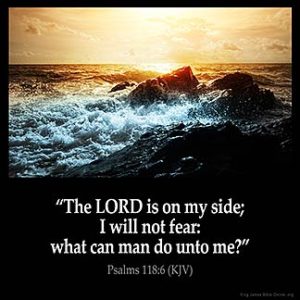
I’ve recently shared Psalm 118:6 with a few colleagues after we were discussing our upcoming evaluation at work. It says,
The Lord is on my side; I will not fear.What can man do to me?
I repeated the verse multiple times in the conversation and we shared a laugh as we both prepared. It helped relax the moment but also recognized its truth. No matter the outcome of my future meeting, I was reminded about God’s plan for us. Honestly, I share this verse more often now and it serves as a wake up call once I’ve got myself focused on others. Hebrews 13:6 also shares these words and is a shining light in the darkness of trying to always please others.
Growing up I displayed many insecurities through my poverty lifestyle, dysfunctional events, and lack of an earthly father struggle. My connection with a heavenly father wasn’t present and it showed. In my mind attempting to think, say, and act the way I thought others wanted was my number one priority. Many people can act this way, it helps people to fit in. It was truly the opposite of Psalm 118:6-8. I cared more what others wanted or thought of me and less about God. I was truly blind. This was and is an emotional trap for people when you are always trying to please others. The truth is this doesn’t change to often with years, status, or money. The factor is our relationship with God.
Rick Warren says in the article, ” You Can’t Please Everybody” that “Even God can’t please everyone. Only a fool would try to do what even God can’t do.” Proverbs 29:25 connects with this statement by saying; The fear of man lays a snare, but whoever trusts in the Lord is safe. Personally, I needed a lot of E.G.R. (extra grace required) when I made most of my decisions based on others and my own selfish desires. It’s important to remember these commands presently in our day of age when we are quick to make decisions based on a desire to please man. We need to trust in the Lord for all things. We need to examine our heart. How’s it looking? Am I currently seeking the favor of men, or of the Lord?
In Does It Matter What Others Think by John Piper, the litmus test is whether Christ looks great in the way we live? Looking at Philippians 1:19-20 asks ourselves, “Is Christ magnified in our bodies whether by life or by death?”
Each day we must put our trust in something or someone. Are you willing to put your trust in God to guide you in all your earthly decisions and to our eternal destination?
There’s so much goodness in God’s words for us today in our reading plan. I had a hard time deciding which scripture to write on but one verse from Isaiah 52 stuck in my mind:
“For this is what the Lord says: “You were sold for nothing, and without money you will be redeemed.” Isaiah 52:3
If read in context, Isaiah is telling us about the deliverance of the Jews from Babylon. God is reminding the Israelites that no matter how bad the invasion and exile might be, there is a future for Israel. They should expect to return to their land. This verse catches me and lingers because of the phrase “sold for nothing.” It reminds me of that feeling we all get after we buy something on impulse…buyers remorse. How often in my life do I sell out for that material thing? Do I sell who I am, my conviction for Christian living in order to fit in? God reminds us through the prophet Isaiah that it is without money that we will be redeemed. That message makes my Monday easier. I am free from the bondage of debt. The next time my world tries to sell me on the promise of a product, a diet or a president for that matter, I’ll be armed with the truth. Our hearts can be sold for nothing. We can so quickly fall into the trap and be sold in an instant. But God reminds us that he’ll redeem us without that worldly cost. That’s so powerful.
I believe that this message from our Heavenly Father is enough to fill our soul today. Also, I’ve typed each letter of this on my iPhone as my worldly electronics have failed me today in a coordinated mutiny! I pray that a little bit of His word fills your sails.
My journal today was originally written as a response to the hatred, in the violence, recently experienced in the Orlando Club Massacre. When I realized my post fell on Father’s Day; since I had already goofed up my Mother’s Day post, blogging about driving expensive sports cars in Las Vegas, I needed to focus on Father’s Day! Not only am I a father, but I know a bunch of ’em. Some are better than others, but we all have the privilege of profoundly impacting the lives of their children. What an AMAZING thing this is!
On a very personal note, I have had three Fathers. All of whom are deceased. Because of them, my life is rich with great memories. I deeply miss them all! With each one, I shared a special relationship. With each there was a bond of trust and loyalty. With my biological father, the bond was forged before I knew it; always there and never broken, despite separation, divorce, alcoholism and mental illness. I remember once, when I was eleven, calling him from a pay phone in Canada, at a park ranger station, after having almost drowned in a waterfall. I wanted to come home from camp so badly, yet he encouraged me to tough it out. It’s only another forty five days. You’ll be glad you stayed. And he was right.
The bond of loyalty with my two step fathers was forged in time. With John, my first stepfather, just when our relationship was at its best, he died unexpectedly. He was in his thirties, and I was fourteen, just returning from summer camp in Canada, after winning all the awards he had encouraged me to compete for.
In honor to all the fathers who cannot be with us, I wanted to share part of that story. Partly because he helped define me, and also as a cautionary tale, because, in my grief, instead of turning to God, I turned away. This was the begining of a long journey to restore my faith and trust in God. Something I never should have doubted.
“To say I was stunned to discover that my thirty-eight year old superhero had suffered a major coronary and was in a coma, would be an understatement. This had to be some weird dream that I kept trying to awaken from. I was in shock.
My grandmother took me to her house and told me which room I would be staying in. She asked me if I wanted something to eat.
Can we go to the hospital? I asked.
Not just yet. I can take you later. You should wash up and have something to eat.
I had lost my appetite, so went upstairs to take a shower. As the warm water poured over me I cried out to God in anguish, please God, don’t let him die! I’ll do anything. Take me instead of him! We are all so happy, everything is so perfect. Please, please, please let him be ok. God please let him live!
When I saw him at the Intensive Care Unit, he was on a respirator along with the usual web of tubes and wires for comatose patients. That was the last time I saw him, barely alive, supposedly brain dead, perhaps already beyond this world. His discolored form lay on that hospital bed, pretending to breathe with the help of a machine.
After he passed my mother returned home, weary and broken down. She was thirty six. We finally had time to talk, amidst the planning and the calls. He knew about it you know, all your awards at camp, he knew what you did, she said.
How? I asked, mixed with skepticism and grief, still in utter shock. I told him. I kneeled down and whispered in his ear and told him how well you did. She reached out and pulled me close. When I told him, he cried. He knew Ricky, he heard me. And as she hugged me, we sobbed together, sharing each other’s pain and grief. I cried because I was grateful, because I was sad, and because I knew this man that had made everyone in my life so happy, if only for a brief chapter, was gone and he wasn’t coming back.
My sadness was shared by many on the day he was buried, at the Pioneer Cemetery. He had been a descendent of the first settlers and his final resting place was the historic Fuller family grave yard, at the end of a road in the middle of Hinsdale. An hour earlier at Grace Episcopal, our old Tudor style Anglican Church, for the first time ever I saw my stoic German grandfather cry like a baby. John’s body, in its casket, was ceremoniously born down the magenta runner, out of the big carved doors, towards its final rest, as we sang the “Battle Hymn of the Republic:” My eyes have seen the glory of the coming of The Lord; He is trampling out the vintage where the grapes of wrath are stored; He hath loosed the fateful lightning of His terrible swift sword: His truth is marching on:
Glory, glory hallelujah …..
The cradle of mourners at the wake eventually thinned out, later that day and over the weeks and months. My grief was my own, not understanding how to reconcile the sadness and devastation, that had suddenly broken my world. Nothing that had come before had prepared me for this. If anything, I had felt set up, to be torn down. God was there for me, but in my grief I held Him responsible.”
Looking back now, I finally realized that God was always faithful and present. It was in the struggles of life, in its hardships, that we are offered opportunities to grow spiritually. Having a Heavenly Father that can be trusted is a gift beyond measure, but it is one that must be received. It is the most valuable relationship we will ever have, and it is one that must be pursued if it is to become what it is meant to be, in all its power and blessing.
May the Lord cause you to flourish, both you and your children. May you be blessed by the Lord, the Maker of heaven and earth.-Psalm 115:14-15
Yesterday Jon talked about the fear of the Lord – fear, a noun, defined as reverential awe. Today I also want to talk about fear, but a different kind of fear – fear, a noun, defined as a distressing emotion aroused by impending danger, evil, or pain; the feeling or condition of being afraid.
Then Death and Hades were thrown into the lake of fire. This is the second death, the lake of fire. And if anyone’s name was not found written in the book of life, he was thrown into the lake of fire (Revelation 20:14-15).
Revelation 20:15 may be the scariest verse in the Bible. It describes the final judgment- the last chance for people to be in or out. Either your name is written in the book of life and you will spend eternity with God or it is not and you are condemned to spend eternity in hell away from God. Eternal torment. This reality should strike fear, a truly distressing emotion, into the heart of anyone who doesn’t have confidence they are in.
If your question today is, “how do I have confidence I am in”, let’s review:
God’s invitation is open to all – Come to me, all who labor and are heavy laden, and I will give you rest (Matthew 11:28).
We all need it – For all have sinned and fall short of the glory of God (Romans 3:23); For the wages of sin is death… (Romans 6:23a).
We can’t earn it – …but the free gift of God is eternal life in Christ Jesus our Lord (Romans 6:23b); For by grace you have been saved through faith. And this is not your own doing; it is the gift of God, not a result of works, so that no one may boast (Ephesians 2:8-9).
Jesus is the only way – “I am the way, and the truth, and the life. No one comes to the Father except through me” (John 14:6).
Jesus paid the price for us – For God so loved the world, that he gave his only Son, that whoever believes in him should not perish but have eternal life (John 3:16).
We must affirm faith in Jesus to be saved – If you confess with your mouth that Jesus is Lord and believe in your heart that God raised him from the dead, you will be saved (Romans 10:9).
God’s plan for salvation isn’t about fear. It is about love. Do you still need to put your faith in Jesus Christ? If you haven’t already, would say this prayer with me today?
God, I confess I am a sinner and deserve the consequences of my sin. But, I believe that Jesus’ death and resurrection made a way for my forgiveness. Today, I am turning from my sin and putting my trust in Jesus and Jesus alone. Thank you Lord for forgiving me. Thank you for saving me. Amen.
Today’s reading has three verses referencing a fear of the Lord. That made me wonder if I actually fear him, so as an exercise to help me think about what it means to fear something, I brainstormed on a few things that I actually do fear: falling off the edge of a cliff (even though I’m nowhere near the edge), ladders, electricity, clowns, extreme turbulence, diving into shallow water, and lack of preparation. Some irrational fear in there but some healthy fear as well.
He provides food for those who fear him; he remembers his covenant forever. (Psalm 111:5)
The fear of the Lord is the beginning of wisdom; all those who practice it have a good understanding. His praise endures forever! (Psalm 111:10)
And from the throne came a voice saying,
“Praise our God,
all you his servants,
you who fear him,
small and great.” (Revelation 19:5)
I’ve come to view the word fear in these verses to be reverence as opposed to a common “fear” of something we might want to run away from. For example, I don’t fear a hot stove, but I have a healthy respect for its intended use and corresponding dangers when misused. In what ways do I reflect a lack of fear (reverence) in the Lord? What does fearing the Lord look like? How is this wise?
Creating the table below was a great exercise to challenge my thinking and behaviors. Each of the earthly focused items are all too near to the way that I live, so creating this table reminded me of my current focus and where it needs to be.
My earthly focus disrespects, dishonors, or demonstrates a lack of fear of God when I…
My eternal focus demonstrates fear or reverence for God when I…
The wisdom…
Blatantly disobey to feed my own desire. If it feels good, I do it!
Obey his commands, even when I don’t want to. Die to self.
And whoever does not take his cross and follow me is not worthy of me. (Matthew 10:38)
Keep on sinning. He’ll forgive me right?
Choose to give up a recurring sin and remember the price that Jesus paid for me to be forgiven.
For freedom Christ has set us free; stand firm therefore, and do not submit again to a yoke of slavery. (Galatians 5:1)
Put my trust in wealth, power, and pleasure. I choose the lies that the world tries to tell me.
Put my trust in Godly things. His word, guidance from the Holy Spirit, his mercy through Jesus.
The works of his hands are faithful and just; all his precepts are trustworthy (Psalm 111:7)
Seek “what’s in it for me” in this relationship.
Meet someone new and contemplate how I can share the love of Jesus with them. Pray for guidance from the Holy Spirit so as to make Jesus known. Share what a difference Jesus has made in my life.
And this is eternal life, that they know you the only true God, and Jesus Christ whom you have sent. (John 17:3)
Try to speed through the week to get to the weekend for some fun!
Slow down. Rest. Live in the moment. Thank God for each new day, for the little things. Live in prayer and set aside time for the reading of scripture.
And he said to them, “Come away by yourselves to a desolate place and rest a while.” For many were coming and going, and they had no leisure even to eat. (Mark 6:31)
Worry about the future; my job, family, and finances.
Give it all up to God. He’s got it!!! He may not give me what I think I want, when I want it, but he’s in control and that’s that!
Trust in the Lord with all your heart, and do not lean on your own understanding. In all your ways acknowledge him, and he will make straight your paths. (Proverbs 3:5-6)
I sat and sat trying to find the perfect story to explain Isaiah 48. I wanted to tell how we all take Gods promises and use them to glorify ourselves. Like the time that God honored my prayer for more business and I decided the growth was because of my superior product knowledge. I also wanted to tell about how we all have carved idols, we just name them other things. For example, I asked God for a car so that I can get to work more easily and he granted my request. I bought a Cadillac and quickly rose to the top of the parking lot. I am sure thankful for his great provision. Heck, I even tell anyone who asks that it was a gift from God.
If I were to write that story, I would also have to explain that these prayers are just like the Israelites. Isaiah lashes out at them in the very first verse. He illustrates that we are quick to invoke God’s name in all things, but our actions don’t reflect his commands. This is where it gets hard because people don’t want to hear about God’s commands. They only want to know about how loving and merciful he is. Besides, if he didn’t want us to sin, he wouldn’t have given us the desire to do so, right? That conversation would have taken us all the way back to the Garden of Eden. I would have to remind the reader that our bad choices demanded that God establish rules, even rules that are impossible to keep. Our failure to keep them illuminates the Truth. They can show us when we are stealing glory from him. The story would conclude with an explanation of why we are here. It would say God created us for his good pleasure and to give him glory. The answer is easy really. In fact, the answer to all of our problems lies right there. Give him the glory. When we do, he returns peace and righteousness. When we don’t, we get cut off and destroyed. In the end, I wonder why we didn’t pray for his glory and our righteousness in the first place.
If I were to write that story, I would feel really awful for having gotten it wrong all these years. I would wonder if there is still hope for me and if God could still love me. I would shed a river of tears feeling hopeless and guilty. And then I would remember Jesus.







You must be logged in to post a comment.