The Poor Widow

Mark 12:41-44

And he sat down opposite the treasury and watched the people putting money into the offering box. Many rich people put in large sums.  And a poor widow came and put in two small copper coins, which make a penny.  And he called his disciples to him and said to them, “Truly, I say to you, this poor widow has put in more than all those who are contributing to the offering box.  For they all contributed out of their abundance, but she out of her poverty has put in everything she had, all she had to live on.”

A couple of months ago, my son Samuel got a $5 bill from his grandma. Actually, all of the kids received a cash gift from her that day. While they were all chatting about what they were going to buy with their money, Samuel looked at me and said, “Mom, I want to take this to church for the kids in Haiti. They don’t even have clean water to drink.”

This is the passage that I thought of when he told me that. $5 will not make a dent in repairing Haiti’s water problems. But that is not what mattered about the gift. He gave all that he had, with a happy heart.

Pray today that when faced with an opportunity to be generous, we are able to do so with joy and humility.


Blind Bartimaeus

Mark 10:46-52

He was blind.  Unable to work and unable to carry on a normal life.  He was a beggar.  Sitting on the side of the road, day in, day out, hoping someone would toss him a few bucks.  What hope could there be for a better future?  None, until he hears about a man that performs miracles.  The man was named Jesus.  As luck would have it, he heard that the man was coming his way.  There was excitement in the air as Jesus approached and a flurry of people trying to get a better position.  Bartimaeus only had one option.  To cry out.  “Have mercy on me,” he shouted.

If the story stopped there, you could tell me how it ends.  It is obvious because we know the character of Jesus.  He saves people.  He is a healer.  The only requirement he ever puts on people is to believe.  In fact, he asks us directly to express our beliefs (Romans 10:9-10).  There is a problem though.  Not everyone agrees.

Bartimaeus discovers it first hand.  As soon as he expresses his belief and reaches out to Jesus, they immediately pull him back.  Verse 48 says that they rebuked him and told him to be silent.  In other words, they said “hey, shut up you, idiot!”  I’m sure they were forceful and intimidating.  True faith, however, promotes persistence.  Frustrated by the people, Bartimaeus realized that he needed Jesus to save him from more than just eyesight.  He needed freedom from these wretched people too.  So, he shouted louder.  Loud enough to get Jesus’ attention.

Yes, crying and shouting to God will get his attention.  Do we know what to do once we have it?  Bartimaeus knew with 100% clarity what he wanted.  “I want to see,” he says in verse 51.  In an instant, he was cured.  Thankfully, Bartimaeus’ request was clear, not muddled.  What if he said, “Hey, I’d really like a more comfortable blanket or, I need a bigger bowl to collect tips in?”  I love that he didn’t ask for those easy things.  He asked for the impossible, with clarity and specificity.  Not only did he ask, he believed.

We have an advantage over Bartimaeus.  Jesus died and sent us the Holy Spirit.  That means we have his attention.  It means that our tears and shouts are not wasted.  He hears them.  In fact, just like Bartimaeus, he wants to radically change our lives.  He is there, waiting for us.


The Fear of Letting Go

Jesus shared approximately forty parables with his followers, and it’s no wonder that almost half of them included a message on wealth. He knows our hearts, what we hold on to, and what trips us up.  Money is definitely one of those things.

I know how money makes me feel – more powerful and more in control. Which is exactly when I start to get in trouble and rely less on the Lord and more on myself. While the world is focused on wealth accumulation, God calls us to wealth distribution through reduction. Can you think of anything that is asked of us, that isn’t ultimately for our own good? I love the scripture that says “lay aside every weight” – and our wealth can become a heavy, burdensome weight that slows us down.

More money, more problems… it’s so true! The more stuff we buy, the more it requires. We need space and time for all of the upkeep, repairs, updates, and maintenance, for the THINGS we accumulate through our wealth.

When you read in Mark 10:17-31 about the Rich Young Man, you find that he is seeking eternity. He has followed the letter of the law, and now he is seeking surety of eternity. How cool that Jesus’ love for this man is called out. Right before he gives him this very direct admonition, he “looks at him and loves him”. God’s grace for us is so amazing, leading us with love.

Because Jesus knew his heart, he drew his attention to the one thing that was getting in the way of his relationship with God. His stuff. He was told by Jesus to give away all he had, and come and follow him. Instead of heeding the instructions, the man left, sad at the thought of losing his stuff. I wonder what specifically was most hard for him. Did he cling to the security he believed his money  represented? Were there family heirlooms that he didn’t want to give away? Maybe he was accustomed to the conveniences that he saw his wealth provide.

Another thing that strikes me is that time and time again in scripture we have examples of people being called to sell or give their stuff. It’s not just “give your extra money”, but it’s a call to simplification through reduction. Idolatry has been a challenge for thousands of years, and while we may not be making golden calves, I think we all could think of things that get in the way of our relationship with the Lord.

I don’t want to be captive to my possessions. I can think of a few areas I need to “clean house” and let go. Along with an abundance of stuff, I also have a bunch of justifications for it all. Seriously! One big category for me is in all things ‘serving and hosting’. At some point in time, I started accumulating things for celebrations. Decorations, dinnerware, linens, and on and on. You know, for the next dinner party, birthday gathering, etc. I’ve collected and then kept all these things, justifying it with some scripture about the gift of hospitality. Serve well. Oh, and I will use it all again someday, so I should really be a good steward and save it. WHAT?!! Okay, who is going to check in with me in a couple of months to see if I’ve cleaned out my storage area?

As God loves us, he sanctifies us. I don’t know what God has for you today… maybe it’s a release of your money, stuff, time, or something else. Ask him, and I know he will lovingly reveal it to you, just as he did the Rich Young Man. He perfectly knows what we need, and what we don’t need.

This passage wraps up with the disciples questioning the difficulty of a wealthy man entering heaven. And Jesus reminds them of God’s power: With man it is not possible, but with God, all things are possible. Be encouraged – God will equip you to do whatever he calls you to.  And when he helps us to unclench our fists, and truly let go of the things we so tightly hold on to, it is then that our hands are open. Open to receive more of his love, grace, and blessing. He promises that we will receive so much more in eternity than we can imagine.

Everyone gets a seat at the table

In the post published March 3rd, 2019 titled “Clarity given, but faith needed to receive” I shared the story of how our family had planned to serve in Kenya with Goya Ministries. It turned out that our plans weren’t quite what God had in mind.

While we weren’t able to join that trip, we were able to start a relationship with the team who did go. Two of those team members, Roxanna “Roxy” Parker and Wendy Roberts recently stayed with us for a few days at our home in Florence, Italy.

The time spent with these two ladies was a tremendous blessing for our entire family. They cut and styled Amy’s hair, toured Tuscany with us, prayed with and for us, worshiped with us as we attended Eastview online, brought laughter and fulfilling conversation into our home, gave lots of love and attention to our boys who were delighted to have some “America” close by, and most importantly they filled Amy’s “spiritual jar” to the top and provided her with some much-needed girl time.

Our readers can now also benefit from their visit!

When I asked Roxy for some thoughts on today’s reading which is Mark 7:24-30, she promptly responded with words far more powerful than I could ever write. The Holy Spirit is definitely at work here. Thanks Roxy for sharing and for your obedience to His calling!

Here are Roxy’s words, unedited: 

From what I understand of Jesus, I think he may have been trying to test the woman. To remind her of where the world says her place was in society (“get in line, others come first”) and yet she answered back to remind him that even Jesus should know that the very least among us are still seen and are provided for by the Lord (* even the very dogs get the first fruits from the children that eat first in line) The verses share that he was impressed. I find it interesting that she impressed him. Why? Was it her recognition/self awareness of who she is? Or was it her faith? She states that there may be others that come first but the ones last are still fed, simultaneously, under the table of those who are being served first.

This story encourages me that when I feel small and insignificant, I can still remember that the Lord will provide for me exactly what I need even in the midst of what looks like a provision for someone else. Can I have that kind of faith?

To be confident in Jesus to supply my need (even if only a small crumb) instead of looking at how he is giving even more to someone else? I think that Jesus was impressed because she believed that even a crumb from Him would change her life forever. No need for a large helping or a first scoop.

What a challenge to humble myself and have faith like that when I’m tired, hungry or my self-worth looks a lot like last place instead of where I’d like it be: at the front of the line, getting recognized first. Yikes. That’s not an easy task. But I’m encouraged that in God’s economy, everyone gets a seat at the table.

Jairus

Today’s reading:  Mark 5:21-43

Our text for today in Mark 5 is the story of Jarius.  Jarius was the manager of the local synagogue.  He was responsible for overseeing worship and taking care of the building. When Jesus arrived in his town, Jarius threw himself at Jesus’ feet with a plea to come heal his sick daughter.  He begged Jesus to come lay hands on her, as she was on the brink of death.  He was desperate.  Verse 24 tells us –

Jesus went with him (Mark 5:24).

As Jesus was following Jairus to his house, he was detained by a woman with a bleeding disorder.  While Jesus was still speaking to the woman, messengers from Jairus’ home came to tell him that he was too late.  His daughter had already died.  They suggested that there was no use bothering Jesus with the situation any longer.   Verse 36 tells us –

Overhearing what they said, Jesus told him, “Don’t be afraid; just trust me” (Mark 5:36).

At this point, Jesus turned the crowd away.  When they finally arrived at Jarius’ house, he only let 5 people come with him into the girl’s room – Jairus, his wife, Peter, James, and John.   Jesus commanded the girl to get up, and she immediately came back to life.

This amazing miracle story is the only passage the Bible has recorded about Jairus.  What can we learn from his life?  As I studied and prepared for this post today, three key lessons spoke to my heart:

Following Jesus requires that we take risks – because of Jairus’ role in the synagogue, he likely had a close tie to the Pharisees.  His outward display of faith in Jesus was risky, as the Pharisees would have pressured Jairus and other synagogue leaders from following Jesus.  Like any other parent, however, Jairus was desperate for his daughter to be healed.  He knew Jesus was capable of healing her.  He was willing to display his faith and risk his position in the synagogue for it.

God is in control – in the first part of the passage, Jairus was trying to get Jesus to follow him to his house.  Did you notice that by the time they arrived, however, Jesus had taken control of the situation?  He already knew the need and he led Jairus, his wife, Peter, James and John into the room so they could witness his miracle.

God’s timing is not our timing – Jairus was trying to get Jesus to his house to heal his daughter before she died.  When messengers came from his house to announce her death, they all assumed it was too late.  It wasn’t.  God has all power, even over death.

Today I ask myself, is my faith really in Jesus?  Do I really trust him?  If the answer is yes, I need to remind myself he knows my needs.  Instead of running ahead and asking Jesus to follow me, I need to slow down and get out of his way so he can take the lead.  He has every situation under control.

“For My thoughts are not your thoughts, nor are your ways my ways,” declares the LORD. “For as the heavens are higher than the earth, so are my ways higher than your ways, and my thoughts than your thoughts (Isaiah 55:8-9).

Judas

Today’s reading is Mark 3:19, 14:3-11, 43-49.

Mark 3:19 Judas Iscariot (who later betrayed him).

Judas was one of the 12 disciples chosen by Jesus.  None of the disciples were perfect and each had their moments of doubt and failure. We single Judas out as the worst one because he made the ultimate mistake……betraying Jesus which lead to his death on the cross. There is no recovering from this betrayal. Why would he want to betray Jesus? In reading I was reminded that the disciples were imperfect people like you and me following a perfect leader. They did not always understand his methods because they were always letting their own selfishness get in the way.  Judas was no exception.

Mark 14:3-11 John Mark shares about Mary and her total devotion to Jesus. She pours a jar of beautiful and expensive perfume on Jesus head, sacrificing what may have been her most prized possession to show her love for him. She did not hesitate. There was nothing more important to her than Jesus and it was obvious in her actions. The disciples complained about how she wasted the sacrifice and should have sold it instead to help the poor but  Jesus honored her with his words and praised her actions. She had done a good deed for Him. In contrast, the next verses are about Judas planning his betrayal of Jesus to the leading priests in exchange for a monetary reward. Mary poured out all she had for Jesus while Judas greedily puts money in his pocket for handing Jesus over to his death. Had he been planning this all along or did Mary’s “frivolous” actions tip him over the edge? Something happened that caused him to stop believing in Jesus and start thinking the reward from the religious leaders was better.

Mark 14:43-49 Judas betrays Jesus with the kiss. As soon as he kissed Jesus and called him Rabbi the religious leaders moved in to attack. That was the signal they were waiting for and they moved in quickly.  It was done, no turning back for Judas. But Jesus knew all this was going to happen. He told the disciples that one of them would betray him, and they all denied it.

It is not for me to judge how Judas is spending eternity. It does cause me to reflect on my own free will and if I have ever “betrayed” Jesus. I have chosen my own way many times over the decision to be obedient to Christ…in my relationships, with my money, with my time. Those are small betrayals in comparison to completely turning my back on him but they are still a choice to do my own thing rather than what Jesus suggests.  Each betrayal takes me farther from His love and care for me and closer to the trappings of this world. Am I lavishly pouring out my very best for Jesus or hanging on greedily to the rewards of this world?

Shelly


John the Baptist

The voice of one crying in the wilderness, Prepare you the way of the Lord, make his paths straight. Mark 1:3

I love the stories of John the Baptist.  He didn’t care what people thought, what he wore, or what could happen to him as he pointed others to the coming of our Lord. John had a focus on repentance and baptism.  John encourages people to turn from their sin, and towards God.

Today’s Readings included stories of John in Mark 1:1-11, 2:18-22, and 6:14-29.

John prepared a way for Jesus 2,000 years ago and he prepares it for us today.  He checked his pride at the door. He didn’t care about his reputation, he spoke the truth with integrity.  What holds us back from preparing a way for others? Honestly, for me, it can be fear or pride. So, in order to,  “Prepare the way for the Lord, make his paths straight” I need to give up my selfish ways that become evident in my calendars, finances, and time spent. It has been a journey but I know there is still work to do.  I’ll ask for some prayers to not let these insecurities or prideful selfishness get in the way of drawing closer to Christ each day.


John prepared the way for so many.  It was never about him, but about our Lord who baptizes with the Holy Spirit. How are we preparing a way for others?  How is the way being prepared for you? Do you know anyone lost, looking for a relationship with Christ?

John had two goals.

  1. lead people to repent from their sin (make new in Christ)
  2. prepare for us a way to the Lord ( do what is right, follow His commands)

If you have fallen off the path closer to our Lord will you pause to pray with me?

Dear Lord,  I admit that I have fallen short, that my ways have gotten in the way of your ways.  It’s only by Your grace that we are here now. Help me to get back on a path closer to you. I pray for guidance and protection against my selfishness and earthly desires.  Lord, I ask you to help us be models and examples of you to all we meet. Renew our hearts and commitment to you Lord.  Only through our love, and trust in you is this possible. We love you and are preparing a way to you eternally. Amen


I desire to do your will, my God; your law is within my heart.” Psalm 40:8


The Final Mercy : Joseph of Arimathea

Today’s Reading

Matthew 27: 32-61

The story of the passion has been told countless times.  Sometimes when we hear the same story and recounting of the facts we can become complacent and not taking the full experience as it was originally felt. Over the last several weeks while preparing for the person of the week, I have had the chance to really meditate and revive the passion and the full breath of Joseph of Arimathea.

In today’s passage, the first person that we are introduced to is Simon of Cyrene.   This is a man from the Northern part of Africa who has come to Jerusalem for the Holy Feast of Passover.  He and his family are casually walking in the streets or marketplace and he is forced to take Christ’s cross.  Let this sink in for a minute.  This man was celebrating the highest of holy days with his family, then the armed guards takes him away from his family.  He is probably dressed well and ready for celebrations.  He is then taken and forces to carry a “criminal’s cross”. At this point Christ has carried the cross for some time and his blood has soaked into the wood.  By Simon being forced into the role of cross-carrier, he grants Jesus the first Mercy.  He has helped in a visceral way to complete the Passion of Christ.  What if he had not obliged and granted the request?  Who would have been the cross-carrier?  Who would have given Christ some rest before his final hours?

The next several events are show the true sacrifice and pain that Christ endured

  • Verse 34 : they offered him wine to drink, mixed with gall, but when he tasted it, he would not drink it.
    • This was a typical antiseptic – to help easy the pain of the Crucifixion
  • Verse 3 : And when they had crucified him, they divided his garments among them by casting lots.3
  • Verse 37: Then they sat down and kept watch over him there. 37 And over his head they put the charge against him, which read, “This is Jesus, the King of the Jews.
  • Verse 38: Then two robbers were crucified with him, one on the right and one on the left.
  • Verse 39 :  And those who passed by derided him, wagging their heads 40 and saying, “You who would destroy the temple and rebuild it in three days, save yourself! If you are the Son of God, come down from the cross.”
  • Verse 40: 41 So also the chief priests, with the scribes and elders, mocked him, saying,42 “He saved others; he cannot save himself. He is the King of Israel; let him come down now from the cross, and we will believe in him. 43 He trusts in God; let God deliver him now, if he desires him. For he said, ‘I am the Son of God.’
  • Verse 44: 44 And the robbers who were crucified with him also reviled him in the same way.


After Simon has given Jesus a piece of grace, Jesus is being assaulted with some of the most vile and cruel items that would have broken many of us.  This is the price that he cared for us.  Then the Joseph gives Jesus his final earthly Mercy: Joseph took the body, prepared the body, and placed the body.

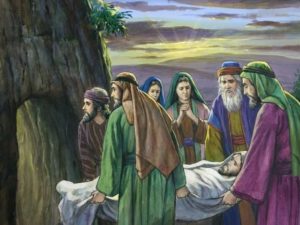
When it was evening, there came a rich man from Arimathea, named Joseph, who also was a disciple of Jesus. 58 He went to Pilate and asked for the body of Jesus. Then Pilate ordered it to be given to him. 59 And Joseph took the body and wrapped it in a clean linen shroud 60 and laid it in his own new tomb, which he had cut in the rock. And he rolled a great stone to the entrance of the tomb and went away. – Matt 27:57-60 

Joseph took the body:

  • Joseph breaks an important rule of Jewish law: he physically touched a dead person on the Sabbath, but prevents the curse of a dead man on the tree. Number 19:11-13 and Deuteronomy 21:22 -23
  • Being a Pharisees, Joseph knew the letter and expanse of the law, but he knew the person of Jesus and understood the reward for his discipleship is greater than the punishment of man.


Joseph prepares the body:

  • Joseph is the only that is mentioned in the gospels to have direct contact with body of the dead Christ. The other disciples were not at the crucifixion and the women were not allowed to be close to the body.  Joseph was the last person to clean the wounds of Christ.  He is the last one to apply balm and ointments to the body.  He is the last one to wrap the body in clean swaddling linens.  This preparation is one of the most intimate and profound responsibilities that one can have.  Christ made the ultimate sacrifice by giving his life, Joseph had given Christ the best response by gently and compassionately preparing his body for the next phase of the Passion.


Joseph places the body:

  • The final act of Mercy is that Joseph placed Christ in his tomb. This was a very powerful and meaningful gesture and example of his love.  In the earlier centuries, there were not a lot of tombs for common people or people without means.  Joseph had enough wealth, that he had this tomb prepared for himself many years of his expected death.  Many times people would use tombs of their ancestors, similar to catacombs. But this tomb was fresh cut and had not had any pervious occupants.  This was Jesus place of peace for three days.


Joseph, who shares the name of the step-father of Jesus, gives Jesus the same compassion and gentleness that Joseph did when he came into the world.


God has reveal many things in this passage:

  1. We may experience someone taking our cross when we are in the weakest parts of our journey
  2. While we are going through the midst of our hardest days the onslaught of worries, pain, defeat, criticisms, & meanness God has relief for us
  3. When we have finally gotten to the end of our journey: Christ will take our body, prepare our body, and place our body in a beautiful place where no one has been before.

Be Blessed

Peter

Matthew 26:20-75

1 Peter 1-2

I began preparation for today’s post as I always do.  First, I thought about what I already knew of Peter.  I remembered that Peter was a fisherman, that his name means “rock” and he was a disciple of Christ.  I also recalled how he denied Jesus 3 times before Jesus was crucified.  

Next, I read through Matthew 26:20-75, which sets the stage for Peter’s denial.  After the disciples had finished The Last Supper, Jesus predicted that Peter would deny Him 3 times. Then it actually happened, Peter denies Jesus 3 times and the rooster crowed!

Peter swore, “A curse on me if I’m lying-I don’t know the man!”  And immediately the rooster crowed.  Suddenly, Jesus’ words flashed through Peter’s mind;  “Before the rooster crows, you will deny three times that you even know me.”  And he went away weeping bitterly.    Matthew 26:74 &75

Peter, the “rock” of the church and a close friend of Jesus denies Him 3 times.  I read this and think how could Peter do this?  But, then I think of myself and times I have also done what I don’t want to do or think that I would ever do.  Just as Peter, I am sorely disappointed in myself and what I have done and what I never thought I would do.

But then, I go on to read 1 Peter 1 &2.  What a difference.  We go from Peter denying that He knows Jesus to then Peter actually writing encouraging and helpful words to believers that were suffering persecution.  

How did Peter go from weeping bitterly from denying Jesus to writing  encouraging words to believers?  

As soon as Peter heard the rooster crow, his heart fell.  He felt the depth of his own failure.  He realized that he had just done the very thing that Jesus had said he would do.  The thing that Peter insists he would never do.  It was perhaps the worst moment of his life.  

Jesus is now dead.  Peter’s last encounter with him was denial.  There is not time for apologies.  No time to ask Jesus to forgive him.  Can you imagine the guilt that he felt?

Jesus was dead.  Peter stayed with the other disciples.  On the third day after Jesus’ death, the disciples get a message from Mary Magdalene that the tomb where Jesus was put is empty.  

Now go and tell his disciples, including Peter, that Jesus is going ahead of you to Galilee.  You will see him there, just as he told you before he died.”                                Mark 16:7

Can you imagine how Peter felt when he heard this?  How nervous he must have been to maybe meet Jesus face to face again after denying him?  

But Peter ran to the tomb and pushed right inside the tomb.  He saw that Jesus’ burial cloths were neatly folded.  Where is Jesus?  

Notice that the message was to “go tell the disciples and Peter”.  Peter was singled out because Jesus had a message for Peter.  Peter, who denied Jesus three times, would be given another chance.

Jesus still loved Peter.  Jesus was going to show mercy and forgiveness to Peter.

He does the same for you and me.

Peter went to Galilee to meet Jesus just like the angel told him too.  Where do you go to look for Jesus? 

As believers in Jesus Christ, we can cling tightly to the promise in Romans 8:1 that says, “There is therefore now no condemnation for those who are in Christ Jesus”.

Peter was forgiven and given an amazing ministry.  

The Sadducees

Today’s reading is on the Sadducees, specifically Jesus’s interaction with them in Matthew 22:23-46.

So, that Sadducees: generally, not a well-liked bunch. It’s easy to see why in the Gospels, as they repeatedly pop up to attempt to trick Jesus into speaking blasphemy against their laws and silencing his radical preaching. But who is this group and why is this smackdown Jesus delivers particularly noteworthy?

The Sadducees were one of the main religious leading groups in Israel during Jesus’s life. They were an offshoot sect of sorts of the Pharisees, seated as a sort of oppositional ruling party to the Pharisees. But whereas the Pharisees believed in the oral passing of traditional teachings of God and fervently interpreted the books of Moses in their own terms, the Sadducees were more direct and literal in their interpretation of God’s word. They believed nothing but the Pentateuch, the first five books of the Bible as we know it, were the word of God, and while the rest may have been divinely inspired, they saw anything outside of that as unfit for following as the law. Since their writings didn’t have any mention of an after life either, the Sadducees, unlike their Pharisee counterparts, didn’t believe in any sort of an afterlife – that God ruled over this life absolutely, but after this life, nada. This is displayed in Matthew 22:23, as well as later in Mark 12:18 and Luke 20:27, where it is expressed the Sadducees “say there is no resurrection.” They had no belief in angels or demons either, essentially distilling the essence of God’s word to its most literal and applicable usage as they saw fit. Their faith was more of a political ruling practice – this was done out of love for power and ruling over Israel, not for love of God.

So when Jesus begins speaking in the Sermon on the Mount about the kingdom of heaven, and inheritance in a life beyond this, he was preaching a message proudly opposed to their laws and ways of life. This man, who the Jews would come to call the awaited Messiah, spread a message of God in direct opposition to their own. In their view of the law and of the word of God, no one who spoke of resurrection and life after death was speaking for God in any capacity.

This belief of no life after death is what sets up the Sadducees’ question to Jesus here in Matthew 22:23-46. They come here of course not with the intention of learning about marriage after the resurrection, but with the intent of trapping Jesus in a trick question. One of the laws of Israel that the Sadducees were familiar with was the teaching of “Levirate marriage” In Deuteronomy 25:5-6 – a law describing the successors in marriage of a widow. By stretching this law to its extremes, they were hoping Jesus would provide an answer not covered by Levirate marriage, offending Jewish teachings & breaking the law, a jail-worthy offense and a means of silencing their biggest dissenter of the time.

But here comes Jesus with the response in Matthew 22:29-32 – “You are in error because you do not know the Scriptures or the power of God. At the resurrection people will neither marry nor be given in marriage; they will be like the angels in heaven. But about the resurrection of the dead – have you not read what God said to you, ‘I am the God of Abraham, the God of Isaac, the God of Jacob’? He is not the God of the dead but of the living.” Not only does Jesus provide new divine insight of the resurrection and the disposal of our earthly bodies for blameless angelic beings after death, topics the Sadducees did not consider legitimate, but in the same breath renders their intent moot by giving them an answer from Exodus 3:6, when God first revealed Himself to Moses in the burning bush, using their own God-given law to invalidate their line of question. Boom. This is like the WWE Smackdown of Israelite scriptural debate.

But we can do better than be merely entertained – we can learn from all Jesus has to say. Especially convicting to me is this particular line: “You are in error because you do not know the Scriptures or the power of God.” Here we had a group of people who knew the word of the Lord and applied it as the law of the land. But to them it was merely a tool, something purely logical and utilitarian, some way with which to wield power and authority of their own. We know however, that all Scripture is God-breathed and holy. As Paul tells Timothy in 2 Timothy 3:16, “All Scripture is breathed out by God and profitable for teaching, for reproof, for correction, and for training in righteousness.” Every piece of Scripture in the Bible contains value and wisdom, not just the Pentateuch. The meaning for it, as Jesus demonstrates in explaining God’s power over death, extends beyond simply the law into educating, uplifting, correcting, and celebrating.

But Scripture is only half of what Jesus mentions – alongside the power of God. Jesus knows His Father’s power extends beyond the living – over all who were as well. He knows the Sadducees’s denial of an afterlife is wrong, for as he tells Martha in John 11:25, “I am the resurrection and the life. Whoever believes in me, though he die, yet shall live, and everyone who lives and believes in me shall never die.” To deny that the Lord’s power extends over the dead is to miss out on the incredible power of God. But to believe in Jesus, that He is the resurrection and the defeater of death, is to be right and just. So arm yourself today with the knowledge of Scripture, and remind yourself of the power of the Lord. Pour over the word of the Lord and ponder it always. And hold fast to our awesome and mighty God. For we know with these two things, we can overcome any adversity that would deny the Lord’s power.