Sound Doctrine

Little child girl plays superhero. Child on the background of sunset sky. Girl power concept

2 Kings 16; Titus 2; Hosea 9; Psalms 126–128

There is no shortage of inspirational messages these days. They are readily found in books, speeches, podcasts, blogs, and videos. With the abundance of information available to us, it is critical that we know what we are filling our hearts and minds with. Today, in Titus 2:1, Paul is encouraging Titus to maintain “sound doctrine.” Rather than skip over those two words, I want to take a close look at them. In many ways, they can become a filter for us both in what we hear and in what we are teaching to others.

Let’s start by defining “sound.” Paul is talking doctrine that makes us well, in good heath, pure and uncorrupted.   I like the way John Calvin puts it. He says, “Sound, means wholesome, that which actually feeds souls.”  is the inspirational information that you are consuming feeding your soul?  Don’t forget, the doctrine with which we feed our souls can be evil too. So the question to ask is, “does this conversation also turn my heart toward Jesus.” When the answer is “yes,” we can move forward in confidence that we are engaging “sound doctrine.”

Anything that moves our soul is also going to move our mouths (Luke 6:45) and feet (James 2:14). Therefore, consider the resulting actions of our “sound doctrine.” The second question to ask is, “does it move me to action that exults Jesus?” if not, Jesus, then who? Again turning to Calvin, if it doesn’t promote Jesus, it “promotes ostentation.” Ouch!  You see, there are plenty messages that can stir my soul, but not all of them cause me to worship Jesus.

As you go about your day and your week, consider more closely what you are filling your heart and mind with. Make no mistake; they are changing your attitudes and actions. Are they moving you closer to Jesus?

Counting Sheep

Sheep on the landscape taken in Somerset England

2 Kings 8; 1 Timothy 5; Daniel 12; Psalm 119:49–72

Sometimes I don’t sleep well.  I’m thinking that the writer of Psalm 119 didn’t either.  He says, “At midnight I rise to praise you, because of your righteous rules.”  (Psalm 119:62) Now, he may very well wake up at midnight to praise God.  Hat’s off to him if he does.  On the other hand, maybe he just wakes up and can’t get back to sleep.  That’s what happens to me.  Rather than read a book, or click on the TV, I have learned to do something like the Psalmist.  In verse 55, He adds, “I remember your name in the night, O Lord.”  My goal is the same.  Remember his name in order to praise, honor and glorify Him.  If you know the alphabet, you can do it too.  Simply assign an attribute of God to each letter in the alphabet.  It goes something like this:

Almighty – Revelation 11:17
Bountiful – Deuteronomy 28:11
Consuming fire – Hebrews 12:29
Divine – Romans 1:20
Eternal – Revelation 1:8
Father – 2 John 1:3
Glory- 2 Peter 1:17
Holy – Isaiah 6:3
Immaculate – 2 Samuel 22:31
Just – John 5:30
King of kings – 1 Timothy 6:15
Lord of lords – 1 Timothy 6:15
Marvelous light – 1 Peter 2:9
Near – James 4:8
One – 1 Corinthians 12:13
Prince of peace – Isaiah 9:6
Quiet – 1 Kings 19:12
Refuge – Psalm 46:1
Slow to anger – Numbers 14:18
Teacher – John 3:2
Unchangeable – Hebrews 6:18
Victorious – 1 Corinthians 15:7
Wonderful – Psalm 139:14
eXtreme – Ok I cheated here. Read Hebrews 11 to see what I mean about God being extreme
Yahweh – 2 Chronicles 14:11
Zenith – Luke 2:14 & Mark 11:10.  Yes, I cheated here too.   “Zenith” isn’t in the Bible, but it sounds a lot like Luke 2:14 and Mark 11:10.

I find several benefits of this simple exercise.  First, I rarely make it to the end before the Lord gives me sleep.  Second, I find bigger and better descriptions for him.  Finally, I have placed his name above all others, just as he asks.  I Worship.

Pompous Kings

two-faced manhypocrite deceitful person abstract vector background

2 Kings 1; 2 Thessalonians 1; Daniel 5; Psalms 110–111

As I continue to read through the old testament, I have a tendency to become discouraged. Mostly because I cannot figure out why the kings don’t get it.  They repeat the same mistakes, over and over. Occasionally, one will appear to be different, attempting to do good. But, his efforts are often half-hearted and almost always stamped out by the next generation. This pattern will continue through our reading of 2 Kings and into Chronicles. As you read the stories, pay attention to these three common threads.

Kings have a way of using God’s good things for their own aggrandizement      For example, today in 2 Kings 1, Belshazzar occupies the throne. He is enjoying the good life and taking full advantage of his reign as king. In order to prove his greatness above all others during a party, he ordered the treasures of the Temple of Jerusalem to be brought out for the guests. It wasn’t enough for Belshazzar to simply use them for the party. In fact, while drinking from them, “they drank wine and praised the gods of gold and silver, bronze, iron, wood, and stone.” Daniel 5:4 (ESV).  These acts clearly illustrate contempt of Godly things.

The reign of a king is temporary.  Maybe you didn’t notice, but they all die. In fact, many of them come and go without any fanfare at all.  During their reign, however, they make short-term decisions, based on their short-term world-view.  Their goal is simple.  To maximize their existence.

Contrast these kings’ short-term world-view with Jesus’ eternal world-view.  His decisions and actions are clearly different, focusing not on his own existence but on the eternal existence of all people.

God invites them to participate in His work.  Throughout these stories, God attempts to get their attention. He does it often through the voices of others, generally called prophets. They are the ones that know God’s word and will. Even though the king may have asked a prophet’s advice, they rarely listen, attempting instead to preserve their own ego’s, status and power. They refute and disclaim the advice of the prophets, always with predictable consequences. In the end, they are forced into humility by others, or they die an early death.

Jesus invites us to participate in His work too.  In fact, not only are we promised forgiveness, we are also given new life.  According to 2 Corinthians 5:17, we are a “new creation.”  Think of all the good things that we can do.

Habits

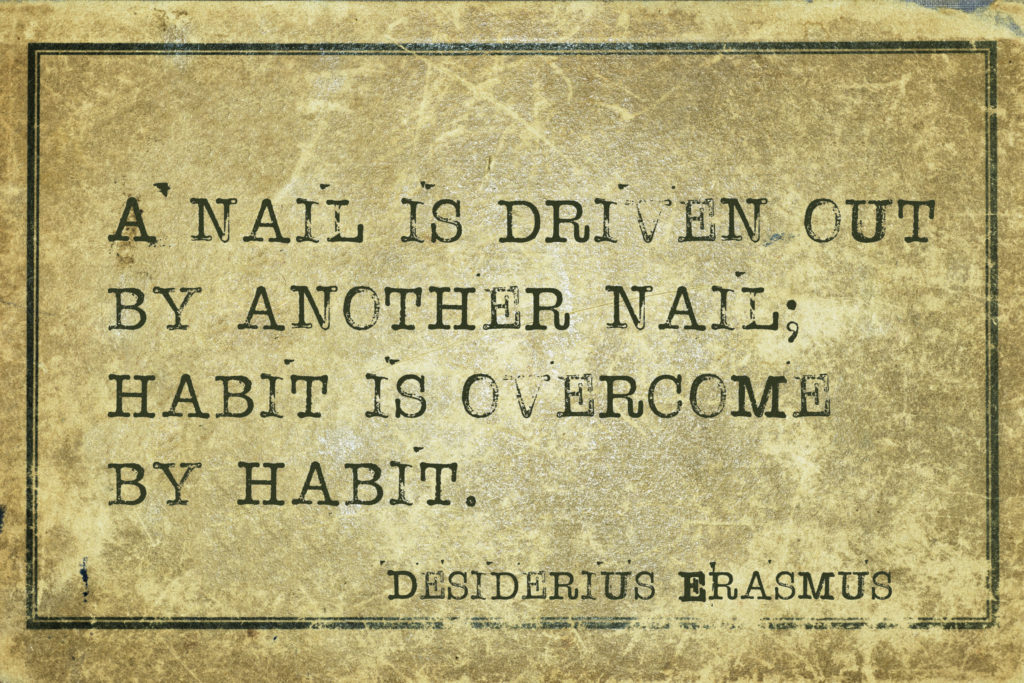
A nail is driven out by another nail; habit is overcome - ancient Dutch philosopher Desiderius Erasmus quote printed on grunge vintage cardboard

1 Kings 16; Colossians 3; Ezekiel 46; Psalm 102

Much of our behavior is not intentional, it is the result of habits. Habits are patterns of behavior that we have acquired over time. Consider, for example, my routine when I get home from work. First I drop my bag into kitchen table chair. Second, I remove my shoes underneath the chair and yes, I lay my coat over it as well. I don’t think it through, it is my habit. Is it good or bad? In order to determine that, I look to my wife, Jennifer.  She starts with a gentle reminder, saying, “hey, your shoes are in here.” As time passes, her irritation escalates to anger.  I’m sure you can figure out the rest of the story. The bottom line is that our habits affect other people and they have a significant impact our relationships.

Once I recognize that a particular habit is straining our relationship, there is a choice to make. Do I continue on, knowing that they anger my wife, or do I change? I know what you are thinking, “Hey, idiot, pick up your shoes!” Right? Yes, that is the obvious answer. Yet, each of us makes similar choices, every day. Consider, now your habits relative to God. Today in Colossians 3, Paul reminds us that because we have chosen to be in a relationship with God, we must alter our behavior. Just like our spouses, our routines and habits affect our relationship with God.

How are we to do change our habits? The recipe is simple. It starts with our focus. Paul encourages us in Colossians 3:2 to “think about the things of heaven not of earth.” Now, I don’t think he’s telling us to think about streets paved in gold. Instead, he wants us to be reminded of the pure and perfect love in heaven because of God’s presence. The result magnifies God in a way that stirs our desire to please him. Our attempts to please Him will reveal conflicts with our natural behavior. In fact, just as in my marriage, it is impossible to attain a healthy relationship without removing old behaviors and replacing them with new behaviors that are pleasing and uplifting.  Paul says to put them to “death.”

If you are like me, thinking of all the habits I need to change is paralyzing.  For now, I’m going to focus on one small thing. What is ONE action that you can take today that will allow God’s love to flow more freely in  your life?  Don’t over think it.  It might be as simple as moving your shoes.

Daily Grind

Business People Commuting Rush Hour Concept

1 Kings 9; Ephesians 6; Ezekiel 39; Psalm 90

What does your relationship with work look like?  Do you love going to the office  every day, or do you arrive moaning and complaining about the daily grind?  If you don’t know, listen carefully to the words in your thoughts and  prayers.   Your attitude about work comes out through them.  When we are focused on our surroundings and situations, we besiege God with questions about why we are here.  Rather than listen for answers, we pester God for intervention, assuming that His blessing will fully eradicate our problems.  God doesn’t  work that way for me.  In fact, when I focus and concentrate on my problems, cursing my work, I am generally spiraling downward.

How do we avoid this spiral?  According to Ephesians 6:7 (ESV)  we are to, “render service with a good will as to the Lord and not to man.”  In short, stop looking to work for what it will gain you.  Instead, start thinking about work as an opportunity to serve and praise God.  To be honest, I have to be careful not to dismiss those answers as simplistic and trite.  Instead, if I stop and look carefully, my heart reveals that I really do want to serve and praise God through my work.  To do so, I must first replace the adverse effects of discouragement with life and energy, which require that we adopt new behaviors.  Let’s start today with the shape of our prayer.  Instead of asking God to resolve specific problems at the office, ask Him to fix your inner world.  Specifically, ask Him:

  • Reveal to me where you are working today
  • Reveal to me how my words and actions at work are affecting others
  • Reveal to me how my words and actions are affecting my psyche
  • When you show me these things, Father, will you also present me with alternatives that will bring you glory?

Remember, God is not asking us to endure our days. He created us so that we can embrace them, joyfully. It is only possible when He is the center and subject of our work.

Trusted Advisors

Photo of man with depression talking with counselor

1 Kings 1; Galatians 5; Ezekiel 32; Psalm 80

I have many good friends.  Even so, there are only a few that I also call trusted advisors.  One of these trusted advisors recently noticed my life accelerating into high gear.  He sent me a simple email asking, “Are you ready for me to begin meeting with you regularly to ask good questions, think outside the box & keep you oriented towards Jesus, your wife, and kiddos?”  When first read it, I wasn’t thrilled with the implications. Today, however, I have a new perspective. It comes from watching the Prophet Nathan.  His relationship with David was not simply friendship, he was a trusted advisor.  What are the characteristics of a trusted advisor?

  • Trusted advisors encourage us to lean into our dreams and vision

In 2 Sam 7:3 Nathan encourages David to run with his dream of building a Temple for God. He says, “Go, do all that is in your heart, for the Lord is with you.”

  • Trusted advisors help us align our activities with God’s will

In 2 Samuel 7:8-17, Nathan discerns the full will of God. Once he understands that David is not the one to build his Temple, he immediately relays the information accurately and rigorously to David.  His willingness to speak truthfully to David fosters alignment with God’s will, so that God can receive full glory

  • Trusted advisors hold us accountable

In 2 Samuel 12:1-31, Nathan learned that David caused Uriah’s death.  Cunningly, he led David to self-discover the truth of his actions. The result was David’s complete surrender to God, which paved the way for reconciliation.

  • Trusted advisors wake us up from our malaise

In 1 Kings 1:22-27, Nathan illustrates to an elderly King David the effects of his failure to name a successor. This wake-up-call causes David to reaffirm his commitment to Solomon. Realizing the indiscretion, David stepped up, announcing, “as I swore to you by the Lord, the God of Israel, saying, ‘Solomon your son shall reign after me, and he shall sit on my throne in my place,’ even so will I do this day.”

God has blessed me with several “Nathan’s.”  My guess is that you can name them in your life too.  Maybe it’s time to reconnect with them.  When we do, like King David, we are better able to focus our activities so that God receives all the glory.

Your Eulogy

Angel on top of gravestone in the Greenwood Cemetery in Brooklyn - Black & White

2 Samuel 18; 2 Corinthians 11; Ezekiel 25; Psalm 73

I was recently asked to write my eulogy. No, nothing is wrong. Writing your own eulogy is an exercise that prompts focus. It allows us to envision our lives complete and accomplished, thereby giving us the ability prioritize today. Have you ever thought about your own? What would it say? What will you be remembered for?

As I think about it, I am tempted to write about all of my accomplishments. Maybe I want everyone to think of the beautiful homes that I built, my beautiful wife or the amazing kids that I raised. Today, as I listen to Paul boasting of his accomplishment’s, I am reconsidering. According to 2 Corinthians 11:22-28, Paul’s eulogy would include

  • He was a Hebrew
  • He was an Israelite
  • He is the offspring of Abraham
  • He was a hardworking servant of Christ
  • For Christ, he endured prison with countless beatings, often near death
  • He was whipped, stoned and beaten with rods
  • He lived in danger of being robbed, everywhere he went
  • He was often hungry, cold and endured sleepless nights without protection

I don’t know about you but reading that list does not fill me with warm fuzzies. Even so, it’s exactly the list that Paul is most proud of. Why? They were the periods of his greatest weakness. What Paul had figured out is that when he was at his weakest, he was at his best because he was fully reliant on Christ.   Ironically, we are taught to avoid our weaknesses.  Instead of weaknesses we are taught to find our strengths.  Once we do, we are told to exploit them. Paul warns us against such philosophies in verse 3.  He says, “I fear that somehow your pure and undivided devotion to Christ will be corrupted, just as Eve was deceived by the cunning ways of the serpent.” (NLT).   He continues to explain that our adoption of such success strategies are really our acceptance of “different gospels.” In other words, they literally steer us away from the King and Christ, Jesus.  Paul continues to explain that our adoption of these teachings will affect our eternity.  Hear his words in verse 15. “It is no surprise if his servants, also, disguise themselves as servants of righteousness. Their end will correspond to their deeds.”

If you die today, what will your eulogy say?  God willing, we all have many years ahead of us.  Remember, you get to choose, today and every day, whether it will be an account of your worldly accomplishments or your ridiculous love and dangerous witness.

Jars of Clay


Young plant - "Ficus" in a broken flower pot
Today’s Reading: 2 Samuel 11; 2 Corinthians 4; Ezekiel 18; Psalms 62–63

I was recently asked about what I do to stay motivated. I offered the stock answers, explaining how I spend time every morning studying and praying. I exercise and eat right (sometimes). I read a lot and am careful of how much sleep I get. Sounds like a 10-step plan, doesn’t it. In fact, you could get similar advice from any self-help book ever written. Don’t get me wrong, there is some truth in those answers. The problem with them is that they don’t get to the Truth.

The Truth is that no matter how much you exercise, eat right or study and pray, you are going to have hard days. Maybe not only days, but weeks, months and years! Our lives are, in fact, fragile. In every moment, we are vulnerable physically and mentally to the forces of nature, illness, economics, character assassination, and defamation. The Apostle Paul calls us “jars of clay.” It is a fitting metaphor. You see, anything made of clay is rigid and strong enough to contain precious things. Even so, it is brittle and fragile. It reminds me of our clay flower pots.  When that clay pot makes sharp contact with the corner of your table or the wind blows it over onto your concrete patio, watch out! We encounter these same dangers in our everyday lives. So, if we are so fragile, how is it that we are to live fearlessly?   How will we stay motivated to press on?

The answer those questions lie in your “big why.” I learned about this from the founder of Keller Williams Realty, Gary Keller. He writes, “The Big Why is about having a purpose, a mission, or a need, that in turn gives you focus. High achievers always have a Big Why powering their actions.” This statement is spot on. In fact, we can look throughout history and see where many people put their very lives on the line to achieve their singular purpose. To illustrate this further, I could cite men like Abraham Lincoln and Martin Luther King. No person stands out to me more than the Apostle Paul. He endured one painful day after another. Amazingly, Paul didn’t just endure the suffering of his life he thrived in it. So, how did Paul stay motivated? Simple, he had a really big why.

as God’s grace reaches more and more people, there will be great thanksgiving, and God will receive more and more glory. (2 Corinthians 4:15, NLT)

That’s it! Paul was so enamored with God that he became laser focused on Him. His sole purpose, his Big Why, in this life was to “reach more and more people so that there would be great thanksgiving and God would receive more and more glory.” Wow! I am immediately and deeply humbled by the purity and righteousness of Paul’s motives. Truly, I want to be “sold out” like that. I want to be fully aware that the dangers to my “earthen vessel” are nothing. As Paul says, “our present troubles are small and will not last very long.” (2 Corinthians 4:17, NLT) That mindset is only possible when we “fix our gaze on things that cannot be seen.” (2 Corinthians 4:18, NLT). When we do, God will remove the cares of our temporary, earthly minds and bodies, replacing them with His “surpassing power,” (2 Corinthians 4:7, ESV) which becomes our motivation. What is your Big Why?

Works Cited:
Keller, Gary; Jenks, Dave; Jay Papasan; Gary Keller; Dave Jenks; Jay Papasan (2004-03-11). The Millionaire Real Estate Agent (Kindle Location 1163). McGraw-Hill. Kindle Edition.

The Way of Love

Happy loving family. Father and his daughter child girl playing and hugging outdoors. Cute little girl and daddy. Concept of Father's day.
2 Samuel 2; 1 Corinthians 13; Ezekiel 11; Psalm 50

Living in America, we are presented with endless opportunities. From birth, we are taught that we can be anything we want to be and that we can do anything we set our minds on. I believe this. In fact, it fuels my desire, causing me to seek greater knowledge, wisdom, and skills so that I can attain them. It’s a good thing. In fact, I want my kids to recognize that they have the same opportunities. I, like you, tell them that they can be President.  I encourage them to reach high, to develop knowledge, wisdom, and skills.   As I teach them, I hope that they will do well. Today, however, 1 Corinthians 13:1-3 forced me to evaluate how I am conditioning them.

I speak in the tongues of men and of angels, but have not love, I am a noisy gong or a clanging symbol. And if I have prophetic powers, and understand all mysteries and all knowledge, and if I have all faith, so as to remove mountains, but have not love, I am nothing. If I give away all I have, and if I deliver up my body to be burned, but have not love, I gain nothing. (1 Corinthians 13:1-3)

 Do you see it? When I read those three verses, I cannot help but look evaluate how I am developing my kids. My determination is that I am very good at teaching them about worldly things like acquiring knowledge and Godly things like having faith.   They are on my short list.   Unfortunately, according to Paul, these things alone are worthless and nothing. One thing is needed to make it all worthwhile; love. This begs the question, how am I teaching my kids to love? That question strikes terror in my heart. The truth is that my kids, like your kids, learn love the way that we love them. Additionally, they are learning how to love their future spouses by the way that we love ours.  Why does it strike terror in my heart?  I am very aware of my shortcomings both as a father and a husband.  Seriously, both are far from God’s design. Thankfully, this is not the end of the story!

This is the beginning of the story.  When I recognize that my love falls short of what God created it to be, I need to look no further than Jesus.  His perfect love and his perfect sacrifice fill the gap.  My acceptance of His perfection establishes and strengthens my bond of love with Jesus.  His love, now in me, enables me to grow in love as both a husband and a father.  The love of Jesus is not just for me.  It is for you too.


Justice

Scales_of_justice1 Samuel 25; 1 Corinthians 6; Ezekiel 4; Psalms 40–41

I recently had a real estate transaction fall apart.  As best as I can tell, the buyer simply decided he didn’t want to buy the property anymore. This happened despite our legally binding contract.   There are plenty more details to the story, but they are not important. What I really want to know is, what would you do? More importantly, what is the right thing to do? Most of the time, we consider things in terms of right and wrong relative to ourselves. For example, think for a second about how many inconveniences my seller endured. A willing and able buyer comes along to buy his house and, in good faith, he signed a contract stating the terms. Once signed, he got about the business of securing another residence, organizing and managing movers, utilities, insurance and the like.  His whole life is in upheaval. This is the context from which we base our decisions. So, what would you do?

One option is to forgive the buyer and simply walk away.  Sadly, I am confronted with an internal conflict. The voice in my head says, “hey, wait a minute! You cannot just let people walk away from a contract. If everyone did this, our whole world would collapse.” My position is even supported by the founders of this country. John Adams, for example, said that “we are a government of laws, not men.” So clearly, I should let the law dictate my next action.

So why, if the law supports my position should I turn aside and move on? In 1 Corinthians 6, Paul rightly directs the thoughts of Christians toward Jesus. He reminds us that we too were once deceived by the practices of this world. However, the cleansing blood of Jesus allows us to be washed clean, justified and sanctified. My reflection upon Jesus immediately reshaped my thoughts. His power, working inside me, allows me to evaluate my decisions differently. Instead of thinking in terms of right and wrong, the Holy Spirit gets me thinking in terms of glory. The new question I ask is, “what action will cause the other party to take notice of Jesus?”

When we finally get it right, our decisions will always point to Jesus.  Then, He will be glorified and his kingdom will be established here on earth.